

Beyond the Horizon
By Pradeep Kumar
Chief Minister Pema Khandu, while commemorating 75th years of Independence, christened Azadi Ka Amrit Mahotsav, had paid rich tributes to Matmur Jamoh, one of the unsung heroes of India’s freedom struggle, at Yagrung near Pasighat in East Siang district on 13.08.22, responding to Prime Minister Narendra Modi’s call that no freedom fighter should go unrecognized, had said:”We constituted a state level committee headed by Deputy Chief Minister Chowna Mein to research and document Arunachal’s role and contribution in the freedom struggle.”
About 80% work on the documentation has been completed, which was recently approved by the state Cabinet for onward submission to union ministries concerned, he had said, adding “Arunachal Pradesh has its own share of freedom fighters. Sadly, most of them are lost in history. We have to trace them and their families so that they can be given their due place in the history of India,” Khandu had said.
I wonder if the list includes name of patriot pilot Biju Patnaik, whose Kaling Arilines has left an indelible mark by transporting essential commodities to Arunachal during NEFA days?
It is well known that Biju Patnaik actively helped freedom fighters in the 1940s. Then Vice-President Hamid Ansari had in 2016 said his “daring was evident as he actively joined the Quit India movement in 1942 and collaborated with the underground leaders, like Jayaprakash Narayan, Aruna Asif Ali and Dr. Ram Manohar Lohia, even while in the British service”. Patnaik was imprisoned by the British Govt later for three years.
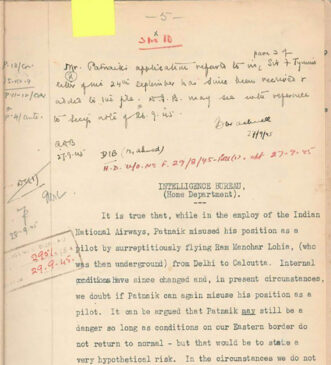
On the occasion of his 104th birth anniversary, Prime Minister Narendra Modi had tweeted an Intelligence Bureau (IB) document from 1945 to show how Patnaik bravely lent his flying skills for freedom fighters, like Ram Manohar Lohia. The IB note claims that while in the employment of Indian National Airways, Patnaik “misused” his position as pilot by “surreptitiously flying Lohia (then underground) from Delhi to Calcutta”. In 1933, Indian National Airways Limited (INAL) was set up by Delhi-based industrialist Raymond Eustace Grant Govan.
Debating whether Patnaik could be allowed to fly again, the IB note, concluded that flying is his “normal way of making a living” and therefore the IB preferred he remained employed. Also, stating that Patnaik was an “excellent pilot”, the IB concluded that even if they prevailed on the INAL to not re-employ him, the Tatas would probably employ him.
Patnaik, a trained pilot, flew with private airlines but at the beginning of World War-II joined Royal Indian Air Force and eventually became head of air transport command. He showed keen interest in nationalist politics while in service and used air force transports to deliver what was seen as subversive literature among Indian troops. He had remained committed to fighting the Axis Powers and jailed for two years for his illegal activities after declaration of Emergency in 1975.
Indonesia: He had played a vital role in Indonesian freedom struggle by saving Sultan Sjahrir. Patnaik while taking part in Indian freedom struggle met Jawaharlal Nehru and became one of his trusted friends. At the desire of Nehru, Patnaik and his wife Gyan Patnaik flew to Java and brought Sultan Sjahrir out on a Dakota to reach India via Singapore on 24.07.1947. For this act of bravery, Patnaik was given honorary citizenship and Indonesia had conferred ‘Bhoomi Putra’, one of the highest Indonesian award, rarely given to a foreigner. Indonesia while celebrating its 50th Independence Day in 1996 had conferred Patnaik with Bintang Jasa Utama, the highest national award. When Indonesian President Sukarno was blessed with a daughter, he had invited Biju Patnaik & his wife to name the infant and theyhad named her as Meghawati.
Role in saving Kashmir: Patnaik piloted the first plane that left Delhi’s Palam Airport at dawn on 27.10.1947 and landed at Srinagar Airport in early morning. He had taken 17 soldiers of 1-Sikh Regiment commanded by Lt. Col. Dewan Ranjit Rai. “The pilot flew low on the airstrip twice to ensure that no raiders were around… Instructions from PM Nehru’s office were clear: If the airport was taken over by the enemy, you are not to land. Taking a full circle, the DC-3 flew ground level. Anxious eye-balls peered from inside the aircraft – only to find the airstrip empty. Not a single soul was in sight. The raiders were busy distributing war booty amongst them in Baramulla.”
NEFA or Arunachal Pradesh: During 1962 Sino-India War, Nehru sought Patnaik’s advice repeatedly, sometimes as his unofficial advisor. The PM was dazzled by Patnaik’s familiarity with military subjects,’ a political commentator had said then.
Vijoynagar advanced landing ground (ALG), along India-China-Myanmar tri-junction in Changlang district, was reopened on 18.11.11 by then state Governor Gen (Retd) J J SIngh after renovation by the IAF. Coincidentally, I had accompanied the governor.
The IAF’s Dakota and Otter had begun operations from Vijoynagar in 1962 and subsequently AN-32 was pushed into service since 1984. But after renovation, the ALG facilitated routine and regular air maintenance reflecting IAF’s commitment to national security besides as a boon for the needy and poor people of the valley.
Its renovation reminded famous federal pilot Biju Pattanaik’s Kalinga Airlines, which had maintained lifeline of NEFA during 1956-57 by flying AN-32 from Supply & Transport directorate at Rowriah, in Assam’s Jorhat to drop rations throughout the remote hinterland by landing at Anini and Ziro.
Food & Civil Supplies Minister Kamlung Mossang had told this editor that the ALG, one of the eight, renovated under the PM’s 2008 package, resumed supply of essential commodities regularly since its renovation. Its operation was suspended since 26.08.09 while kerosene oil got delisted from PDS items since 2005-06.
“The difference is that it was Biju Babu’s AN-32 during 1956-57 and IAF’s AN-32 now that revitalized PDS to meet people’s basic needs,” Mossang had said.
The Independent, in an obituary after he died in 1997, narrated Patnaik’s journey as a pilot from colonial days to after independence. “As an officer in Royal Indian Air Force in early 1940s, Patnaik flew innumerable sorties to rescue British families fleeing Japanese advance towards Burma’s capital Rangoon. He also dropped arms & supplies to Chinese troops fighting the Japanese and later to the Soviet army struggling against Hitler’s onslaught near Stalingrad. On the 50th anniversary of the end of the war, Patnaik was honoured by the Russians for his help.”
Politics in independent India: Patnaik’s political ideals centred in socialism and federalism. His strong advocacy for equal resources to all needy Indian states made him a champion of Odisha. He was Odisha chief minister (23.06.61-02.10.63) before resigning under Kamraj Plan, CM (1990-19950), elected to Lok Sabha in 1977 to become Union steel & mines minister in both Morarji Desai and Charan Singh Govts until 1979, re-elected to Lok Sabha in 1980 and 1984, re-elected to Lok Sabha in 1996 and continued till his death on 17.04.1997. He played a key back-door-role to make V P Singh PM. Patnaik is the only Indian leader whose mortal remains were wrapped in national flag of three countries – India, Russia & Indonesia.
In 1992, Patnaik had said: “In my dream of 21st century for the State, I would have young men and women who put the interest of the State before them. They will have pride in themselves, confidence in themselves. They will not be at anybody’s mercy, except their own selves. By their brains, intelligence and capacity, they will recapture the history of Kalinga.”


 20

