
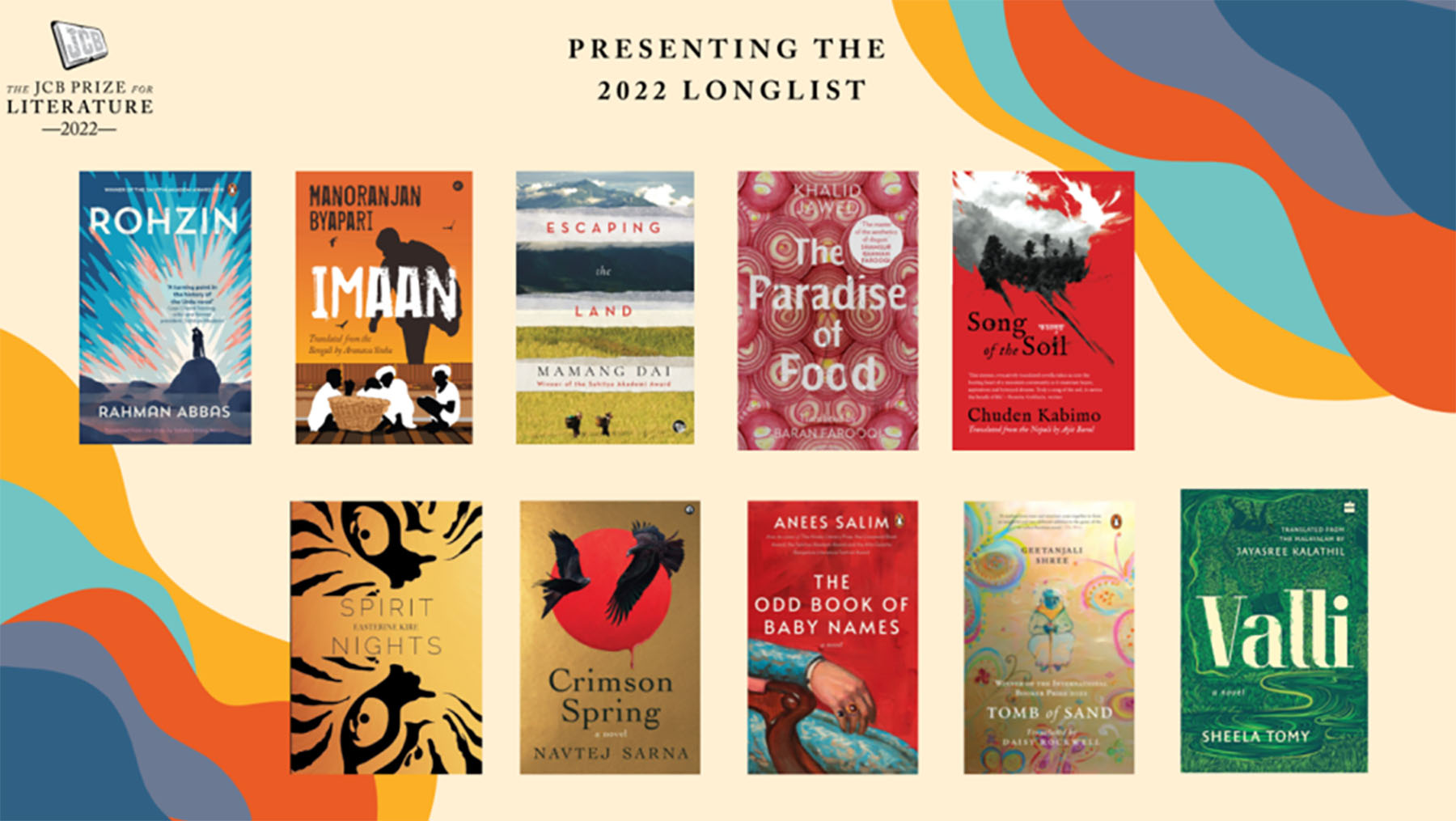
NEW DELHI, Sept 03: The 5th JCB Prize for Literature in 2022 is dominated by six translations in English, Bengali, Malayalam, Urdu, Hindi and Nepali, including stories of Nagaland, Arunachal Pradesh, Kalimpong, Punjab, Kolkata, Kerala and the heartland.
Selected by five judges – journalist & editor AS Panneerselvan (chairman), author Amitabha Bagchi, author & academician Rakhee Balaram, translator, historian & academician Dr. J Devika and author Janice Pariat, chose writers of 16 states for their publications between 01.08.21 and 31.07.22.
The JCB Prize for Literature is awarded each year to a distinguished work of fiction by an Indian writer and Rs 25 lakh JCB Prize for Literature will be announced on November 19. If the winning work is a translation, the translator will receive an additional Rs 10 lakh. Each of the 5 shortlisted authors will receive Rs 1 lakh; if a shortlisted work is a translation, the translator will receive Rs 50,000.
The selected publications are: Rohzin by Rahman Abbas, translated from the Urdu by Sabika Abbas Naqvi; Imaan by ManoranjanByapari, translated from the Bengali by Arunava Sinha; Escaping the Land by Mamang Dai; Paradise of Food by Khalid Jawed, translated from the Urdu by Baran Farooqi; Song of the Soil by Chuden Kabimo, translated from Nepali by Ajit Baral; Spirit Nights by Easterine Kire; Crimson Spring by Navtej Sarna; The Odd Book of Baby Names by Anees Salim; Tomb of Sandby Geetanjali Shree, translated from the Hindi by Daisy Rockwell and Valliby Sheela Tomy, translated from the Malayalam by Jayasree Kalathil.
Commenting on the 2022 list, Panneerselvan observed: “This year’s deliberation to select the novels for the JCB prize for the 2022-long list was an enriching experience. It was a rich collection, the translations from different languages showed how writers were pushing the linguistic and creative boundaries to document our lives. These ten novels are in a sense a metaphor of contemporary India, where each language is permitted to shine; its intrinsic beauty is not subsumed by the other.”
Comments of the jury on 10 novels:
Rohzin: With a dramatic love story at the heart of it, this novel is also the story of a young boy moving to a big city. It presents parts of Mumbai, like Mohammad Ali Road, that are rarely seen in English fiction. The real and the fantastical, the contemporary and the ancient, mix seamlessly while the grand themes of Hindi cinema play out in the background.
Imaan is a completely novel iteration of the humanist tradition of Bengali literature. It presents a vivid portrait of people from the periphery but is neither voyeuristic nor patronising. Each character has agency no matter how circumscribed their life may be. A raw, deeply authentic and honest story which is also well-paced, poignant and eloquent.
Escaping the Land: Breathtakingly lyrical and poetic, Escaping the Land is a memorable account of a life lived on the North-eastern frontier of India. Amidst the varieties of masculinity portrayed in fiction the protagonist in this novel is a rare one-that of a man who fails and accepts his failure. There is an underlying intelligence that runs through the book, becoming more vivid as the narrative progresses.
Paradise of Food is a brutal and mesmerizing account of the contemporary body, home and nation told through the food and kitchen. In a world consumed by hyper-consumerism, the book provides a bracing counter-narrative making it an important piece of work. The incredibly skilful translation highlights the poetry and music of the original text.
Song of the Soil is a shining example of how one can write about a violent incident without recreating the violence. The author blends bildungsroman with a conflict story with great dexterity, bringing out new aspects of both forms. This book is able to make poetry out of brutal situations, but does so with honesty, humour, and gentleness.
Spirit Nights posits a different view of the world where the human is just another creature struggling within the vastness of creation. Simple yet evocative, full of deep insights and important teachings, this grounded & lyrical novel is a powerful celebration of oral storytelling traditions.
Crimson Spring: A solidly crafted work of historical fiction, Crimson Spring not only talks about the historical moment of turbulence and terror triggered by the Jallianwala Bagh massacre but also vividly brings to life rural Punjab at the turn of the century.
The Odd Book of Baby Names: Dealing with a multiplicity of perspectives, the narrative moves from one to the other with ease. A smooth and enjoyable read, with a smattering of dry humor, yet filled with tenderness and poignancy. The book proves it is possible to produce a criticism of the decaying feudal order, presided over by Muslim authorities without resorting to any othering devices
Tomb of Sand: Wild and unruly, Tomb of Sand challenges our notions of what a novel should be. This novel is witty and irreverent yet filled with tenderness and psychological insight.
Valli is a beautifully written work that transports us into another time and place. It presents a world gone by in which the natural world is an extension of the human world. The prose has many textures, with letters and quotes from scriptures, making for a deeply satisfying reading.
The JCB Prize (Literature) was set up in 2018 to enhance the prestige of literary achievement in India and create greater visibility for contemporary Indian writing. The prize encourages translations and aims to introduce new audiences to works of Indian literature written in languages other than their own. It is funded by JCB and administered by the JCB Literature Foundation, according to an official release.


 20

