
SEPPA, Sept 14: Reacting to rumours being spread by miscreants in social media about missing mountaineer Tapi Mra and his assistant Niku Dao, East Kameng district administration (DA) on Wednesday advised to desist from such insensitive actions as all efforts are being made to locate both of them.
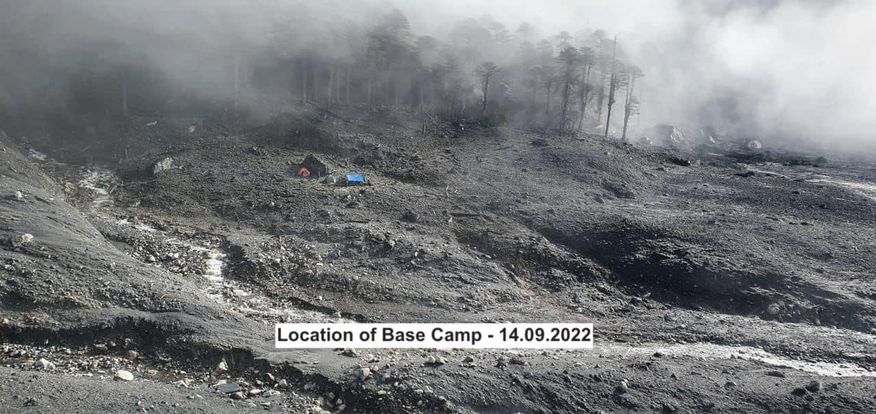
Two mountaineers, who reached base camp successfully on Wednesday to join on-ground rescue operations, observed that route to base camp is not only arduous but dangerous too due to widespread presences of screes. The team will proceed to camp-1 on Thursday.
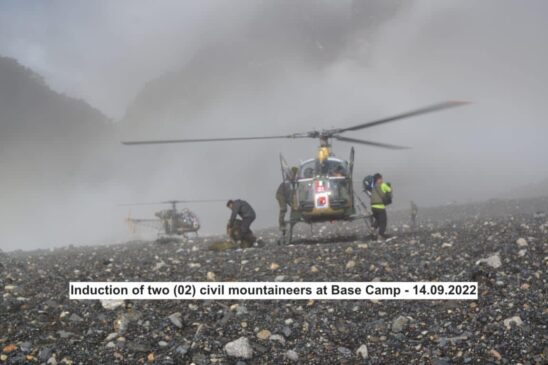
The district magistrate (DM) issued ‘standard operating procedure’ to ensure safe and effective rescue operation. A four-member team of porters was sent by DA on Wednesday to assist the rescue team and facilitate their retrieval by foot, in case of bad weather. Moreover, a 13-member Army team has been deployed from Veo village to facilitate on foot retrieval.
Trekking in high-altitude regions has become treacherous due to persistent rains for past two weeks for which the DM in an order u/s 144 has prohibited any kind of trekking expeditions in Sawa, Khenewa and Lada circles for two months, according to a DA release.
By Pradeep Kumar
Rescuers suspect that first Everester of Arunachal Pradesh Tapi Mra and his assistant Niku Dao might have gone missing after falling into crevasses or hit by avalanches in snow-capped Mount Kyarisatam before losing contact with the porters in the base camp as both have been missing since August 17, as per a Guwahati report.
In a major breakthrough in the operation, the aerial search team has finally identified a foot track leading from Camp 1 to Camp 2, both set up by Mra. They said the mountaineer and his assistant had reportedly gone missing from near Camp 2. “Likely area of missing persons is Camp 2, which is full of deep and wide crevasses as observed from a helicopter. Avalanches were observed in the adjoining areas of Camp 2,” East Kameng ADC-cum- incident commander Rajib Chiduni said.
Three Cheetah helicopters of the army failed to trace human presence on the third consecutive day of aerial search on Monday, even after reaching camp 2- the highest camp set by mountaineers in Mount Kyarisatam. Camp 2, located at around 700 meter above the base camp, was set up last year by Tapi Mra’s team at 5,119 meter altitude.
“Clear weather window provided opportunity for a detailed helicopter search today. The aerial search team has been able to identify foot track leading from Camp 2 to some distance (approximately 15-20 meters) in the northerly direction,” Chiduni added.
Two Army helicopters have expedited aerial search in the mountain range on Sunday after slight improvement in weather conditions, whereas a 10-member team of Army personnel and a mountaineer are doing the ground recce from the base camp. Chiduni added that the rescue team which was inducted in the base camp on Sunday will proceed to Camp 1 for ground search on Tuesday.
Sources in the search team said climbing upto Camp 2 from the base camp takes one day and thus, the focus of the 10-member ground team previously was to conduct the search operation near the base camp.
Mra, first Arunachalee to conquer Mount Everest, on 21st May 2009, and his associate Niku Dao, had reportedly ventured out to climb Arunachal’s highest snow-capped peak Kyarisatam at 7,001 metres. Tagit Sorang, one of the youngest Everesters in Seppa earlier said the duo perhaps wanted to set up camp 3 for the first time and reported making plans to summit.
What is crevasse and dangers it poses?
A crevasse is a crack, crevice or fracture in a glacier or moving mass of ice that forms from the movement and stress of the glacier, especially as it moves downhill. Stress in the ice caused by the glacier’s movement causes crevasses to open and close. Crevasses usually form in the upper 150 feet of a glacier where the ice is more brittle than deeper ice, which tends not to break and fracture as the glacier moves.
It also form from speed of a glacier as it creeps downhill. Ice in the middle of a glacier tends to move more quickly than along the edges where it catches and grabs the underlying rock surface and cause crevasses to gape open. Crevasses usually have vertical walls and are up to 150 feet deep and as wide as 70 feet. Crevasses, however, are usually narrow and thin, forming extreme hazards for mountaineers crossing a glacier.
Crevasses pose a huge danger to climbers in the mountains since a climber who falls into a crevasse usually dies. Narrow crevasses are additionally dangerous because the top can be filled in with drifted snow forming a snow bridge, which may or may not be stable. Snow bridges can break under the weight of a passing climber. The snow makes the crevasses invisible to the inexperienced eye. Mountaineeers who climb and cross glaciers and icecaps learn essential glacier travel skills, such as how to cross a glacier with a partner and a climbing rope, and how to do crevasse rescue for yourself or your partner. These are essential climbing skills that must be regularly practiced for safe glacial travel.


 20

