
Yaa Devi Sarva Bhuteshu Shakti Roopen Sansthita
Yaa Devi Sarva Bhuteshu Matri Roopen Sansthita
Yaa Devi Sarva Bhuteshu Bhakti Roopen Sansthita
Yaa Devi Sarva Bhuteshu Shanti Roopen Sansthita
Durga Puja or Sharadostava, the most awaited annual event, of our times, is here. The cities and towns have got a temporary makeover and even the darkest of the streets have been lit up with glittering lights. Majestic pandals, unrelenting beating of ‘dhaaks’, lingering vendors and obnoxious traffic jams, awaits us. But the spirits are high. This is a time when people go into a state of spiritual slumber. Most of us will have, at least a week away from work; a time to be well spent with family and friends. Our beloved Mother has descended from her heavenly abode, only to stay with us, in our realm just for few days.
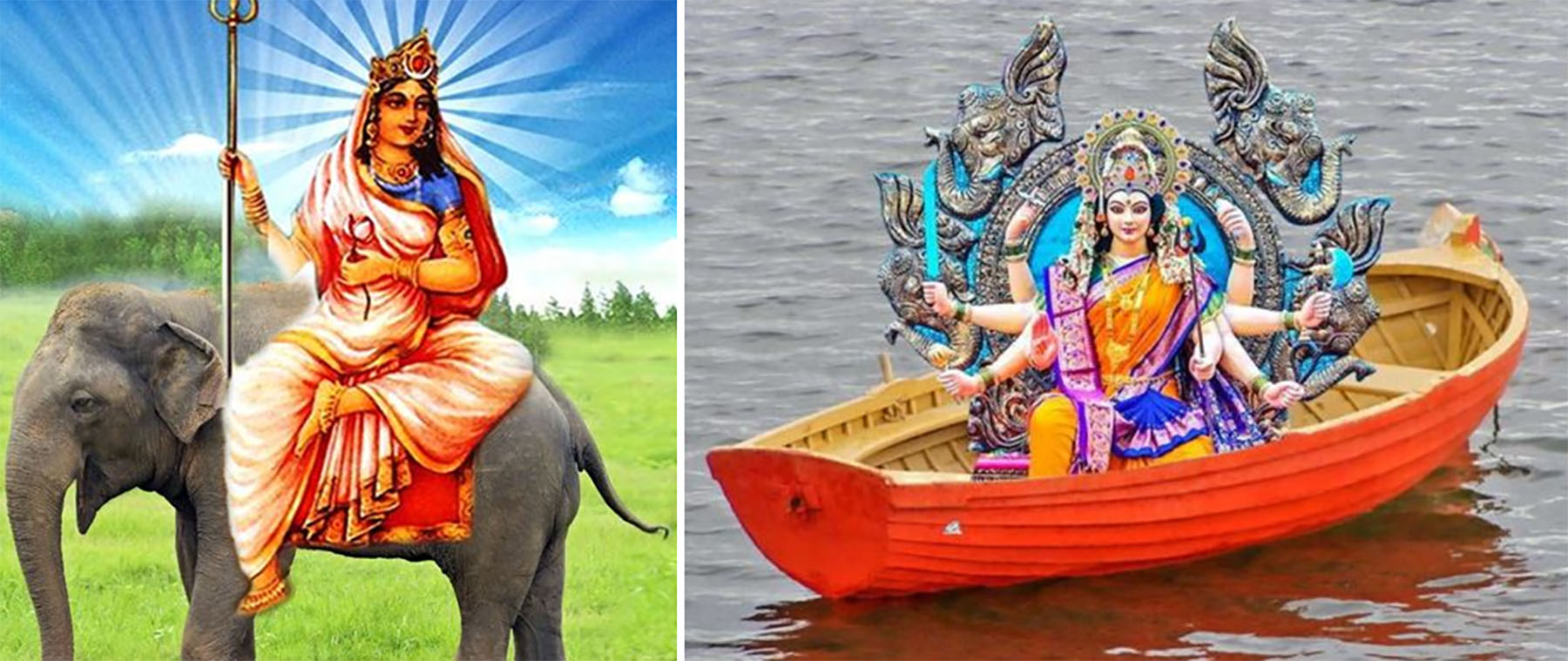
Pratipada – the first ritual of Ghatasthapana (pot or Kalash sthapana) – marks the beginning of the nine-day festival. But her arrival and departure is indicator of status of the year ahead. Apart from the lion, Maa Durga has four vahanas (vehicles) – elephant, horse, boat and palanquin. It is believed that she arrives and departs on two different vahanas and the choice of her vehicle is important for the fate of mankind. It’s also believed that if she arrives and departs on the same vahanas, it means doomsday – it means mankind will have to face natural disasters, political unrest and other social problems. What the vehicles signify as per legend:
Elephant stands for peace and prosperity. If she arrives or departs on the Elephant, it means that life be filled with happiness by her blessings. According to Drik Panchang, if she comes on an elephant is considered auspicious. It is believed that it brings plenty of rainfall for bumper harvest in ensuing year.
Boat is the vehicle of water and indicates both flood and good harvest. When she comes on this, it means she will bless you to reach your ultimate goal.
Palanquin: her arrival on the palanquin, as per the scriptures, indicates the outbreak of an epidemic.
Horse: Her coming on a horse is not considered very auspicious. It is believed that it is an omen of likely war among nations, as per Drik Panchang.
All devotees should be very happy as Maa Durga arrived on an elephant this year and return on a boat.
Goddess Durga is a multi-dimensional goddess, with many names, like Durga, Bhavani, Amba, Chandika, Gauri, Parvati, Mahishasuramardini, many personas, and many facets with other manifestations. “Durga” means “inaccessible”, and destroyer of evil – with her ten mighty arms carrying lethal weapons she triumphantly slays demon Mahishasura.
As Sati, beloved daughter of King Daksha and Queen Menaka she gives up a kingdom and earns her father’s wrath. As Kali, she turns black as the night and omnipotent, terrible in rage and fury, with just a string of skulls as her garland and her only garb. As Parvati, she is serene, the pretty consort of Lord Shiva by his side in the snowy peaks of the Kailash mountain. She is Bhawani, symbol of life. She is Sati, the object of death. She is Basanti, the heralder of springtime. She is also Amba, Jagadhatri, Tara, Ambika and Annapurna. Durga, through all her forms, encompasses the essence of salvation and sacrifice. She is the mother of bounty and wealth, as also of beauty and knowledge, for her daughters are Lakshmi and Saraswati (Hindu goddesses of wealth and knowledge, respectively).
Thus goes the story of Lord Rama, who first worshipped her by offering 108 blue lotuses and lighting 108 lamps, at this time of the year. When the Pandavas entered the capital of Virata for their period of one year in disguise they propitiated Durga who appeared before them and granted them boons. In the Hindu epics Mahabharata and Ramayana there are various references to goddess Durga. Before the great war of Kurukshetra begun, Lord Krishna advised Arjuna to worship Goddess Durga to ensure victory in battle.
The most important form of Maa Durga is as Mahishasuramardini or the slayer of the demon king. The image is of the Goddess cutting off the head of the buffalo-demon. This image usually most commonly is shown with eight or ten arms, and the hands hold a trident, an axe, a discus, an arrow, a sword, a mace, a spike, a bow, a bell and a snake. Mahishasura, the demon, may be shown half emerging in his human form from the carcass of his former buffalo form. She has an extra divine eye in the middle of the forehead. Her hair is in Karandamukuta, a crown style of hairdo. She wears gorgeous red clothes and several ornaments, and stands on a lotus or the head of a buffalo or rides a lion. There are endless aspects of Durga described in Puranas and ancient Hindu texts and the iconography is consequently varied.
- Mahalaya is an auspicious occasion observed seven days before the Durga Puja, an invitation to Goddess Durga to descend on earth. This is done through the chanting of mantras and singing devotional songs
- Shasthi: Goddess Durga descends to earth with her four children Lakshmi, Saraswati, Kartikeya and Ganesh. The colourful idols of the goddess that have been handcrafted and installed for the festival are unveiled on this day.
- Maha Saptami: The first day of Durga Puja, is when the holy presence of Goddess Durga is invoked into the idols in a ritual called Pran Pratisthan. The day commences with the Kola Bou’s bath a banana tree is bathed before dawn in a river or body of water, dressed in a sari like a newly wed bride (known as “Kola Bou” or the banana bride) and placed besides Lord Ganesh, as his wife. Nine different types of plants are worshiped, representing the nine divine forms of Goddess Durga.
- Maha Ashtami: One of the most significant days of Durga Puja. The goddess is worshiped in the form of a young unmarried virgin girl, adorned as Goddess Durga, in a ritual called the Kumari Puja. In the evening, the important Sandhi Puja is performed to worship Goddess Durga in her Chamunda form to kill the buffalo demon Mahishasura.•Maha Navami: The last day of worship, which concludes with a maha aarti (great fire ceremony) to mark the end of the rituals and prayers. Goddess Durga is believed to have killed the buffalo demon Mahishasura on this day, and she’s worshiped in the form of Mahisasuramardini, the Annihilator of the Buffalo Demon. Everyone gets dressed up in their finest, most glamorous clothes. The goddess’s favourite food (bhog) is prepared and offered to her, and then distributed to devotees.
- Vijaya Dashami: (Sindur Utsav) Married women offer red vermillion powder to the Goddess and smear themselves with it (this powder denotes the status of marriage, and hence fertility and bearing of children). Its time for Goddess Durga to return back to her husband abode thus the idols are taken for immersion. After the immersion, people visit their relatives and friends to give and receive blessings. Sweets are distributed and lavish dinners shared. The dress code for the day is traditional and classic.
The primary goddess revered during Durga Puja is Durga but celebrations also include other major deities Lakshm (goddess of wealth & prosperity), Saraswati (goddess of knowledge & music), Ganesha (god of good beginnings), and Kartikeya (the god of war). Though its exact origins are unclear, but manuscripts of 14th century provide guidelines for Durga puja, while historical records suggest that royalty and wealthy families were sponsoring major Durga puja festivities since at least 16th century. Its prominence increased during the British Raj in the provinces of Bengal, Odisha and Assam. However, in modern times, the importance of Durga puja is more as a social and cultural festival than a religious one, wherever it is observed.
The 11th or 12th century Jain text Yasatilaka by Somadeva mentions an annual festival dedicated to a warrior goddess, celebrated by the king and his armed forces, and the description mirrors attributes of Durga puja.
The name Durga, and related terms, appear in Vedic literature, such as in Rigveda and Atharvaveda. A deity named Durgi appears in the Taittiriya Aranyaka. A key text associated with Durga puja is Devi Mahatmya, which is recited during the festival. Durga was likely well established by the time this Hindu text was composed, which scholars variously estimate between 400 and 600 CE. The Devi Mahatmya scripture describes the nature of evil forces symbolised by Mahishasura as shape-shifting, deceptive, and adapting in nature, in form and in strategy to create difficulties and thus achieve their evil ends. Durga calmly understands and counters the evil in order to achieve her solemn goals. Durga, in her various forms, appears as an independent deity in the Indian texts. Both Yudhishira & Arjuna of Mahabharata invoke hymns to Durga. She appears in Harivamsa in the form of Vishnu’s eulogy and in Pradyumna’s prayer.
The festival is particularly popular and traditionally celebrated in West Bengal (Kolkata Durga puja has been inscribed on Intangible cultural heritage list of UNESCO in December, 2021.
As per Hindu scriptures, the festival marks the victory of goddess Durga in her battle against the demon Mahishsura the festival epitomizes the victory of good over evil, though it is also in part a harvest festival celebrating the goddess as the motherly power behind all of life and creation. Over the years, Durga puja has morphed into an inseparable part of Indian culture with a diverse group of people celebrating this festival in their unique way while on tradition.


 20
