
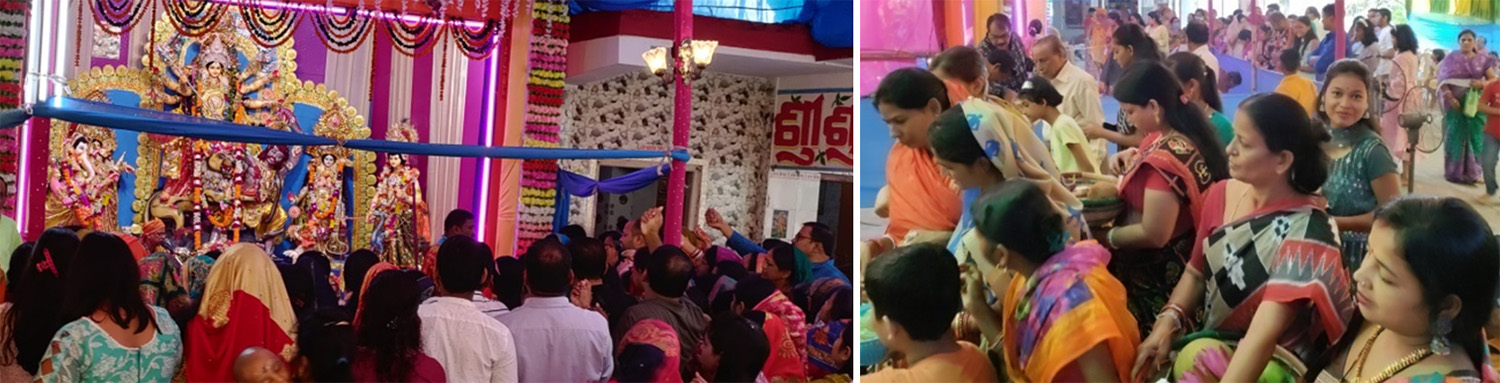
4th Durga Puja at Chandmai Padia
By A O News Service
BALASORE, Oct 03: Durga Ashtami or Maha Ashtami, the 3rd day of Durga Puja and 8th day of Navratri, is considered to be one of the most important and auspicious day during Navratri.
Innumerable devotees young and old of both sexes belonging to all strata of the society made a beeline to pandals across India to seek blessing of Goddess Durga after worshipping here. The time of Maha Ashtami this year was during 6.47 PM (Oct 2) to 4.37 PM (Oct 3). As the rituals continued, the pandals rented with hymn;
Om Sarva Mangal Mangalayayei Shive Sarvartha Sadhike
Sharanyayi Triambike Gauri Narayani Namostute..!!
Om Devi Maha Gaurya Namah..!!
Significance: Maha Ashtami holds a great significance among Hindus. The eight forms of Maa Durga is worshipped on this day. It is believed that eight forms of Maa Durga – Brahamni, Maheshwari, Kaumari, Vaishnavi, Varahi, Nasinghi, Indrani and Chamuda – emerged from her.
According to Hindu mythology, Goddess Durga is the mother of the universe and is believed to be the power behind the creation, preservation and destruction of the universe. Warrior Goddess Durga is portrayed as a beautiful woman with 10 arms that bear divine weapons to protect each one of us.
After killing all the demons, she appeared in the form of Maa Durga and all the deities worshipped her. Thus, Durga Ashtami is celebrated as her victory over demons, named Mahishasura, Chand Munda, Shumbh Nishumbh and Raktabeej.
In some parts of India, people worship Maha Gauri (in pic) who is considered to be extremely beautiful, white like snow and she wears white colored ornaments. She represents calmness. People who worship the Goddess with pure intentions, gets prosperity, happiness, wealth and health. The left upper hand holds a ‘Damru’ and the lower one is in the pose of granting boons to her devotees.
On this day the weapons of Goddess Durga are worshiped and the celebration is known as ‘Astra Puja’. This day is also popularly known as ‘Virashtami’ owing to the display of arms and other forms of martial arts. Hindu devotees offer prayers to Goddess Durga and keep a strict fast to seek her divine blessings.
Durga Ashtami Vrat is observed with complete devotion in the northern and western regions of India. In some regions of Andhra Pradesh, Durga Ashtami is celebrated as ‘Bathukamma Panduga’.
Sandhi Puja: Ashtami Puja lasts for Ashtami and Navami. In Sandhi Puja, the last 24 minutes of Ashtami and the starting 24 minutes of Navami is called as Sandhi time or Kaal. The time of Sandhi Kaal is considered as the most auspicious time for Durga Puja. Because it is this time only, when Ashtami Tithi ends and Navami Tithi begins. There is a ritual to perform balidan/animal sacrifice during Sandhi Kala and those who do not At Belur Math in West Bengal, bananas are offered at the time of Sandhi Puja. Apart from this, 108 clay lamps are lighted at the time of Sandhi Kaal.
Kanya Pujan: People celebrate Maha Ashtami all over India by performing Kanya Pujan. People invite 9 young girl children and worship them as a symbol of Maha Gauri Maa. Devotees of Maa Durga offer them food and various gifts.


 20

