
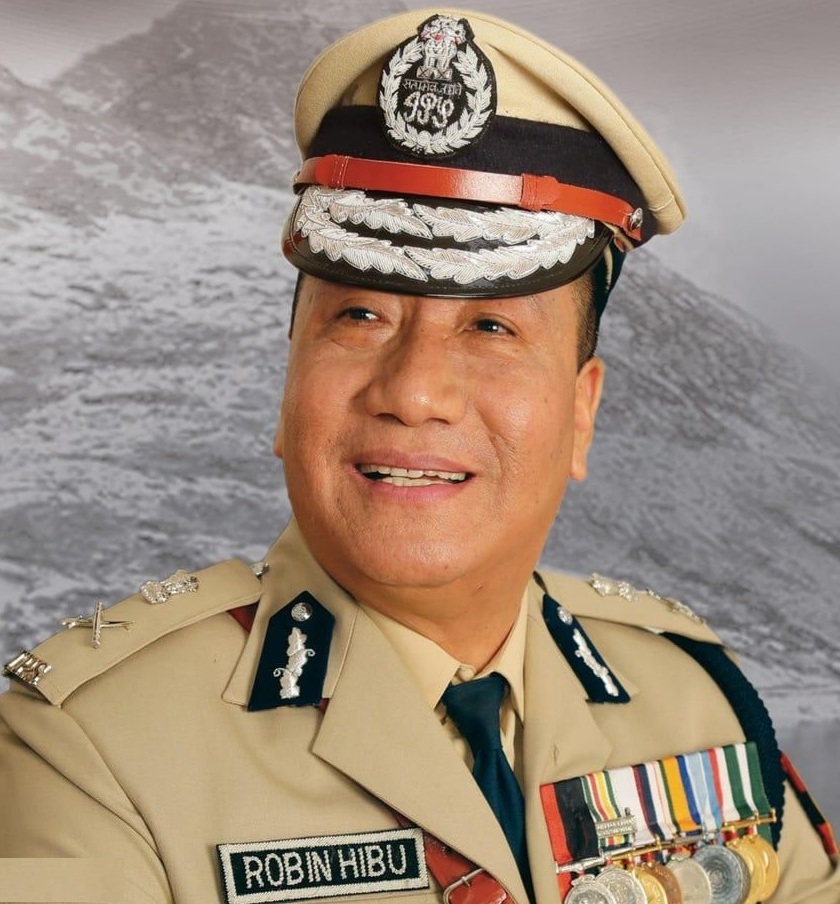
By Robin Hibu
Background: Repeated goof-ups by the APPSC in conducting the prestigious public service examinations have resulted in staging of dharnas and litigations, including the recent arrest of high-ranking officials of APPSC and from the neighboring state too. The alleged ‘fiascos’ have caused massive uproar all around, including the social media, and even instances of arson at APPSC office and attacks on the members of the public service commission occurred years back (when I was the SP in Itanagar).
Hundreds of aspirants have expressed deep anguish, and the image of the commissions has been tarnished and sullen beyond repair. After all, the benign constitutional objective of the public service commissions is to fearlessly select the most eligible brains of the time for high-ranking public offices – persons who would spend their lives in the public services and would serve as the permanent machinery for the implementation of schemes for the progress of the society.
We cannot afford to tinker with this cardinal pillar stone of our society. History is witness that civilizations like the Roman, the Greece, the Mauryan and the British, who ruled for centuries, had robust, transparent, egalitarian systems for recruiting the best and the most intelligent citizens as permanent governance officials. The day the systems were tinkered with by unscrupulous elements at the helms of affairs, disastrous results ensued, and the mighty civilizations collapsed due to chicanery, favouritism and mediocrity, with merit thrown to the air.
Fault Lines: Too many unbelievably unfair means are adopted during examinations which have grey areas where fissures for an unequal competitive milieu emerge. These ‘fault lines’ are:
1) Unprofessional approach and lack of foolproof setting of questions papers; lackadaisical checking of answer papers; and scope for awarding marks at whims and fancies due to lack of straight-jacketed guidelines or double-checking of answers by other subject experts to find imbalances and discrepancies.
2) Leakage of questions papers before examinations.
3) Disparity in awarding marks. Arts students can never get 100% whereas science students can easily score 100%. Even during the time of my IPS training along with IAS and IFS trainees, most trainees were from the science background.
4) Unfair means of cheating, such as using tiny Bluetooth devices connected to persons outside the examination halls, impersonating for someone in the examinations, copying in the examination halls or in the bathrooms, etc.
5) Emergence of middlemen (especially for subordinate jobs) who somehow try to woo gullible candidates, promising selection in lieu of cash or in connivance with staffers of the commission.
6) Lack of holistic planning of recruitment for jobs. Sometimes hundreds of jobs are advertised in a particular year and then there is no recruitment for a few years, thereby depriving the brightest youths during the no-recruitment years. Many bright Arunachalee students have confided in me personally of this situation which has resulted in candidates becoming overage or being unable to compete with fresh graduates. Sometimes yearly recruitment is conducted at random for various reasons, depriving many bright youths of joining the elite state services.
7) Too many marks allotted for interview. Such huge marking for the interview round can topple the ranks and even eliminate the toppers in the written examinations.
8) Untrained personnel manning the supposedly hallowed public service commissions, right from the top to the bottom of the hierarchy. Lack of specific training for the specialized jobs adds to the problem.
9) Lack of latest know-how and technology to ensure foolproof confidentiality and to effectively hinder leakages. The personnel manning these commissions should be put under hawkish supervision and surveillance.
10) Outsourcing to the state departments or allowing the department concerned to conduct recruitment for vacancies in the respective department is another bottomless black hole where department officials are virtually given a free hand for recruitment. No wonder that recently, one department selected all its lower subordinate officials from a particular sub-clan from a particular village. The officer who was in charge of the recruitment was from that particular tribe.
11) Lack of interactive social media forum for FAQs (frequently asked questions or queries) to allay doubts about the process, syllabus application, results, etc.
12) Lack of orientation and induction training for members of the commission and the staff and officials of the state public service commission.
13) Lack of background or proven experiences of members of the commission and staff matters the most. Rigorous scrutiny is sine qua non for manning the hallowed institution. APPSC members should for those meritorious individuals having impeccable track records in their services.
The UPSC is a shining example where only person of highest integrity are adorning as members. No wonder, there has been no such sticky leakage of papers in its more than 70 years of existence.
I was thrilled to be interviewed in my UPSC viva voice by retired galaxy of luminaries- JF Ribeiro, IPS, one IFS officer, One IAS officer, one ISRO scientist, all were doyen in their career with 30 years outstanding service record and I was thrilled and educative to talk to them in my interview for 41 minutes .
14) No feedback/stock-taking after every examination for better conducting future examinations.
15) Lack of an annual calendar for recruitment by the commission to ensure advance planning for logistics, secrecy, technology, foolproof papers, etc.
16) Unavailability of IT-based personnel to devise or delve into the latest know-how for advance planning, precision execution, and data bank generation-cum-storage in secure domains with the latest impregnable anti-virus apps.
17) Lack of serious pruning and orientation of members and staff for the entire gamut of recruitment.
Strategies for recruitment:
1) Conducting compulsory rigorous induction training, followed by examination (where they have to qualify) for all the members and staff of the state public service commission.
2) Seeking guidance from the UPSC for all operational procedures. Many illustrious officers who have served in Arunachal are members of the UPSC. Even, why not bring on deputation those officers who have had successful stints in the UPSC. Even an Arunachalee officer with a five-year successful stint can be requested to join as the secretary of the commission.
3) Adopting time-tested practices in conducting foolproof public service examinations.
4) Need for critical analysis and feedback for improvement from every examination conducted by the respective state public service commission.
5) Using the latest information technology for upgrading databanks for retrieval and improvisation of arsenal for robust leak-proof conduct of examinations.
6) Preventing unfair means like impersonation and copying through Bluetooth or Blu-ray by having impregnable requisite data on the admit cards, like identification mark on the face, Aadhaar card number, etc; jamming the internet/mobile connection, using the latest jammer; selecting proven high-integrity subject specialists as examiners, both for examination days and for evaluation of the papers by two experts secretly; enhancing the honorarium money per answer sheet for quality and timely checking of the essay type answers; having tamper-proof assigning numbers for original roll numbers; ensuring fair play for both arts and science subjects as arts subjects are very difficult to score marks in, unlike science and maths subjects.
7) Impact analysis and all-round stock-taking by the state public service commission, keeping in view the recent controversy leading to arrests and cancellation of the examinations, followed by court cases, in many NE states and other states.
8) The marks awarding system during viva voce needs rethinking. There is no justification column in the viva voce format for giving very high marks to a candidate. As a result, there exists ample scope to favour a candidate by the members of the viva voce board.
The board members for viva voce should be kept secret and there should be rotation or rostering of viva voce in the last minutes to avoid prior lobbying or any external pressure for giving more marks in the interviews.
Permanent marker pens should be used for awarding marks at viva voce, with full signature of the board members, and the average of the board members should be calculated immediately by the chairman of the board in the presence of other members.
The marks awarded should also be written in words, duly signed on the mark sheet of viva voce by all members.
No pencil or ink pen should be allowed to prevent any tampering or manipulation of the mark sheets. Only permanent markers should be used for marking.
Any viva voce member awarding high marks to any candidate must justify the reason for giving the high mark.
9) Only persons of proven integrity and having some exposure to the recent trends in administration (civil, military, security, management or judiciary) should be appointed to this august cradle of breeding public servants who would be in the services for life.
10) No videography during whole recruitment process.
11) Why not request UPSC to train all APPSC officers and members from Chairman to down the line till peon and chowkidars conducting public services examinations?
12) Why not select those highest integrity officials from state services both officers and clericals staff by giving massive incentive in pecuniary gains for deputation to APPSC?
Rather than just getting these officials and clerks on routine basis without stringent verification of their integrity.
Recent series arrest of APPSC officers is a blot for the hallowed APPSC.
Innovative strategies for foolproof recruitments:
1) All members of the recruitment team are kept under surveillance to prevent human error and deter infiltration, leakage, etc.
2) Using different teams for different jobs, without the knowledge of the other branches.
3) Detailed arrangement, such as sitting plan, supervisors, nearby toilet facilities, police bandobast, drinking water; elaborate plan for searching and frisking, jammer for jamming mobile or internet signal, food packets for staff, medical team with doctor, arrest party, and mounted CCTV cameras in the examination centre.
4) Introduction of biometric fingerprints equipment for candidates. Twelve impersonators were detected and arrested.
5) Establishing a 24×7 ‘war room’ for any examination one month ahead. It should be manned by an officer who has all information on FAQs, coordinates and branches on action taken before the examination.
6) Repeated rehearsals on ground with all stakeholders including non-commissioned units like police, centre in-charge, jammer, and keeping enough space between the candidates.
7) Selection of only those staff as team whose integrity is beyond doubt.
8) Debriefing, followed by immediate clearance of all honorariums, and offering appreciation to excellent performers immediately.
Conclusion: The present perception of the state public service commission is a wake-up call for serious introspection, pulling up socks, and taking all steps by all the stakeholders to allay any misgiving over the constitutional trust bestowed on this supposedly hallowed commission.
After all, this commission is dealing in giving birth to the cardinal governance structure involving the best and the brightest youths who want to serve the society in their careers for more than 30 years in service. The earlier the reform, better it will be for the society.
(The writer is an IPS officer and present Delhi Police special commissioner. The views expressed are his personal opinions based on his experiences as Chairman Recruitment Board in United Nation, Delhi Police and in Arunachal Pradesh.)
Hollowed or hallowed institution?
By Pradeep Kumar
This reminds me my write up -Who would bell the cat? – written on 17-01-09 in my Beyond the Horizon column, which I would like to reproduce.
Arunachal Pradesh has many records to its credit – highest forest cover (82%), availability of rare orchid species, richest hydropower potential, four species of big cats live only in this state considered one of the richest biodiversity hotspots in the world – to name a few.
Is Arunachal Pradesh Public Service Commission (APPSC) targeting for another feat–the longest period in announcing the results of Arunachal Pradesh Civil Service Examination (APCSE) 2006?
APPSC’s poor state of affairs questioned
What could be expected from the so called independent body which is headed by mostly political appointees since its inception in 1988, contrary to academicians of repute or experienced bureaucrats heading such commissions in other states of the country?
APPSC conducted its first recruitment test in 1988 and subsequently in 1991, 1993, 1999, 2003 and 2006 erratically without any calendar – a clear reflection of unplanned recruitment policy. Otherwise, APPSC would not have been reportedly calling assistant director or such low ranking officers to interview engineers and doctors and gasping for breath to appoint examiners at the last minute to check answer scripts. Can the state government be free from blemish?
APPSC answer papers are proof of its poor state of affairs which can be replaced easily for want of identification mark (AAPSC perforation on its body), like the Union Public Service Commission. In fact, the irrational subjects offered in the APCSE manned by all inexperienced officers have also been criticized in the past.
After conducting the APSCE 2006, the fixation of the cut mark (40% in English) without consulting if there is any such precedent in UPSC or other state commissions drugged it to legal litigation that delayed the results.
In fact, the directorate of higher and technical education (HTE) holds a unique record of declaring results in 24 hours of over 5,000 aspirants of various technical, medical and diploma seats who appear at the joint entrance examination (JEE) every year. Present director Dr Joram Begi appointed in 2002 is credited with the record.
The JEE results, a cumbersome and lengthy process in the past, had embroiled into repeated controversies for alleged manipulation/s of seat/s. May had moved the court exposing the rot in the system.
Conscious of the negative past, Dr Begi brought a drastic change in question pattern and procured an advanced evaluation machine (optical machine for reading) to avoid loss of time to quickly announce the results. He also made the counseling transparent to avoid the scope for any criticism.
Regrettably, the inordinate delay in announcing the APCSE results has made APPSC a laughing stock. The apex students’ body (AAPSU) has expressed its strong resentment and served an ultimatum to the APPSC, which had invited the criticism of the aspirants and their parents. Is APPSC aiming to enter the Gunnies Book of World record, wondered AAPSU general secretary Ojing Tashing.
The recent allegation of APPSC auctioning jobs had prompted it to issue a clarification. It is a matter of great concern, many top ranking officers said on condition of anonymity. When the state government is facing acute shortage of officers, the inefficiency of state’s lone recruiting agency raises many eyebrows, they rued.
The UPSC has a think tank, which included, to my knowledge, two top ranking IPS officers who have served in Arunachal Pradesh. Moreover, it seeks feedbacks from various sections from across the country to constantly improve the most prestigious examinations of the nation. But the APPSC continues to loose the public confidence.
How long this should be allowed? Why APPSC can not take a cue from the HTE directorate? Otherwise, the state government could consider hiring the service of an academician or bureaucrat expert in the job to stem the rot out of the system and help AAPSC gain the confidence of the people?
Repeated resentments are expressed by the civil society through the local media, which also took exception to the dismal affairs of APPSC, describing its delayed results as ‘Dreams on hold’ or a fit case for ‘Gunnies Book of World record’. ‘Who would bell the cat?’ is the million dollar question.


 20

