
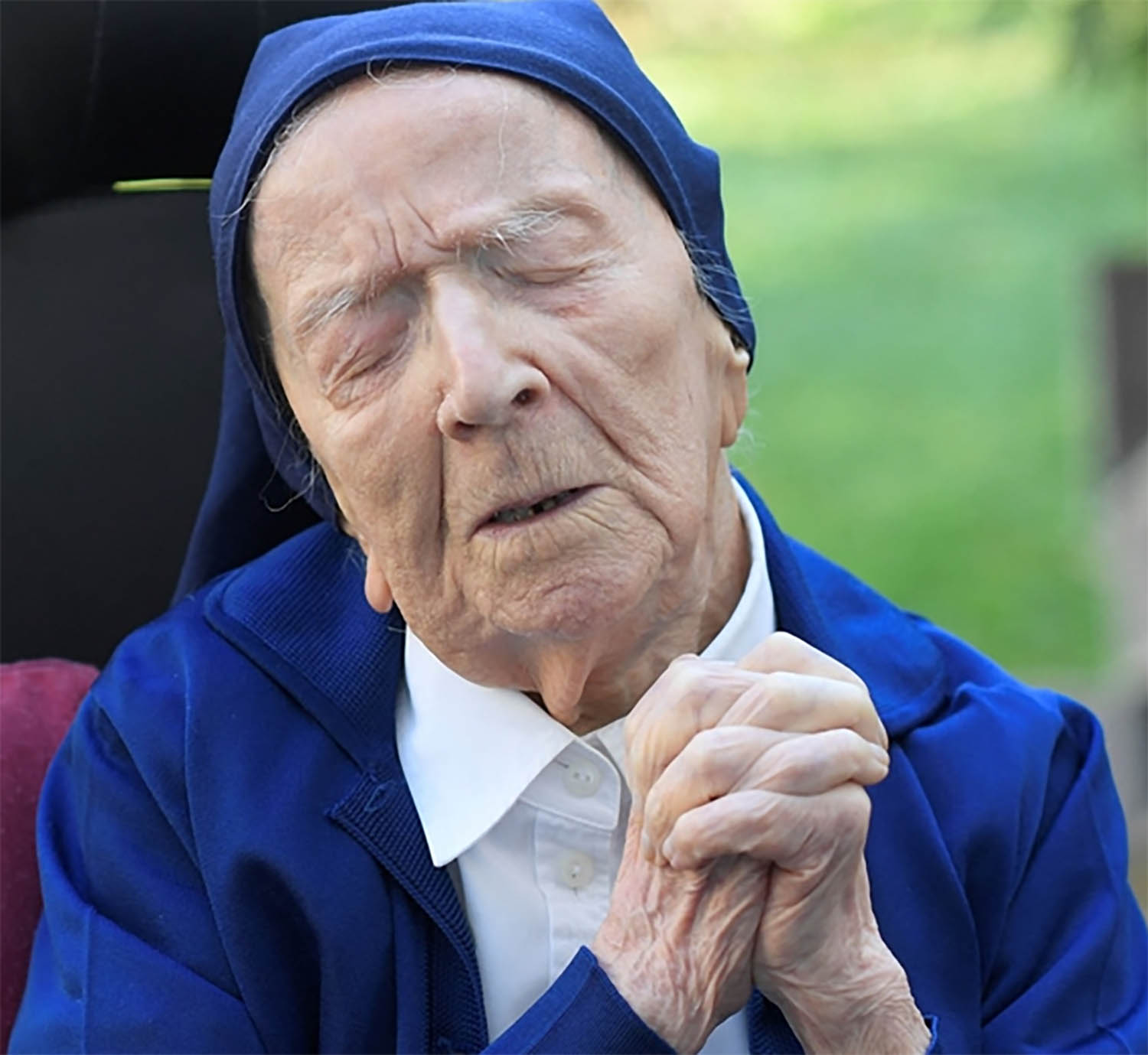
World’s longest living supercentenarian Lucile Randon
Beyond the Horizon
By Pradeep Kumar
A video of a Mulsim woman of Turkey, claiming her age to be 300 years, doing round in social media is nothing but fake.
The oldest person living on earth is Lucile Randon (born on 11.02.1904) who is 118 years and 266 days old, as verified on 25 April 2022. Randon, also known as Sister André, is a French supercentenarian and the world’s oldest verified living person since 19 April 2022, following the death of Kane Tanaka.
Kane Tanaka was a Japanese supercentenarian who, until her death at the age of 119 years and 107 days, was the oldest living person following the death of Chiyo Miyako on 22 July 2018. She is the oldest verified Japanese person and the second-oldest verified person ever, after Jeanne Calment.
Longevity myths are traditions about long-lived people (generally supercentenarians), either as individuals or groups of people, and practices that have been believed to confer longevity, but for which current scientific evidence does not support the ages claimed or the reasons for the claims. While literal interpretations of such myths may appear to indicate extraordinarily long life spans, many scholars believe such figures may be the result of incorrect translation of numbering systems through various languages coupled with the cultural and/or symbolic significance of certain numbers.
The phrase “longevity tradition” may include “purifications, rituals, longevity practices, meditations, and alchemy” that have been believed to confer greater human longevity, especially in Chinese culture.
Modern science indicates various ways in which genetics, diet and lifestyle affect human longevity. It also allows us to determine the age of human remains with a fair degree of precision.
Outside of mythology, the record for the maximum verified lifespan in the modern world is 122.5 years for women (Jeanne Calment) and 116 years for men (Jiroemon Komura). Some scientists estimate that in case of the most ideal conditions people can live up to 127 years. This does not exclude the theoretical possibility that in the case of a fortunate combination of mutations there could be a person who lives longer. Though the lifespan of humans is one of the longest in nature, there are animals that live longer.
For example, some individuals of the Galapagos tortoise are able to live more than 175 years, and some individuals of the bowhead whale more than 200 years. Some scientists cautiously suggest that the human body can have sufficient resources to live up to 150 years.
Ancient extreme longevity claims: Several parts of Hebrew Bible, including the Torah, Joshua, Job & Chronicles mention individuals with very long life spans, up to the 969 years of Methuselah.
- Scolastica Oliveri is said to have lived in Bivona, Italy, 1448–1578 (age 129–130), according to archive of Monastero di San Paolo in Bivona located in Palermo.
- Around 1912, Maharishi of Kailashwas said by missionary Sadhu Sundar to be a Christian hermit of over 300 years of age in a Himalayan mountain cave, with whom he spent some time in deep fellowship. Singh said the Maharishi was born in Alexandria, Egypt, and baptized by the nephew of St. Francis Xavier.
- Chapter 2 of Falun Gong by Li Hongzhi (2001) states: A person in Japan named Mitsu Taira lived to be 242 years old. During Tag dynasty of Japan, there was a monk called Hui Zhao (526–815) who lived for 290 [288–289] years. According to county annals of Yong Tai in Fujian Province, Chen Jun was born in first year of Zhong He time (881 AD) under the reign of Emperor Xi Zong during Tang Dynasty. He died in Tai Ding time of Yuan Dynasty (1326 AD), after living for 445 years.
4) Hindu god Rama is said to have ruled his kingdom Ayodhya for 11,000 years by the time he died according to the Ramayana.
5) Rama’s father Dasaratha lived for more than 60,000 years according to the Ramayana.
- Bhagirathi meditated for 1,000 god years (360,000 years in Human years) to please Ganga to free his 60,000 great-uncles from the curse of saint Kapila. So, he lived for more than 360,000 years.
- Hinu god Krishna is said to have lived for 125 years and 8 months from 3228 BCE to 3102 BCE. According to Hindu scripture, Kali Yuga began after he ascended to his abode Vaikuntha.
- Devraha Baba (died June 19, 1990) claimed to have lived for more than 900 years.
- Trilanga Swami reportedly lived in Kashi since 1737;[journal Prabuddha Bharataputs his birth around 1607 CE, corresponding to year 1529 of Shaka era (age 279–280), upon his death in 1887.
- The sadhaka Lokenath Brahmachari reportedly lived 1730–1890 (age 159–160).
- Shivapuri Baba, also known as Swami Govindanath Bharati, was a Hindu saint who purportedly lived from 1826 to 1963, making him allegedly 136–137 years old at the time of his death. He had 18 audiences with Queen Victoria.
- Vipassi, the 22nd of 28 Buddha, lived for either 80,000[32]or 100,000 years.In Vipassī’s time, the longevity of humans was 84,000 years.
- Tanhankara, the first Buddha, lived for 100,000 years.
- 14) Ibrahim was said to have lived to 168–169 years.His wife Sarah is the only woman in Old Testament whose age is given. She died at 127 (Genesis 23:1). In Quran, Noah allegedly lived for 950 years with his people.
- According to 19th century scholars, Abdul Azziz al-Hafeed al-Habashi lived 673–674 Gregorian years, or 694–695 Islamic years, between 581 and 1276 AH.
- In Twelver Shia Islam, Hujjat-Allah al-Mahid is believed to currently be in occultation and still alive (age 1153).
Extreme life spans are ascribed to Tirthankaras, for example their age before ascension:
- Neminatha was over 10,000 years.
- Naminatha was over 20,000 years.
- Munisuvrata was over 30,000 years.
- Mallinatha was over 56,000 years.
- Aranatha was over 84,000 years.
- Kunthunatha was over 2,00,000 years.
- Shantinatha was over 8,00,000 years.
- Dharmanatha was over 2,500,000 years.
- Anantanatha was over 3,500,000 years.
- Vimalanatha was over 6,000,000 years.
- Vasupriya was over 7,200,000 years.
- Shreananatha was over 8,400,000 years.
- Mahavatara Babajiis said to be an “Unascended Master” purportedly many centuries old and is claimed to live in the Himalays. Hindu guru Paramahansa Yogananda claimed to have met him and was supposedly one of his disciples. He is said to have born in 30.11. 203 AD and still alive – it makes him 1,818-year-old.
(Ascended Masters are high-vibrational, enlightened beings of love and light. They are the highest evolved beings in spiritual hierarchy, surpassing guardian angels and spirit guides.
The Ascended Masters were Mahavatara Babaji, Jesus, Mother Mary, Buddha, St Francis, Vishnu, St Germaine, and the list goes on. Once by chance gets connected to one of them would bring life changing experience.
They have same purposes to assist humanity on our own ascension, and to increase our awareness of spiritual forces that permeate the Universe. Each Ascended Master has completed many lifetimes of experience on Earth, and has undergone a series of spiritual transformations, which can also be called “rebirths” Self-mastery is the process of evolving and becoming more and more enlightened. And at the end of that self-mastery journey is leaving the body and ascending to the spiritual plane, i.e., becoming an Ascended Master.
Babaji deathless avatar, is believed to have re-introduced the ancient science of Kriya Yoga (a tool of enlightenment) that got lost during the dark ages. His mission is to bring humanity closer to God and guide them to follow God’s will.
Buddha, the enlightened or awakened one, lived extremes as a rich prince and as a hermit. His philosophy: key to happiness was to live “the middle way” or moderation of all things. His teachings also explained that you can find happiness through inner peace. He promoted meditation as the main form of mental training.)
- Mahabali, a legendary Indian king, is said to have been born in 2988 BCE and still be alive, which would make him over 5,000-year-old.
- Ashwatthama, the superhero of Mahabharatha, is said to be over 6,000-year-old and still alive.
Egypt: Egyptian historian Manetho, drawing upon earlier sources, begins his Egyptian king list with Gaeco-Egyptian god Hephaestus (Ptah) who “was king for 9,000 years”.
Greece: A book Macrobii (Long-Livers) is a work devoted to longevity. It was attributed to ancient Greek author Lucian, although it is now accepted that he could not have written it.Most examples given in it are life spans of 80 to 100 years, but some are much longer:
- Tiresias, the blind seer of Thebes, over 600 years, Nestro over 300 years & members of “Seres” (a Chinese people), over 300 years.
According to one tradition, Epimenides of Crete (7th, 6th centuries BC) lived nearly 300 years.
Japan: Some early emperors of Japan are said to have ruled for more than a century, according to the tradition documented in Kojiki, viz., Emperor Jimmu and Emperor Kōan.
- Emperor Jimmu(traditionally, 13 February 711 BC – 11 March 585 BC) lived 126 years according to Kojiki. These dates correspond to 125 years, 339 days, on the proleptic Julian and Gregorian calendars. However, the form of his posthumous name suggests that it was invented in the reign of Kanmu (781–806) or possibly during the time in which legends about the origins of Yamato dynasty were compiled into Kojiki.
- Emperor Koan, according to Nihon Shoki, lived 137 years (from 427 BC]to 291 BC).
Korea: Danugan, first ruler of Korea, is said to have been born in 2333 BCE and died in 425 BCE at the age of 1,908 years.
- Taejo of Goguryeo (46/47 – 165) is claimed to have reigned Korea for 93 years beginning at age 7. After his retirement, Samguk Sagiand Samguk Yusa give his age at death as 118, while Book of the Later Han states he died in 121 at age 74.


 20