

By Pradeep Kumar
I have written repeatedly that Arunachal Pradesh is a divine land as this Himalayan state boasts of many a unique treasures unparallel on the earth.
The Dana Kosa Lake or Pemakod, under Singa circle of Upper Siang district, considered as Hidden Land of Guru Padma Sambhaba where the great saint had meditated and considered most important among 16 hidden lands of the universe. Moreover, Tawang Monastery, Parshuram Kund and Golden Pagoda (Kongmu Kham), iconic symbol of Theravada Buddhism, at Tengapani, Namsai make Arunachal Pradesh a divine land of the world.
“Sabu teerth to charaane, badarika jeebee kee karene (All pilgrimages are at your feet, why to visit Badrika? – Does this famous adage not befit this Himalayan state? Badrika, revered as one of the 108 Vaishnavite divine places, is situated between Nara and Narayana Mountains at an elevation of 10,279 ft on the banks of Alaknanda River. Thus, thousands of pilgrims (10,58,490 in 2018 & 12,42,546 in 2019) visit this holy shrine despite hardship.
The sacred region of Besyul Pemakod, known as “The Hidden Land,” is located on a secluded plateau in Himalayan Mountains. This exquisite, ancient land was once part of Tibet. But today, the northern portion (known as Upper Pemakod) is annexed by China, and the southern portion (known as Lower Pemakod) is annexed by India. Upper Pemakod is the main subject of Ian Baker’s book.
Tulku Orgyen P’huntsok’s retreat land and Deden Tashi Choeling Temple are located in Lower Pemakod in Arunachal Pradesh. Untouched by outside influences, this sacred region remains spiritually pristine as during era of Guru Padma Sambhava, who practiced extensively in many caves there and blessed the land with concealment of many sacred treasures. It is therefore one of the most sacred and rare places in today’s world for spiritual practitioners to meditate and practice.
The phrase “hidden land” for Pemakod is significant having three secret meanings. The first implies the ultimate nature of this mind: the infinite enlightened qualities of Buddhas are, by nature, hidden, or beyond this dualistic mind from the beginning. Therefore, the merit of any dharma practice one performs in this hidden land will be tremendously effective for revealing the hidden, inherently pure nature of one’s mind.
The second implies that this is a place where great yogis and yoginis gathered to practice secret tantras and ganachakras. Thus, except to such highly realized beings, this place is hidden.
The third outer meaning refers to Guru Padma Sambhava, who blessed this land with numerous treasures, setting it aside in this degenerate time for only those fortunate beings who are karmically connected to it, ordaining that it remain hidden “the treasures and the blessings” unavailable to others.
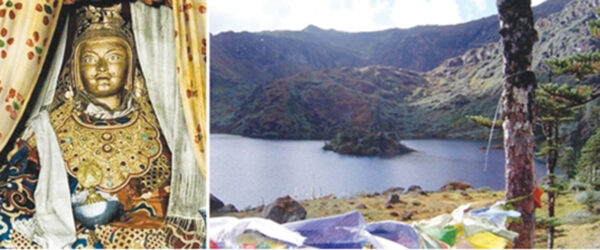
Guru Padma Sambhava’s holy land Citta Puri
Pemakod was very much cherished by Guru Padma Sambhava. In many texts, he refers to it as the king of all other 16 of his hidden lands. In the Tsa Sum Gongdus, he said: “In this hidden land, all mountains are like blooming flowers. All rivers spontaneously recite mantras and flow with nectar; rainbows are arched on trees and bushes. All the oath-bound protectors watch closely and protect true practitioners and punish those who merely pretend to be. Those who practice sincerely will attain enlightenment in this lifetime. Pure samadhi will spontaneously arise just by being in this land.
One session of practice in this blessed land is equal to a year of practice in other places. Those who make three prostrations here will never take lower rebirth. Those who die after seven steps taken with the intention of arriving here will definitely be reborn in this land. Those who build stupas and temples, and perform other works of virtue in this land are my messengers. Therefore, my fortunate sons and daughters, keep devotion to this land. You will soon realize its significance.”
This area contains numerous minor as well as four major holy places. The first of these is Dharmakaya Amitabha’s holy place – Padma Shri; another is Samboghakaya Avalokiteshvara’s holy place – Riwo Tala; third site is Nirmanakaya Guru Padmasambhava’s holy place – Citta Puri and fourth holy site – Devi Kota, is centered between the other three and embodies the blessings of all three. Devi Kota is only a few miles away from Tulku Orgyen’s retreat land, which he visits every year in December.
The legend of Shangri-La emerged from Tibetan Buddhist belief in Beyul, or hidden lands. Tibetan prophecies proclaim that the greatest of these mythical sanctuaries lies at the eastern edge of the Himalayas, veiled by a colossal waterfall at the heart of the forbidding Tsangpo gorge.
Shangri-La, a lost paradise, is where wisdom of the human race is being conserved there against the threat of imminent catastrophe. After years of research and investigation, Buddhist scholar and world-class climber Ian Baker and his team made worldwide news by reaching the bottom of the Tsangpo gorge and finding a magnificent 108-foot-high waterfall – the legendary grail of both Western explorers and Tibetan seekers.
Pemakod, being blessed by Guru Padma Sambhava, one of the holy places for spiritual practitioners to practice dharma and meditate while popular triangle Gelling-Tuting-Singha offering unparalleled beauty with its flora and fauna forms Pemako Zone would soon be included in Buddhism tourism circuit to attract more tourists, Chief Minister Pema Khandu had said in February 2020. He was on a two-day visit to primary Buddhist sites of the district.
It is high time for all pious Arunachlees to awake, arise and walk till the goal is reached!


 20
