
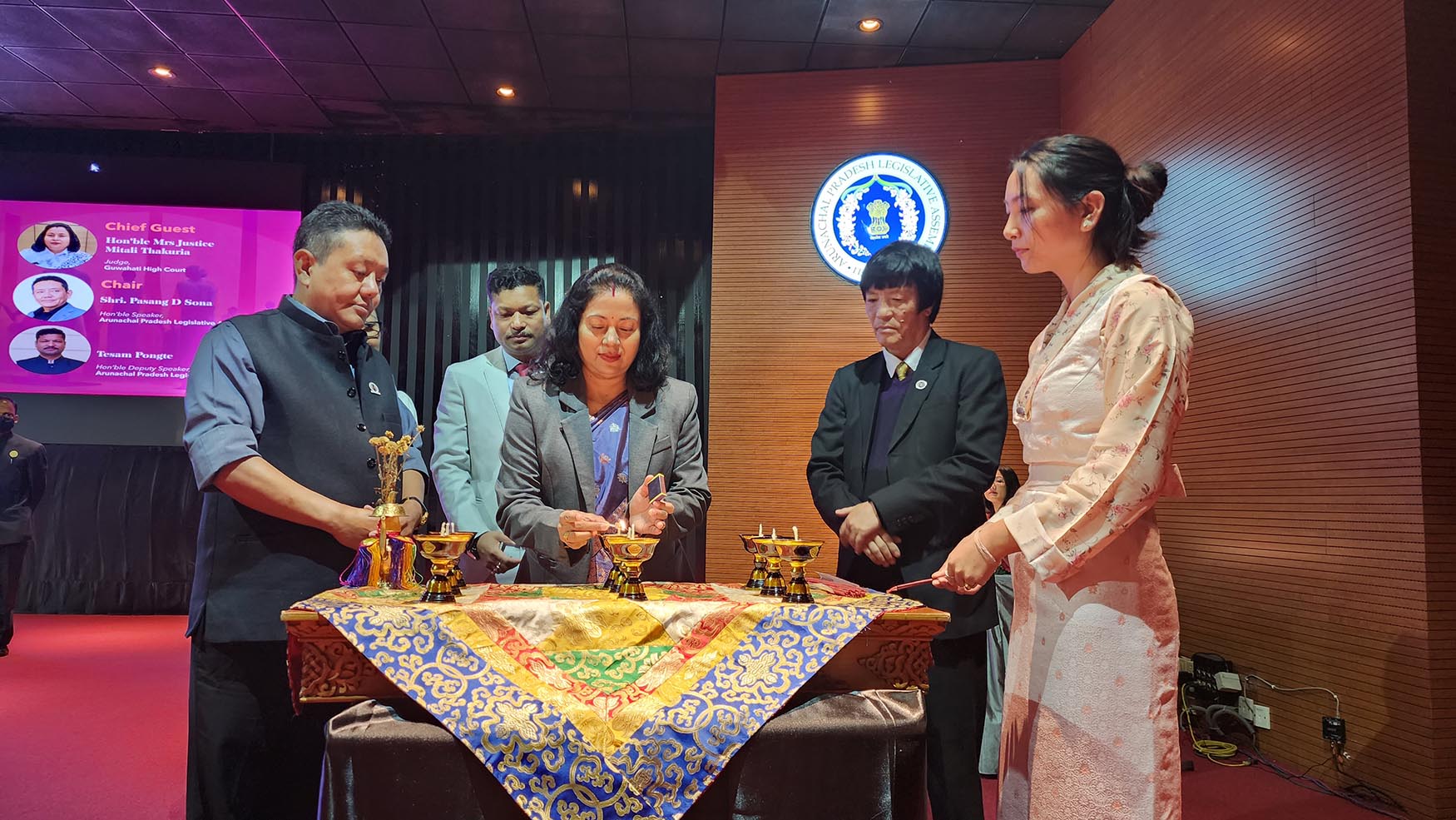
ITANAGAR, Nov 25: Gauhati High Court Judge Justice Mitali Thakuria Friday exhorted the NGOs, political parties, media and panchayat leaders to encourage the women collaboratively to change the political scenario and the society in general.
Addressing a symposium on ‘Engaging Women for Sustainable Political Participation’ organised at the Legislative Assembly here, Justice Thakuria said that despite girls’ achievement in various fields, still they lack in political independency, decision making opportunity and awareness on panchayat system.
“The 33 per cent reservation for women is still not enough as most of the women don’t feel like to come forward to take up the political responsibility due to which 50 per cent reservation still not working,” she said.
Justice Thakuria added that according to census report, females are found to be more populated than their male counterpart, but still statistically, there have been poor representatives of women.
Assembly Speaker Passang D Sona in his address emphasised on women’s contribution in the society and made a comparative analysis between women of tribal society with the rest of the women across the nation, which found to be more empowered.
He urged the people for introspection and perspective change among the society towards women’s participation being as legislature and a political contributor in general.
The day-long symposium was being organized by the Commonwealth Parliamentary Association (CPA) branch of the state assembly in collaboration with Women Studies & Research Centre of Rajiv Gandhi University, to commemorate the adoption of the Constitution of India.
The technical session consisted of seven panelists including, Prof Jumyir Basar, Director of AITS under RGU as a moderator of the session, MLA Dasanglu Pul, who dwelt on women’s contribution in upliftment of the society and demanded 33% reservation.
Pul also emphasised on bringing change in our mindset towards progressive perception and emphasized women’s active participation in every field.
Kamle ZPC Biri Santi Nido talked about the patriarchal society because of which women often left behind in decision making process. She stressed on women empowerment to be self- realized among the women first so to become more self- reliant, self- dependent and self-aware.
IMC corporator Yagam Jamoh highlighted the removal of gender inequality in the constitution and added that women should not only stick to the 33 per cent reservation but instead have the courage to participate and look forward for taking up the responsibility to change the society.
APSCW vice chairperson Nabam Yahi Tad spoke on equal distribution of rights in social and political engagement, equal opportunity in decision making, planning and action.
She also urged the educated women and every stakeholder to have the sense of responsibility in lifting the women of all spheres.
APWWS President Advocate Kani Nada Maling in her deliberation, urged upon the stakeholder to be sensitive and materialize in pushing the women toward political field. She further highlighted the challenges such as stereotype, lack of family support, judgmental, biasness, lack of financial support etc as stumbling block of sustainable growth of women in politics.
APC’s Gender Council convenor Apu Gapak stated that women in media especially, in Arunachal context were found to be empowered. She emphasized on self believe and faith in one’s capability instead of asking for reservation.
She added that educated and capable women should come forward in uplifting other women toward empowerment.
RGU professor Dr Topi Basar said, “Politics is very expensive and to sustain it is also very expensive”.
She encouraged that politics should also be seen like any other profession in which women’s participation should be the driving factor. In order to make it sustain creating a political environment for engaging women should be kept in mind.
She added that the prospective problems concerning to women participation should be looked closely with possible alternatives.


 20
