
Inflation soaring
in Turkey: Guide
“The soaring inflation is due to the fault of government for which the common people are suffering a lot,” said a guide.
“Turkey’s annual inflation had hit 90.60% in October last, highest since June 1998. It was expected to down to 80% by month end, but slow to 70.25% by end-2022 as the central bank continues to cut interest rates despite soaring prices”, a Reuters poll had shown.
Beyond the Horizon
By Pradeep Kumar
A recent five-day trip from November 21 to 24, 2022 with few friends to transcontinental country, Turkey or Republic of Türkiye, justified the adage “seeing is believing” with enchanting Turks asking “How can I help you?” with a smile posed as symbol of the nation.
Tourism and agriculture are economic vehicles of Turkey, surrounded by sea and spread in 7,83,356 km2 area with fertile land and farmers grow rich quality of oranges and bananas in plenty, said tourist guides Kerem Onmyus, Knikim, Hakoin, Omet, Ensat and Atse lucidly explained. All 600 five-star hotels across the nation remain 100% occupied during June to August due to pleasantly warm temperatures, added Foxtrot Travel’s Sneha Mahajan, Siddesh Narukar & Manish Rathod and Inventum Global’s Anurag Zutshi.
Turkey is a regional power and newly industrialized nation with a geopolitically strategic location. Its economy, classified among emerging & growth-leading economies, is world’s 12th largest by nominal gross domestic product (GDP) and 11th largest by purchasing power parity (PPP). Besides being an early member of NATO, Turkey is a charter member of United Nations, IMF and World Bank besides a founding member of OECD, OSCE, BSEC, OIC, OTS & G20.
However, despite a Muslim nation, young damsels and women lead a very liberal life style visible along the streets, bars and hostels being a secular and liberal nation, informed a guide but regretted that it is not free from world’s oldest profession prostitution.
Turkey is located mainly on Antalonian Peninsula in Western Asia, with a small portion on Balkan Peninsula in Southeast Europe. It shares borders with Black sea to the north; Georgia to the northeast; Armenia, Azerbaijan & Iran to the southeast; Syria and Mediterranean Sea to the south; the Aegean Sea to the west; Greece & Bulgaria to the northwest and Cyprus located off the south coast.
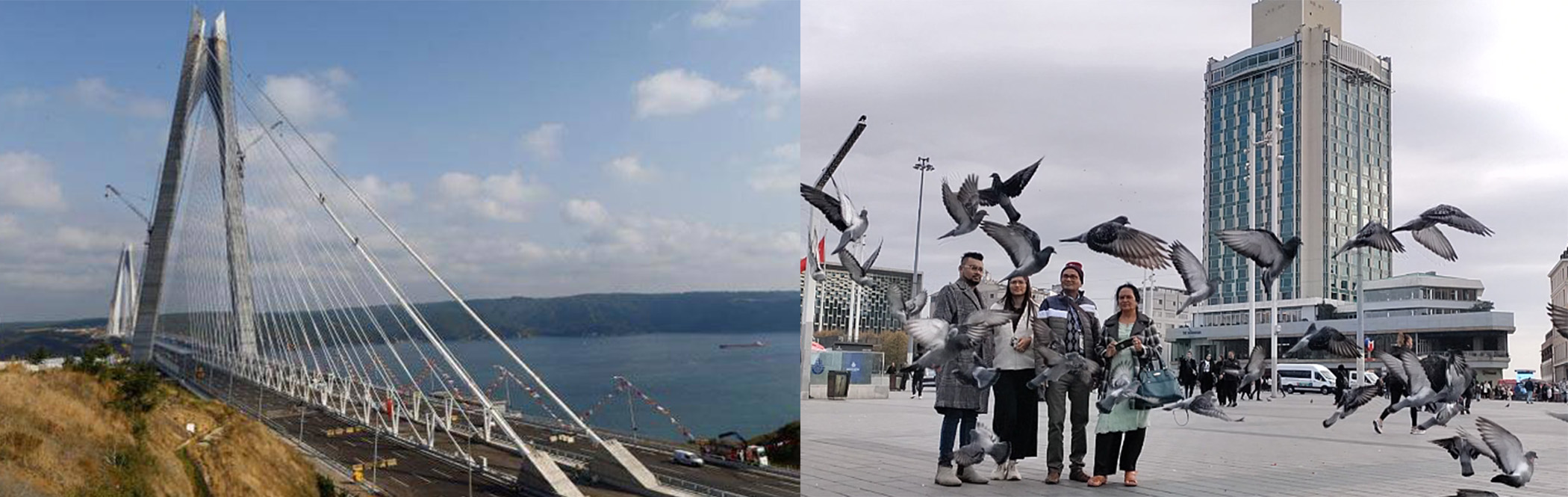
Turkey known since ancient times as one of the world’s earliest permanently settled regions has gone down to history for many reasons, including as centre of the earth and new link between Asia with Europe by a 1.4-km long and 59-meter wide mega bridge across the Bosphorus Straits with eight-vehicle lanes and two high-speed rail lines that tripled the length of the mega metro.
The $200 billion bridge on edge of Istanbul, built in New York’s Brooklyn Bridge style and boasts pylons higher than the Eiffel Tower and named after 16th-century Ottoman ruler Yavuz Sultan Selim, aims at driving economic growth and secure a place as Turkey’s most significant leader of modern republic’s founder Mustafa Kemal Ataturk, President Tayyip Erdogan had said in his inaugural address on 27.08.16.
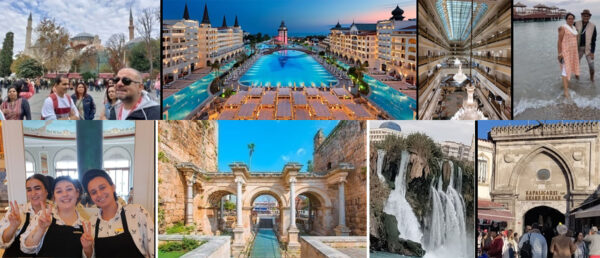
Guide Kerem Onmyus with goggles in front of Istanbul’s Ottoman-era historical imperial Blue Mosque (built between 1609 and 1616 during Ahmed-I’s rule); Titanic Mardan Palace, its sea beach & hotel waitresses; Hadrian’s Gate, Antalya; Duden Waterfalls & Istanbul’s Grand Bazaar
Cruising in Bosphorus Straits or largest port city Antalya along Turkey’s Turquoise Coast, renowned for its sandy beaches, historic old town, Duden Waterfalls and natural wonders, particularly waiters and waitresses, like Rabia Karatas, Gizem Oturmal & Hazal Oz for their affectionate attitude gave lifelong memory.
Istanbul’s Grand Bazaar located in Faith district with the same name Kapalıçarşı, is one of the largest and oldest covered markets in the world, with 61 covered streets and over 4,000 shops spread in 30,700 m2 area that attracts between 2.5 lakh to 4 lakh visitors daily. In 2014, it was listed No.1 among world’s most-visited tourist attractions with 91,250,000 visitors. It is often regarded as one of the first shopping malls of the world. But, a careful observation and analysis proved that quality of products were poor and rates too high in comparison to India. But, the market was full of thousands of tourists from across the world and the shop keepers were doing brisk business on 23.11.22.
The construction of Grand Bazaar’s core began during 1455/56 winter, shortly after Ottoman conquest of Constantinople as part of a broader initiative to boost Istanbul economic prosperity. Sultan Mehmed-II had erected an edifice devoted to trading of textiles and jewels near his palace. It was named Cevâhir Bedestan (Bedesten of Gems), also known as Bezzâzistan-ı Cedîd in Ottoman Turkish. The word Bedesten is adapted from Persian word bezestan, derived from bez (cloth), means “bazaar of cloth sellers”. The building – named alternately in Turkish İç (Internal), Antik (Ancient) or Eski (Old) Bedesten – lies on the slope of third hill of Istanbul. The construction ended in 1460/61 winter and it was endowed to the waqf of Hagia Sophia Mosque. Analysis of brickworks shows that most of the structure originates from 2nd half of 15th century, although a Byzantine relief representing a Comnenian eagle, still enclosed on top of the East Gate (Kuyumcular Kapısı)), has been used by many scholars as proof that the edifice was a Byzantine structure.
Turks, 99.8% of whom are Muslim, form vast majority of Turkey’s population while Kuds are the largest minority. Ankara is its capital while Istanbul (known earlier as Constantinople) is largest city and financial centre. Turkey was home to important Neolithic sites, like Gobekli Tepe and was inhabited by ancient civilizations, including Hattians, Hittites, Anatolian peoples, Mycenean Greeks, Persians and others.
Following conquest of Alexander the Great which started the Hellenistic period, most of ancient regions were culturally Hellenised in modern times, which continued during the Byzantine era. The Swljuk Eurks began migrating in 11th century, and the Sultanate of Ram ruled Anatolia until Mongol invasion in 1243, when it disintegrated into small Turkish principalities. The Ottomans beginning in late 13th century united the principalities and conquered Balkans and Turkification of Anatolia intensified during the Ottoman period. After Mehmud-II conquered Constantinpole in 1453, Ottoman expansion continued under Selim-I. The Ottoman Empire became a global power during reign of Suleiman the Magnificent.
From late 18th century onwards, the empire’s power declined with a gradual loss of territories. Mehmud-II initiated a period of modernization in early 19th century. The Young Turk Revolution of 1908 restricted the authority of the Sultan and restored Ottaman Parliament after a 30-year suspension, ushering the empire into a multi-party period. The 1913 coup d’etat put the nation under control of Three Peshas, who facilitated the Empire’s entry into World War-I as part of Central Powers in 1914. The Ottoman Govt during the war committed genocides against its American, Greek & Assyrian subjects. After its defeat in the war, the Ottoman Empire was partitioned.
The Turkish War of Independence against occupying Allied Powers resulted in abolition of Sultanate on 01.11.1922, the signing of Treaty of Lausanne (which superseded Treaty of Serves) on 24.07.1923 and proclaimed it as a Republic on 29.10.1923.
With the reforms initiated by country’s first president Mustafa Kemal Ataturk, Turkey became a secular, unitary & parliamentary republic. Turkey played a prominent role in Korean War and joined NATO in 1952. The country endured several military coups in latter half of the 20th century. The economy was liberalised in 1980s, leading to stronger economic growth and political stability. The parliamentary republic was replaced with a presidential system by referendum in 2017.
After becoming one of the early members of Council of Europe in 1950, Turkey became an associate member of the EEC in 1963, joined EU Customs Union in 1995, and started accession negotiations with European Union in 2005. Turkey has a rich cultural legacy shaped by centuries of history and the influence of various peoples that have inhabited its territory over several millennia; it is home to 19 UNESCO World Heritage Sites and among the most visited countries in the world.


 20

