
Arunachal Pradesh United Kingdom
- Lady’s slipper that blooms with arrival of spring is an example
By Pradeep Kumar
ITANAGAR, Dec 05: Arunachal Pradesh, one of the rich bio-diversity hotspots of the world, boasts of rich occurrence of orchids with more than 600 species abounding the state. The ideal climate and diversity of habitat have favoured abundant growth of orchids to earn the sobriquet ‘orchid paradise’ of India. The Botanical Survey of India in its first comprehensive census of orchids of India in July 2019 put total number at 1,256.
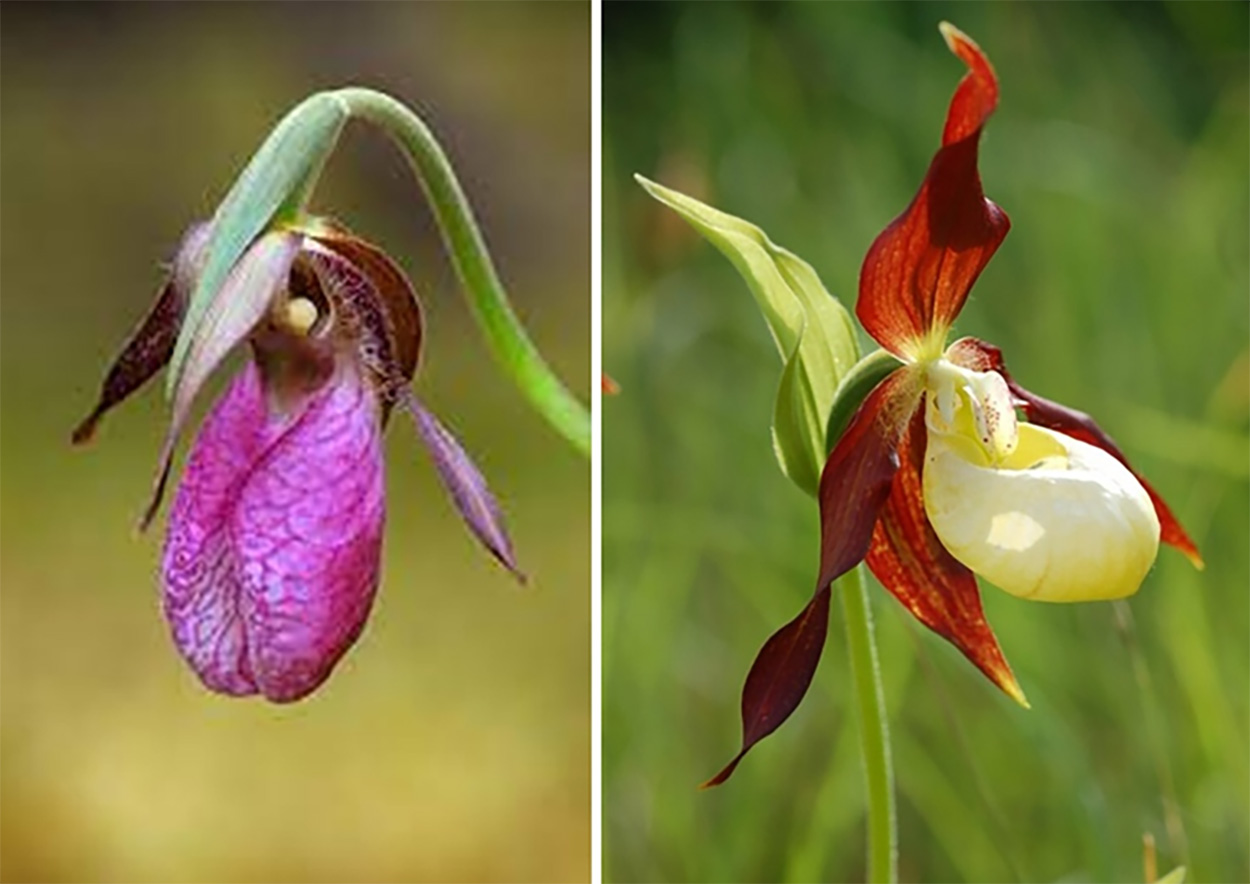
Lady’s slipper, (subfamily Cypripedioideae) also called lady slipper or slipper orchid, subfamily of five genera of orchids (family Orchidaceae), in which the lip of the flower is slipper-shaped. Lady’s slippers are found throughout Eurasia and the Americas, and some species are cultivated. This spectacular orchid is also found in Arunachal Pradesh.
Six species in the genus Selenipedium, also native to tropical America, may be 16 feet tall. The leaves are folded, and the flowers are borne on a spike at the tip of the plant. S. vanillocarpum has vanilla-scented seedpods. All Selenipedium species are considered endangered or threatened according to IUCN Red List of Threatened Species. It costs about hundreds of pounds in UK as was told by former PCCF and secretary to CM K D Singh. Thus, this British orchid is under guard in a secret location being a target of thieves.
A single lady’s slipper orchid, Cypripedium calceolus—the last wild plant of its kind left in the United Kingdom. If you saw the lady’s slipper’s delicate crimson-and-yellow petals tremble in a spring breeze, you too may understand the allure that has gripped collectors for generations.
The love of orchids, labelled “orchidelirium” by the Victorians, erupted in 19th century, as the reach of the British Empire enabled the import of a few of these delicate flowers to the U.K. While supermarkets now sell inexpensive orchids, the flowers’ finicky reproductive process—most of them are slow-growing, with seeds that depend on a symbiotic relationship with a naturally occurring fungus—means that scientists have only managed to adapt a relative few species for mass greenhouse cultivation.
Britain’s Cypripedium calceolus faces a unique dilemma. Compared to other species, this lady’s slipper has a wide range, growing from the U.K. to Russia, and in some parts of Asia. Because it remains relatively abundant in the wilderness of countries such as Sweden, the Red List considers Cypripedium calceolus a species of least concern for conservation in Europe. Zoom into the U.K., though, and the picture changes. Thanks to Victorian orchidelirium, Britain’s lady’s slipper population was decimated by ruthless collection. By the early-20th century, it was believed to be extinct. That is, until 1930, when a lone, nature-loving wanderer stumbled upon one in Yorkshire. Typical of some orchids’ very long lifespans, the plant grows to this day.
The vast majority of the world’s more than 28,000 orchid species remain elusive to most purchasers, says Richard Thomas, Communications Coordinator at TRAFFIC, an NGO monitoring wildlife trade, only amplifies their appeal. Of the 98,500 species included on the Red List of Threatened Species the Red List of Threatened Species, produced by the International Union for Conservation of Nature, 1,360 listings are orchids.
“Originally, the flower’s location was known only to a few botanists, who were more committed to restoring the species than to acquiring it. It is not in public domain now,” says Mike Fay, senior research leader of Royal Botanic Gardens at Kew.
“With all things forbidden word of the flower spread fast. Eventually, government conservationists became so worried about orchid poachers that they swore to keep its location a strict secret—not even all the orchid experts at Kew Gardens know where it is. The plant itself is zealously protected. For a few weeks each spring, the flower’s delicate blooms receive round-the-clock guard. Tasked with the job of collecting data on the flower’s soil conditions, weather and progress of its blossoming, the guard is the first line of defense between the lady’s slipper and its would-be captors, he adds.
Arunachal also known as ‘Treasure Trove of Orchid’ being home to captivating 605 identified species while Indian accounts for 1,200 varieties of total about 20,000 varieties of orchids in the world, according to Orchid Society of India.
It harbours over 5000 plants, about 85 terrestrial mammals, over 500 birds and a large number of butterflies, insects and reptiles. However, New World Encyclopedi records “at least 25,000 different species of orchids, with probably thousands more that remains unknown or unclassified. The Royal Botanical Gardens of Kew lists 800 genera and nearly 22,000 accepted species, but the exact number is unknown because of taxonomic disputes. Horticulturists have also created over 100,000 hybrids for commercialization, as wild orchids are protected under various conservation laws.
It is estimated that about 1,300 species (140 genera) of orchids are found in India. Orchids constituting 9% of our flora is the largest botanical family. The following is the distribution of orchid species in different regions of India. The North-Western Himalayas boasts of 200 species, NE India 800 species and Western Ghats ca 300 species”.
Arunachal having variety of ornamental orchids has great potentials in orchid trade industry which consists mainly of plant and cut-flowers. Various ornamental orchid plants both species and hybrids are sold in market either bare-root or potted plants. Thus, state Govt has set up orchid centres at Itanagar, Tipi, Sessa, Dirang, Jengging, Roing under State Forest Research Institute having good germ-plasm collection of about 400 species and hybrids.
Realising the precarious situation in all Orchid habitats within the state, the Orchid Society of Arunachal Pradesh (OSAP) was set up to spread the message of conservation and promotion of orchids throughout the state. In fact, orchid growing can be developed as a cottage industry in the state.


 20
