

Dung beetle artifact in Karnak Temple, Egypt
Beyond the Horizon
By Pradeep Kumar
All living organisms, flora or fauna, undergo the same chain of life events from birth to death in life cycle. Animals need air, food, water and shelter. Living organisms depend on each other and on their environments or habitats, to meet their needs for survival. We call this interdependence. A food chain is one way to show interdependence.
However, it is interesting and educative as to how the life of human beings is dependent on Dung beetle. The tiny creature is given lot of importance globally right from agriculture to art, culture to science and food to medicines since ancient times. Why?
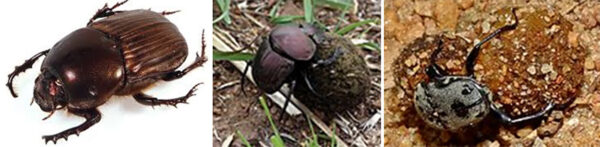
Dung beetle that feed on feces is not only the world’s strongest insect, but also the strongest animal on planet compared to body weight. Dung beetles can roll up to 10 times their weight. Male Onthophagus taurus beetles can pull 1,141 times their own body weight: the equivalent of an average person pulling six double-decker buses full of people. Some species can bury dung 250 times their own mass in one night.
Most dung beetles search for dung using their sensitive sense of smell. Some smaller species simply attach themselves to dung-providers to wait for the dung. After capturing the dung, a dung beetle rolls it, following a straight line despite all obstacles. Sometimes, dung beetles try to steal the dung ball from another beetle, so the dung beetles move rapidly away from a dung pile once they have rolled their ball to prevent it from being stolen.
Types: Cambefort and Hanski (1991) classified dung beetles into three functional types based on their feeding and nesting strategies, like Rollers, Tunnelers and Dwellers. The “rollers” roll and bury a dung ball either for food storage or for making a brooding ball. In the latter case, two beetles, one male and one female, stay around the dung ball during the rolling process. Usually it is the male that rolls the ball, while the female hitch-hikes or simply follows behind. In some cases, the male and the female roll together.
When a spot with soft soil is found, they stop and bury the ball, then mate underground. After the mating, one or both of them prepares the brooding ball. When the ball is finished, the female lays eggs inside it, a form of mass provisioning. Some species do not leave after this stage, but remain to safeguard their offspring. The dung beetle goes through a complete metamorphosis. The larvae live in brood balls made with dung prepared by their parents. During the larval stage, the beetle feeds on the dung surrounding it.
The behavior of the beetles was poorly understood until studies of Jean Henri Fabre in late 19th century. For example, he corrected the myth that a dung beetle would seek aid from other dung beetles when confronted by obstacles. By observation and experiment, he found the seeming helpers were in fact awaiting an opportunity to steal the roller’s food source.
Taxonomy: Many are known as rollers for rolling dung into round balls to use as a food source or breeding chambers. Second known as tunnelers, bury dung wherever they find, while third group dwellers, only live in dung. They are often attracted by the feces collected by burrowing owls.
Dung beetles species are of various colors, sizes and some functional trait, like body mass and leg length having high levels of variability. All species belong to super family Scarabaeoidea, most of them to the subfamilies Scarabaeoidea & Aphodiinae (scarab beetles). As most species feed exclusively on feces, that subfamily is often dubbed true dung beetles. The dung-feeding beetles also belong to other families, like Geotrupidae (earth-boring dung beetle) while Scarabaeinae alone comprises over 5,000 species.
Uniqueness: The nocturnal African dung beetle Scarabeaus satyrus is one of the few known invertebrate animals that navigate and orient themselves by polarization patterns in moonlight, the first animal known to do so. It can also navigate when only the Milky Way or clusters of bright stars are visible, making them the only insects known to orient themselves by such way. The eyes of dung beetles are superposition compound eyes typical of many scarabaeid beetles. The sequence of images shows a sequence of the beetle rolling a dung ball. It does this to navigate.
Behavior: Dung beetles live in many habitats, including desert, grasslands and savannas, farmlands, and native and planted forests. They are highly influenced by environmental context, and do not prefer extremely cold or dry weather. They are found on all continents except Antarctica. They eat dung of herbivores & omnivores and prefer that produced by the latter. Many of them also feed on mushrooms, decaying leaves and fruits. One type living in Central America, Deltochihum valgum, is a carnivore preying upon millipedes. Another species from Mexico, Canthon virens preys on queen of leaf cutter ants. They do not necessarily eat or drink anything, because the dung provides all the necessary nutrients.
Benefits and uses: Dung beetles play a role in agriculture & tropical forests by burying and consuming dung to improve nutrient recycling and soil structure. They have been further shown to improve soil conditions and plant growth on rehabilitated coal mines in South Africa. They are also important for the dispersal of seeds present in animals’ dung, influencing seed burial and seedling recruitment in tropical forests. They can protect livestock, like cattle by removing the dung which, if left, could provide habitat for pets like flies.
Mediterranean dung beetle (Bubas bison) has been used in conjunction with biochar stock fodder to reduce emissions of nitrous oxide & carbon dioxide, both greenhouse gases. The beetles change biochar-enriched dung into soil without using machines. Thus, many countries have introduced the creatures to benefit animal husbandry. American Institute of Biological Sciences reports that dung beetles save the USA cattle industry an estimated US$ 380 million annually through burying above-ground livestock feces.
They are widely used in ecological research as a good bioindicator group to examine impacts of climate disturbances, like extreme droughts and associated fires, human activities on tropical biodiversity and ecosystem functioning, such as seed dispersal, soil bioturbation and nutrient cycling.
In Australia, Commonwealth Scientific & Industrial Research Organisation (CSIRO) commissioned Australian Dung Bettle Prject (1965–1985) led by George Bornemissza, to introduce species from South Africa and Europe. The successful introduction of 23 species was made, most notably Digitonthophagus gazella and Euoniticellus intermedius, which has resulted in improvement of quality and fertility of Australian cattle pastures, along with a reduction in population of pestilent Australian bush flies by around 90%.
In 1995, it was reported that dung beetles were being trialled in Sydney beach suburb of Curl Curl to deal with dog droppings.
An application has been made by Landcare Research to import up to 11 species of dung beetle into New Zealand. Dung Beetle Release Strategy Group says that it would result in a reduction in emissions of nitrous oxide, a greenhouse gas, from agriculture to improve pasture soils. There is, however, strong opposition from some in University of Auckland and others, based on the risks of dung beetles acting as vectors of disease. University’s public health researchers who agree with the current Environment Protection Agency’s risk assessment and indeed there are several Landcare programmes in Australia involving school children collecting dung beetles.
The African dung beetle (D. gazella) was introduced in several locations in North & South America and has been spreading its distribution to other regions by natural dispersal and accidental transportation, and is now probably naturalized in most countries between Mexico & Argentina. The exotic species might be useful for controlling diseases of livestock in commercial areas and might displace native species in modified landscapes. However, data is not conclusive about its effect on native species in natural environments and further monitoring is required. (Continues)


 20
