
Beyond the Horizon
By Pradeep Kumar
Upper Siang district of Arunachal Pradesh, a paradise for nature lovers, offers vast scope for tourism growth. Tuting is the last village of Sino-India border. Exploring its enchanting and unexplainable beauty justifies the adage ‘seeing is believing’ as it is one of the shining examples of ‘Last Shangri-La’ on earth.
Shangri-La is a fictional place in Asia’s Kunlun Mountains, described by James Hilton in his 1933 English novel Lost Horizon by portraying Shangri-La as a mystical, harmonious valley, gently guided from a lamasery, enclosed in western end of the Kunlun Mountains. Thus, Shangri-La has become synonymous with any earthly paradise, particularly a mythical Himalayan utopia – an enduringly happy land, isolated from the world. In the novel, the people who live at Shangri-La are almost immortal, living hundreds of years beyond the normal lifespan and only very slowly aging in appearance.
Ancient Tibetan scriptures mention existence of seven such places as Nghe-Beyul Khembalung. Khembalung is one of several Utopia Beyuls (hidden lands similar to Shangri-La) which Tibetan Buddhists believe that Padmasambhva set up in 9th century CE as idyllic, sacred places of refuge for Buddhists during times of strife.
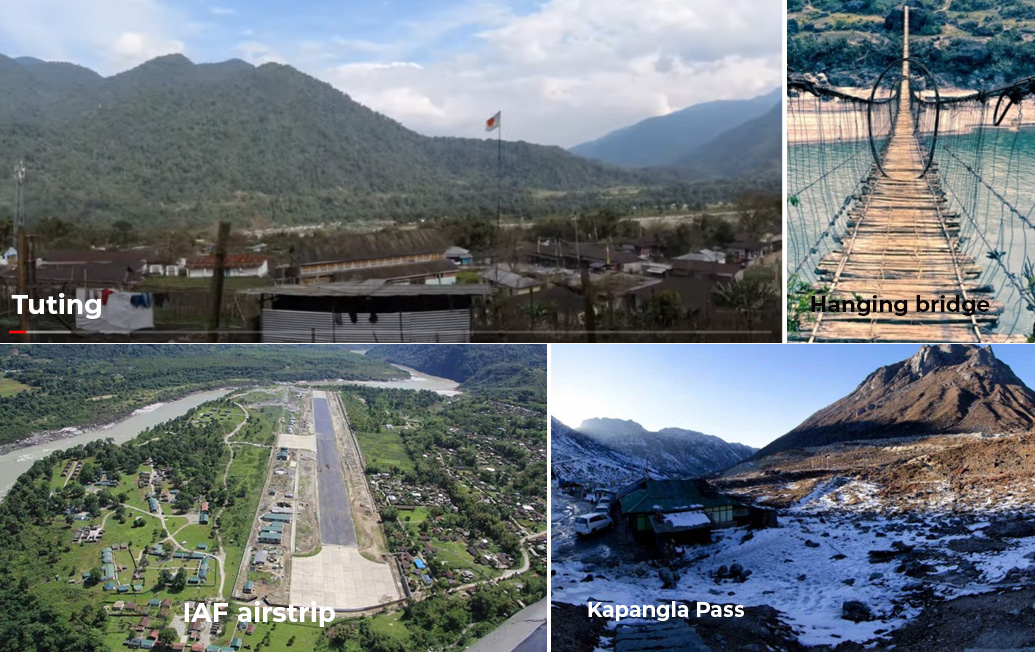
Tuting, a circle headquarters town, is situated on the bank of Siang River (Brahmaputra), about 34-km south of Line of Actual Control and 170-km north of district HQs Yingkiong.
It is one of the Indian military regiment HQs, which reports frequent incursion attempts by Chinese People’s Liberation Army, including an attempt to construct a road in Indian Territory. It is located on proposed 2,000-km Arunachal Frontier Highway (Mago-Thingbu to Vijaynagar) along the McMahon Line, around 35-km upstream is Gelling, the last India village before the Indo-Tibet border.
Tuting is populated by Adi tribe who are indigenous inhabitants but small population of other tribes, like Memba and Khamba, also live there. Indigenous tribe Memba in Gelling circle, northern reaches of Tuting, follow Nyingma Mahayana Buddhism whose key festivals Losar, Tirgya, Dhruba and Tsobum are celebrated by performing Bardo Chham animal-mask folk dance in gonpas. Tuting is connected to Yingkiong and Pasighat in the south and until ITBP office at Gelling in the north on the LAC via Pasighat-Aalo-Tuting-Gelling strategic India-China Border Roads. Tuting has an advance landing ground airstrip of Indian Air Force.
Tsangpo River (Brahmaputra) enters India at Gelling from Tibet and natives know it as the Tsang Chu, which downstream is called Siang River and Brahmaputra in Assam.
Gelling, with three-hour foot track to Indo-Tibet border, is a tourist attraction which has Dampo Tso lake, 300-foot tall Sibe-Re waterfall at Bishing, remnants of now defunct Kapangla Pass, on Indo-Tibetan LAC near Siang River course that separates Medog County of Tibet from Upper Siang district, used for barter trade between local communities on both sides before 1962. It was used by PLA troops to cross into Indian Territory during 1962 Indo-China War and designated as a prospective border personnel meeting point in August 2018. There is an inspection bungalow at Gelling. Thus, Gelling is most suitable for trekkers and nature lovers.


 20
