
Disputed borders in Arunachal Pradesh
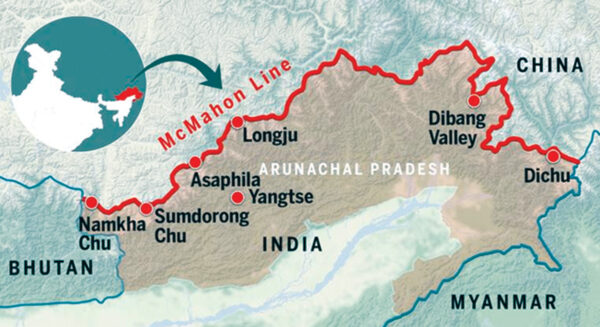
The border disputes between India and China sprang up after Indo –China War (Oct 20 to 21 Nov, 1962) in treacherous terrains. Total 722 PLA soldiers were killed and around 1,400 wounded, while Indian death toll stood at 1,383, and 1,047 were wounded. Besides, 1,696 Indians went missing and over 400 taken as prisoners of war.
India witnesses around 300 intrusions by PLA troops annually while it was record 426 in 2017, the year of Doklam face-off.
By Pradeep Kumar
ITANAGAR, Jan 18: Indian and Chinese troops often face off while patrolling along 3,488-km undefined Line of Actual Control (LAC) of Sino-India border as was seen on 09.12.22 in Yagtse area of Tawang sector in Arunachal Pradesh when 20 Indian Army personnel and reportedly many more Chinese PLA jawans sustained minor injuries.
This was first of its kind after 15.06.20 incident when 20 Indian soldiers were killed and several others were injured in violent clashes with the PLA troops in Ladakh’s Galwan Valley. A similar incident was reported in October 2021, when some Chinese soldiers of a large patrol team were detained for a few hours by the Indian Army as they engaged in a minor face-off near Yangtse. Thus, commanders of both sides had flag meeting to discuss the issue and restore tranquility.
Interestingly, Polo Yorbe Hill is located in Gelling circle of Upper Siang district. Its southern side is Indian Territory and northern side under China’s occupation. A stupa was built in no man’s land in 1959 where soldiers of both sides conduct daily patrolling without any conflict, according to Yingkiong MLA-cum-Health & Family Welfare Minister Alo Libang.
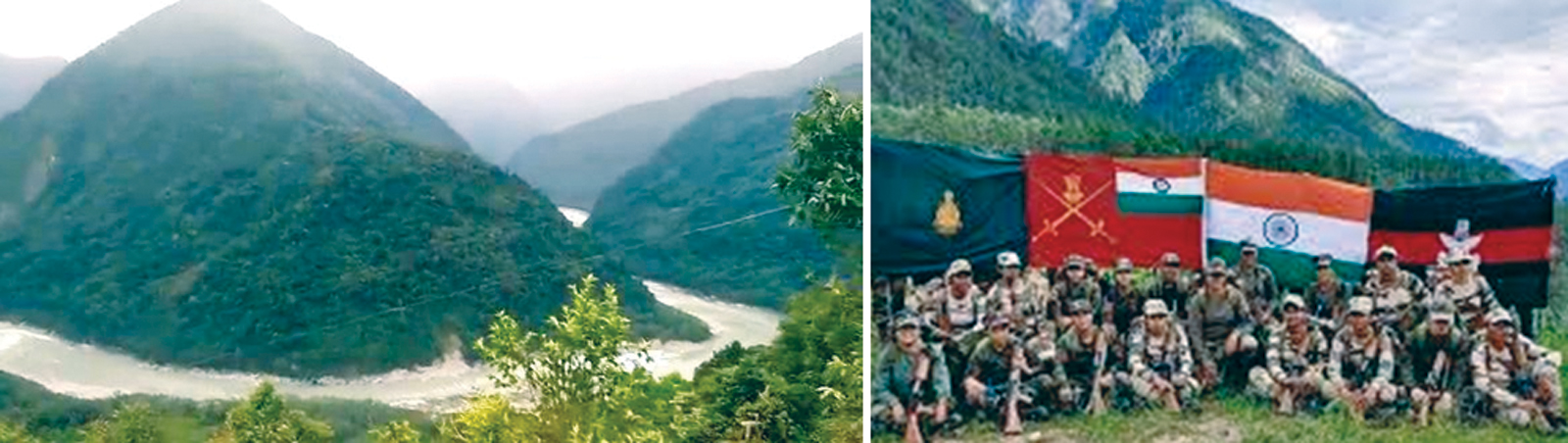
Bishing is last village along Indo-China border in Geling circle where Tsangpo River enters India in S-shape bend as Siang and called Brahmaputra in Assam. Bishing is 7-km by foot from Geling village and 33-km from Tuting. Across the border in Tibet lies Medong County with Namcha Barwa Mountain and Tsangpo gorge. Gelling, located at an altitude of around 4000, is linked by road through Kapang-La Pass, he told this daily.
“Indo-Tibetan Border Police (ITBP) soldiers conduct patrolling till 12 noon while Chinese patrolling starts after 1 pm to avoid face to face confrontation. A memorial for 1962 martyr jawans of Madras Regiment of Indian Army and Assam Rifles was built there where solders of both nations pay respect,” said TRIHMS OSD Dr Rajen Kombo, who hails from Upper Siang district HQs Yingkiong.
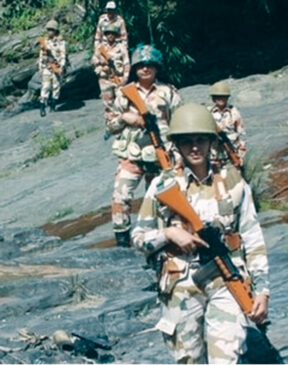
The ITBP is primarily tasked to secure 3,488-km-long LAC with China. ITBP women soldiers patrolling border areas as was seen in a video shared by ANI in 2022 to reflect achievements of women.
In last few years, the Army has significantly upgraded firepower and infrastructure along the LAC in Tawang sector and a similar effort is under way in rest of Arunachal Pradesh. The road built by the BRO that linked Maza, the last border post in Upper Subansiri district, on 28.12,22 is a glittering proof.
However, there was report of Chinese incursions into the area in 2018. National People’s Party the president in a press release had claimed China had built a two-km long road in Bishing region. A report verifying the claim based on satellite imagery was published by The Print, saying the road was laid from the Tibetan temple called Degangsi, near Delgon village towards the LAC and stretched 1-km into Indian Territory. China was trying to create ‘facts on the ground’ to shift the border, The Print had opined
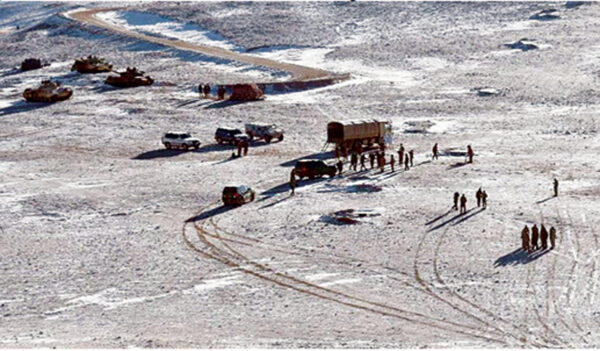
Border dispute: Indian became a republic 0n 15.08.1947 while People’s Republic of China (PRC) was created on 01.10.1949. India is celebrating 75th anniversary of Independence, but Communist Party of China (CPC) and People’s Liberation Army (PLA) have maintained a regressive policy towards India.
The PLA often intrudes into Indian Territory for land-grabbing post-1962 war resulting in conflicts. Chinese threat spreads thick and fast from Taiwan to Indian tertiary Hambantota due to its unbridled aggression across South Asia.
Background: In a reality check of India’s lost territories, it is found that India has been mauled since the 1960s; the Chinese aggression continues from Tawang (Arunachal Pradesh) to Tangtse (Ladakh). It multiplied under Xi Jinping-led CPC-PLA’s ballistic missile use in Taiwan and Japanese zone; giving warning of ‘dire consequences’ to all neighbours, especially India.
Facts: A selective chronological fact-sheet of chronic Chinese hostility to India (1954-1962) shows:
In April 1954, India and China signed Tibet Agreement.
On 17.07.1954: China protested against Indians in Barahoti. Chinese troops entered Barahoti on 28.06.1955 and claimed Barahoti on 26.07.1956.
In October 1957, the PLA announced completion of Tibet-Xinjiang Highway G-219 which cut deep inside India, violating her sovereignty and territory.
In June 1958, China occupied Khurnak Fort, inside Ladakh.
In July 1958, the Chinese map claimed large areas of NEFA (Arunachal Pradesh) and Ladakh.
In September 1958, Chinese troops re-entered Barahoti and s month later built outposts at Lapthal and Sangchanalla.
In March 1959, His Holiness 14th Dalai Lama escaped from Tibet.
In July 1959, armed PLA entered western Pangong Lake to set up Spangur camp.
On 07.08.59, the PLA intruded into Khinzeman (Arunachal)
On 25.08,59, the PLA overpowered troops of Indian outpost of Longju (Arunachal)
On 27.08.59, PLA hoisted its flag near Rezangla (Ladakh), 35-km south of Spangur
On 28.08/59, Indian PM handed over Arunachal’s defence to the Army.
On 08.09.59, Chinese PM wrote a letter to Indian PM, claiming 64,000 sqkm of Indian land.
On 20-21.10.59, tensions rose as PLA penetrated 80-km inside Indian Territory, near Kongka-la, and fired at an Indian patrol party, killing nine soldiers.
In November 1959, the CPC and PM Chou-en-Lai followed 07.11.59 letter to cunningly propose withdrawal of armed forces of both Dragon and Delhi 20-km from McMahon Line in Arunachal Pradesh, and from Ladakh’s LAC.
On 16.11.59, it was agreed to withdraw in Ladakh as far west as the line claimed by the CPC as boundary, provided China too withdrew behind traditional boundary alignment as claimed by India. The PLA supremo was unprepared for this superb counter-trump logic and diplomacy of Nehru. Expectedly, the cunning proposal failed as India handed over Ladakh to the Army.
Nevertheless, PLA’s insatiable aggression led to establishment of more posts near Nyagzu, Ladakh, followed by biggest diplomatic blow to Delhi in May 1962 when the two dictators Mao and Pakistan’s Ayub Khan agreed on negotiations ‘to locate and align’ the portion of India-China boundary in Pakistan-occupied-Kashmir.
The worst of anti-India alliance between the PLA and the fundamentalist army-ruled Pakistan was sealed, thereby exposing their collective mala fide intentions and perennial perfidy to India.
CPA chairman Mao Zedong’s 1962 invasion changed India’s history for ever and prompted every right-minded Indian to identify China as enemy number one.


 20

