
Beyond the Horizon
By Pradeep Kumar
Who is right, who is wrong?
Spotting tiger is appreciable but if after eight years, it is questionable. Who is right and who is wrong? If the state forest department authorities are right, then National Tiger Conservation Authority (NTCA), which conducted the census 2018 are wrong or vice versa. How could 11 tigers disappear in five years from Namdapha Tiger Reserve?
Namdapha National Park is third largest national park in India in terms of area. But, timber smugglers hand in gloves with forest officials have been destroying forest resource for their own benefit. Rampant deforestation has been going on in Namdapha National Park, alleges Society for Education and Environmental Development (SEED), an environmental NGO. “The Park rich in forest cover has been losing it richness due to deforestation . We are holding awareness among locals tribe for conservation of forest. Community participation is necessary to conserve the forest,” said SEED deputy director Minom Pertin. Is deforestation responsible for disappearance of tigers?
Recent report in a regional daily that tiger was spotted in Namdapha in Arunachal Pradesh after eight years was intriguing. India’s last Tiger Census 2018 report was released by PM Narendra Modi on International Tiger Day on 29 July 2019 that disclosed 2,967 Royal Bengal Tigers were left in India, making the country one of the biggest and safest habitats of Royal Bengal Tiger. The figure doubled in comparison to 2006 population of 1,411 tigers.
India is home to 80% of tigers in the world. In 2006, India estimated that there were 1,411 tigers which increased to 1,706 in 2010, 2,226 in 2014 and 2,967 in 2018. The increase in population of tigers in India played a big role in driving up global populations as well; the number of wild tigers globally rose from 3,159 in 2010 to 3,890 in 2016 according to World Wildlife Fund and Global Tiger Forum.
As per 2018 census report, Madhya Pradesh became the Tiger State of India with 526 tigers with more than 408 big cats in the age group of 1.5 years, followed by Karnataka (524) and Uttrakhand (442). It also indicates presence of 18 tigers in Arunachal Pradesh – Namdapha National Park & Tiger Reserve (11) and Pakke (7).
The tiger reserves set up in India since 1973, governed by Project Tiger and administrated by National Tiger Conservation Authority (NTCA), attributed to growth of tiger population. The last tiger reserve declared in 2022 was Ranipur Wildlife Sanctuary, 53rd in India and 4th in Uttar Pradesh. State forestry departments operate 71,027.1 km2 of declared reserves “to ensure maintenance of viable populations of the conservation dependent Royal Bengal tigers in India”. The tigers are maintained for their scientific, economic, aesthetic, cultural and ecological values and to preserve for all time areas of biological importance as a national heritage for the benefit, educational purposes.”
Since the tigers are present in wide expanse of India, it was necessary to distribute the geographical limits and hence the tiger habitats were divided into 5 landscapes – Shivalik Gangetic Plains, Central India and the Eastern Ghats. Western Ghats, North Eastern Hills and Brahmaputra landscapes were analyzed separately to get the most accurate tiger population spread across India and various techniques were used to achieve the results. More than 3,81,000 sqkm of forest area was surveyed. Forest rangers surveyed more than 5,00,000 km on foot. There were 26,838 camera traps deployed in 141 locations which took approximately 3.5 crore photographs and 2,591 tigers estimated through capture-mark-recapture while total population of tiger was estimated at 2,967.
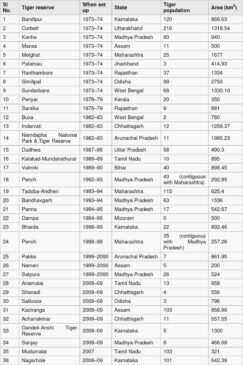
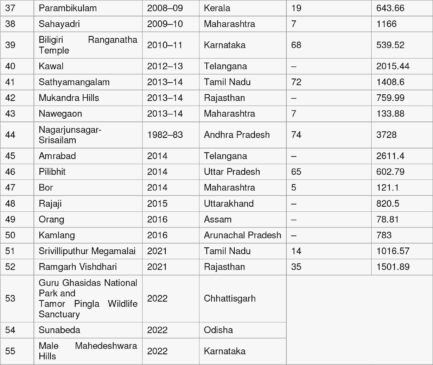
List of tiger reserve & state-wise tiger population in 2018


 20

