
By Pradeep Kumar
NAHARLAGUN, Mar 22: The changed course of MBBS is skill and clinical oriented to benefit the students while giving greater scopes to teachers throughout the year for formative assessment, said Jorhat Medical College & Hospital pharmacology department HoD Prof Anju L. Saikia.
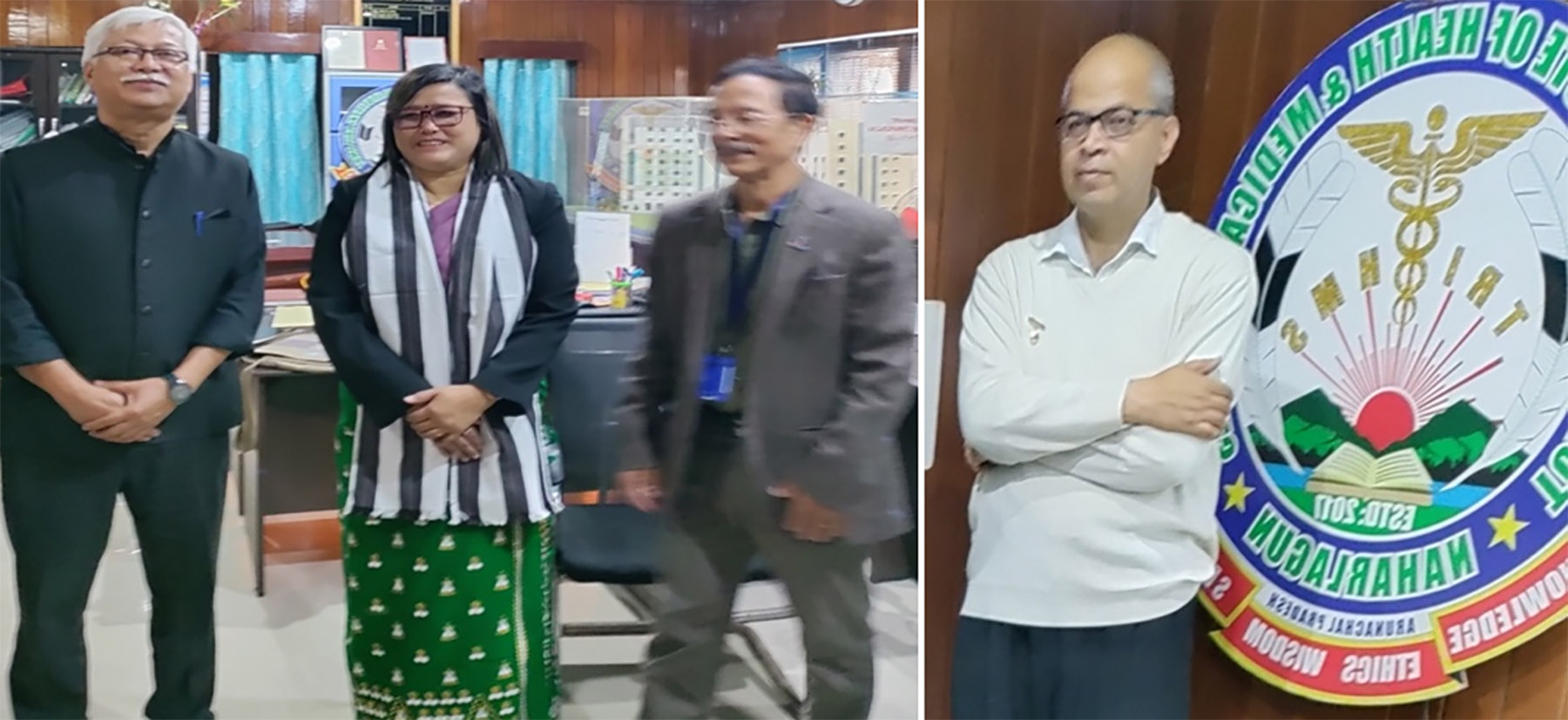
Prof Saikia, who was here with Assam Medical College pharmacology department HoD Prof Rituparna Phukan Ray as externals to conduct 2nd year MBBS examination of 50 students of Tomo Riba Institute of Health and Medical Sciences (TRIHMS), was responding questions from this daily after being felicitated by director Dr Moji Jini in his office on Wednesday.
Responding to questions on benefits of changed teaching pattern prescribed in new syllabus, she said that while ‘small groups teaching’ has been introduced as a new concept, training and skill oriented teaching has replaced only lectures. The teachers have more scopes now to assess the students, she added.
When both pointed out that the present laboratory lacks enough space for installing all equipments properly, Dr Jini said that that the present building is temporary and all problems would be solved once the laboratory is shifted to its planned building after its completion soon.
When Dr Jini sought feed backs on positive and negative aspects of TRIHMS, both said that the students are good, but examination pattern should be changed to given more time to teachers to teach. TRIHMS pharmacology department HoD Dr Devendra Sachdeva was accompanying the duo.
Prof Saikia almost put a seal on what I had reported in this daily – MBBS syllabus changes to CBME: TRIHMS Prof – on 21.10.19.
“The MBBS course undergoing minor changes underwent sea changes after 19 years to make it competence based medical education (CBME), said TRIMHS medical college microbiology Prof Shyamal Bhattacharya.
“Many topics of medical sciences in phase-I, phase-II and phase-III have been integrated so that one should be competent enough to treat effectively as a medical practitioner after obtaining MBBS degree, he said in an exclusive interview to this editor in his chamber here.
“Elaborating further, he said that originally phase-I included anatomy, physiology and biochemistry; phase-II comprised pathology, microbiology, forensic & pharmacology and phase-III covered all clinical aspects, including medicine, surgery, gyanecology and pediatrics. However, the integration ensured a link between three phases, he said, adding community medicine will be taught in all phases”.
Quoting Medical Council of India (MCI), he said “the development and roll out of ompetency driven integrated curriculum marks an important milestone in the evolution of medical education in India. The 2019 Graduate Medical Regulations builds on the previous regulations published in 1997 incorporating newer concepts and addressing the changes in health, illness, societal economic and technology changes that have occurred over a decade and a half.
“The ability of the new curriculum to help the students achieve their potential will largely depend on converting the intent enshrined in the document into tangible curricular delivery mechanism. We believe that creating processes which will ensure that the curriculum is delivered appropriately to the stakeholder is crucial. We outline a curricular governance process to enable this.
“The MCI has revised the undergraduate medical education curriculum so that the Indian medical graduates are capable of recognizing “health for all” as a national goal and be able to fulfil his/her societal obligations. The revised curriculum has attempted to enunciate the competencies the student must be imparted and should have learnt, with clearly defined teaching-learning strategies and effective methods of assessment.
“Communicating effectively and sympathetically with patients and their relatives has been visualized as a core area of the revised curriculum. These and other goals identified in the curriculum are to be implemented in all medical colleges under the ambit of MCI from August 2019 and to smoothen this process Guidelines have been prepared for its effective implementation. In response to the need for a seamless introduction of the curriculum into the undergraduate system, all medical colleges need to upgrade the teaching-learning skills of their faculty. Earlier experience with implementation of curricular changes suggests that a carefully managed, sustainable approach is necessary to ensure that every college has access to the new skills and knowledge enunciated in the new curriculum. Faculty training and development thus assumes a key role in the effective implementation and sustenance of the envisaged curricular reforms.
Though MCI has provided broad framework, it is not possible to bring complete uniformity in a vast country like India. Hence, local authorities such as universities, colleges and faculty need to make appropriate refinements at local level to suit their local needs keeping the broad framework intact. The programme needs to be implemented by all stakeholders and shall be facilitated by universities, nodal and regional centers along with curriculum committees in all colleges”.
The month-long mandatory foundation course included sports, language and early clinical exposure for the newcomers to sensitize them to study medicine focuses on attitude, ethics and communication (AETCOM), said Prof Bhattacharya, who had worked in a GoI project in Nepal, ESI Medical College, Kolktata and Motilal Medical College, Allahabad, during his 24-year career before joining TRIMHS.
The undergraduate medical education programme is designed with a goal to create an “Indian Medical Graduate” (IMG) possessing requisite knowledge, skills, attitudes, values and responsiveness so that he or she may function appropriately and effectively as a physician of first contact of the community while being globally relevant.
The TRIHMS is set up in 2018 as first but lone medical college of Arunachal Pradesh with 50 seats and a 500-bedded hospital. Its first academic session had began on 01.08.18.


 20
