
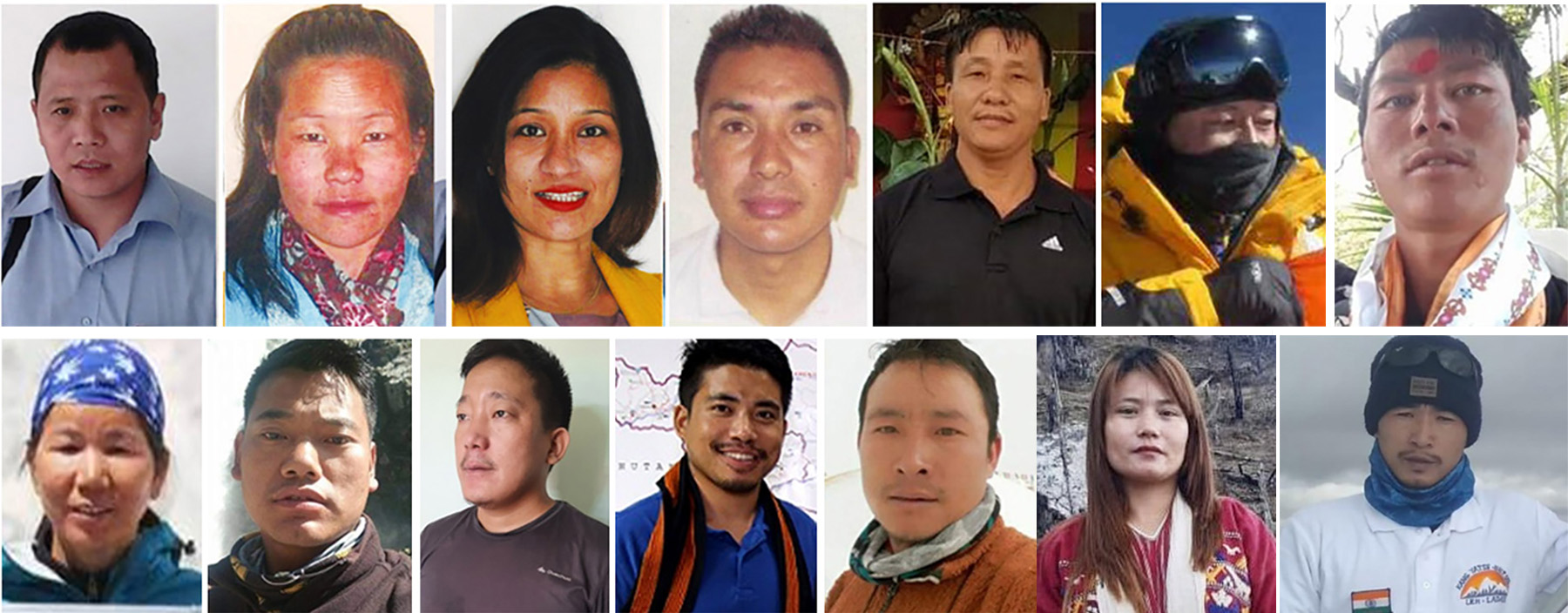
(From L to R) Mra, Mena, Jampsenpa, Lama, Bagang, Paljor, Khandu, Lingi, Nimsonga, Tamut, Teksang, Dondup, Yangjom & Sorang
Beyond the Horizon
By Pradeep Kumar
The first expedition to Mt Everest dates back to 1921, when the British attempted to climb Everest, passing through the northeast slope of Tibet, since access to Nepal was not allowed at that time. A team of six, including mountaineer George Mallory, set off on a reconnaissance mission to chart the easiest route to the summit. The team climbed up to 7,000 meters above sea level. During second expedition in 1922, the objective was to reach the top of the mountain. Two climbers in the group managed to climb to an altitude of 8,320 meters, with respiratory assistance. But this ascent was marked by the death of seven Sherpas, caused by a violent avalanche.
Sir Edmund Hillary and Tenzing Norgay reached the 8,849-m summit of Everest this day in 1953, becoming the first people to stand atop the world’s highest mountain, exactly 71 years ago, while Bachendri Pal of Uttarakhand was first Indian woman to summit it on 23.05.84 at the age of 30 to be conferred Padma Bhusan in 2019.
Total 6,338 different people have climbed Mount Everest and reached the summit as of January 2023 while Kami Rita Sherpa of Nepal has reached the summit for the highest 26 times.
Three countries with the most number of summits are Nepal – 1,756 summits (all Sherpas who join climbers to help are from Nepal), USA – 748 and India – 526.
However, hilly state of Arunachal Pradesh has unique distinction with 14 Arunachalees achieving this feat so far while Anshu Jamsenpa, Bharat ki beti aur Arunachal ki buari, is the only woman on earth to scales Mount Everest for 5th time.
The successful mountaineers are – Tapi Mra (21.05.09); Tine Mena, 1st NE woman (09.05.11); Anshu Jamsenpa (12.05.11, 21.05.11, 21.05.13, 06.05.17 & 21.05.17 [only woman on earth to scale five times]; Nima Lama (17.05.13); SSB constable Tame Bagang (21.05.13); Kalden Paljor (21.05.17); Dorjee Khandu and Tongchen Nimsonga of NIMAS (19-20.05.18), Muri Lingi (14.05.18); Kishon Teksang & Taka Tamut (24.05.18) [Tamut without the support of Sherpa guides while Tekseng had also climbed till Camp IV (26,000ft) without supplemental oxygen, a rare feat], Tibetan Army man Sange Dondup (2019) and Tashi Yangjom of NIMAS (14.05.21). Yangjom was ninth climber of the institute to scale Everest. However, Abraham Tagit Sorang became 14thArunachaee to scale Mount Everest on 11.05,21.
This again proves right, what I had written, “more Arunachalees with their special physique could climb Everest if those interested are given proper training besides lucrative incentives through a policy”.
As Mount Everest draws more than 500 climbers each spring to attempt the summit during a small window of favorable conditions on the rugged Himalayan Mountain that tops out at just over 29,000 feet.
A new study led by researchers of University of Washington and University of California, Davis, finds that the success rate of summiting Mount Everest has doubled in the last three decades, even though the number of climbers has greatly increased, crowding the narrow route through the dangerous “death zone” near the summit. However, the death rate for climbers has hovered unchanged at around 1% since 1990.
The findings were published Aug. 26, 2021 in the open-access journal PLOS ONE. They represent the most comprehensive look at success and death rates in the published literature on Everest. The paper also identifies patterns in the characteristics of mountaineers — such as age, sex and prior experience — that might influence their likelihood of summiting or dying during the spring climbing season.
“Mount Everest is still a very dangerous mountain, and climbing it will never become a walk in the park, because it’s way above the limits of what most people can do,” said lead author Raymond Huey, a UW professor emeritus of biology. “Unfortunately, reported statistics of risk on Everest are often inaccurate. By analyzing climbing data, we provide accurate information on the chances of success and on the chances of dying, thereby helping climbers make an informed decision about whether to attempt this great peak.”
These patterns also can help Nepal and China in deciding whether to institute restrictions on climbers such as maximum age or experience level, Huey added.


 20
