
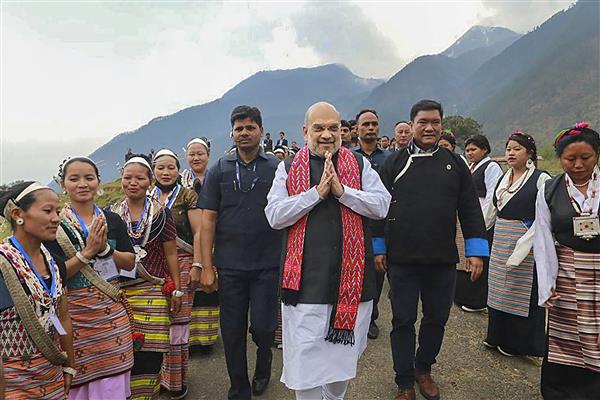
HM Shah with CM Khandu at Kibithoo – file pic
Pul first advocated to
develop border areas
On 20.07.14: Realizing that development of this sensitive border state was lagging far behind, then Health & Family Welfare Minister Kalikho Pul had advocated to push for special dispensation to accelerate state’s development to get assurance from Union MoS (Home Affairs).
During his meeting with Rijiju in his New Delhi office, Pul, who hails from Anjaw district bordering China, had drawn the former’s attention as to how ramshackle porter tracks, foot suspension bridges, log bridges and culverts – the lifeline in border areas – were affecting the border patrolling and life of the locals.
“Huge funds are pumped in for BADP. But security of Arunachal Pradesh would ensure the security of the nation for which a special package should be given for border development,” Pul had emphatically pleaded to receive in principle approval from Rijiju.
NEW DELHI, June 07: The Centre has asked district collectors (DCs) in areas along the Sino-India border to submit reports on infrastructure development within three months under the Vibrant Villages Programme (VVP), officials said.
Union Home Minister Amit Shah has exhorted them to take initiatives related to tourism, employment generation, agriculture, handicrafts and cooperatives, increasing basic amenities and achieving 100% saturation of central and state schemes according to local conditions and weather of each village.
There are three main ways to develop border villages – 100% implementation of central welfare schemes in villages, promoting financial inclusion and increasing digital and emotional connectivity of villages with the rest of the country, he added.
A large number of villages under the scheme lack telecom and road connectivity and are facing the issue of thinning population. One of the villages, Kibitho in Arunachal Pradesh, saw operationalisation of the first 4G telecom tower last month, officials said. (Agency)
AONS adds: On 10.04.23, Union Home Minister Amit Shah, accompanied with Arunachal Pradesh Chief Minister Pema Khandu, had launched the VVP at Kibithoo, a border village. Despite constant uproar among the Chinese administration, India continued to give a strong reaction with its bold and strategic initiatives and the VVP was one such moves.
Kibithoo is one of Arunachal Pradesh’s most distant circle HQs, located at a height of 1305 metres above sea level, about 15-km south of the LAC and 40-km west of India-China-Myanmar tri-junction. Kibithoo had also witnessed 1962 India-China war and is one of five formally agreed-upon Border Personnel Meeting sites between Indian and Chinese armies for frequent briefings and interactions aimed at defusing standoffs.
Kibithoo’s then population was less than 2000 people, and majority of 320 homes had two or more members who live in the state’s urban areas or other parts of the country. With the commencement of this plan, the Govt intended to see return of the migratory inhabitants to their native villages in the future.
The VVP also has a strategic viewpoint as the village along the LAC once populated will help the army to be well-informed about any mischievous activities initiated by the Chinese army. The initiative will serve as a significant component in promoting high-end tourists by traininh local people to cater to tourists.
Shah had also inaugurated nine micro hydel projects of state Govt and 14 infrastructure projects for Indo-Tibetan Border Police (ITBP) worth Rs.120 crore. This central VVP aims at comprehensive development of villages along India-China border.
The launch had come days after Beijing announced the renaming of 11 places in Arunachal Pradesh, calling it “standardized geographical names” in an attempt to unjust claim of the entire state. Addressing the event, Shah had strongly asserted, “India wants peace with everyone but no one will be able to encroach on even an inch of our country’s land.” He further added that the Govt considers the security of the borders as the security of the nation and therefore no compromise can be made with respect to the Indian army and borders.
The VVP’s primary focus is to assist in improving the quality of life of communities living in specific border areas and encouraging them to stay in their native areas, reversing migration and increasing border security. The Govt had approved VVP with central components of Rs.4,800 crore, including Rs.2,500 crore exclusively for road connectivity for financial years 2022-23 to 2025-26.
Under this VVP, 2,967 villages in 46 blocks of 19 districts were identified, abutting the northern border in states of Arunachal Pradesh, Sikkim, Uttarakhand and Himachal Pradesh and UT of Ladakh. In the first phase, 662 villages have been identified on priority, which included 455 villages in Arunachal Pradesh. Under the VVP, the selected villages will be connected by all-weather roads, potable piped water, 24×7 electricity, internet connectivity, healthcare and enhanced livelihood options.
The VVP initiative was seen as India’s response to the 628 model ‘xiaokang’ (moderately well-off) villages built by China along 3,488-km Line of Actual Control (LAC), stretching from eastern Ladakh to Arunachal Pradesh. China started building these new villages, which have dual civilian-military use, in 2017 and completed them in 2021 at a cost of Rs 3.76 lakh crore.
Chinese villages have houses with modern amenities, but do not have occupants, while India’s model is a people-centric with an aim to boost quality of life of existing locals.
CM visits last border village Damin
On 03.12.12, Chief Minister Khandu had visited Damin, India’s last village in Kurung Kume district, to become the first CM to reach there with Home Minister Bamang Felix and local MLA Lokam Tassar;
He had inaugurated many projects, inspected roads built by the BRO, interacted with then BRO’s Arunanak CE Brig AS Kanwar and assured villagers of all possible help to improve infrastructure along the India-China border. Arunachal Pradesh is a sensitive state for sharing 1,129-km of total 3,488-km Indo-China border.


 20
