
- Purity, beauty, simplicity & frankness – Donyi-Polo ethical dimension
By Pradeep Kumar
ITANAGAR, June 30: The Forum for Awareness on National Security (FANS) national general secretary (organisation) Golok Behari Rai and general secretary V N Pandey, after conducting talks on “Challenging China’s hegemonistic tendencies”, along with others visited centurion town Pasighat on Thursday.
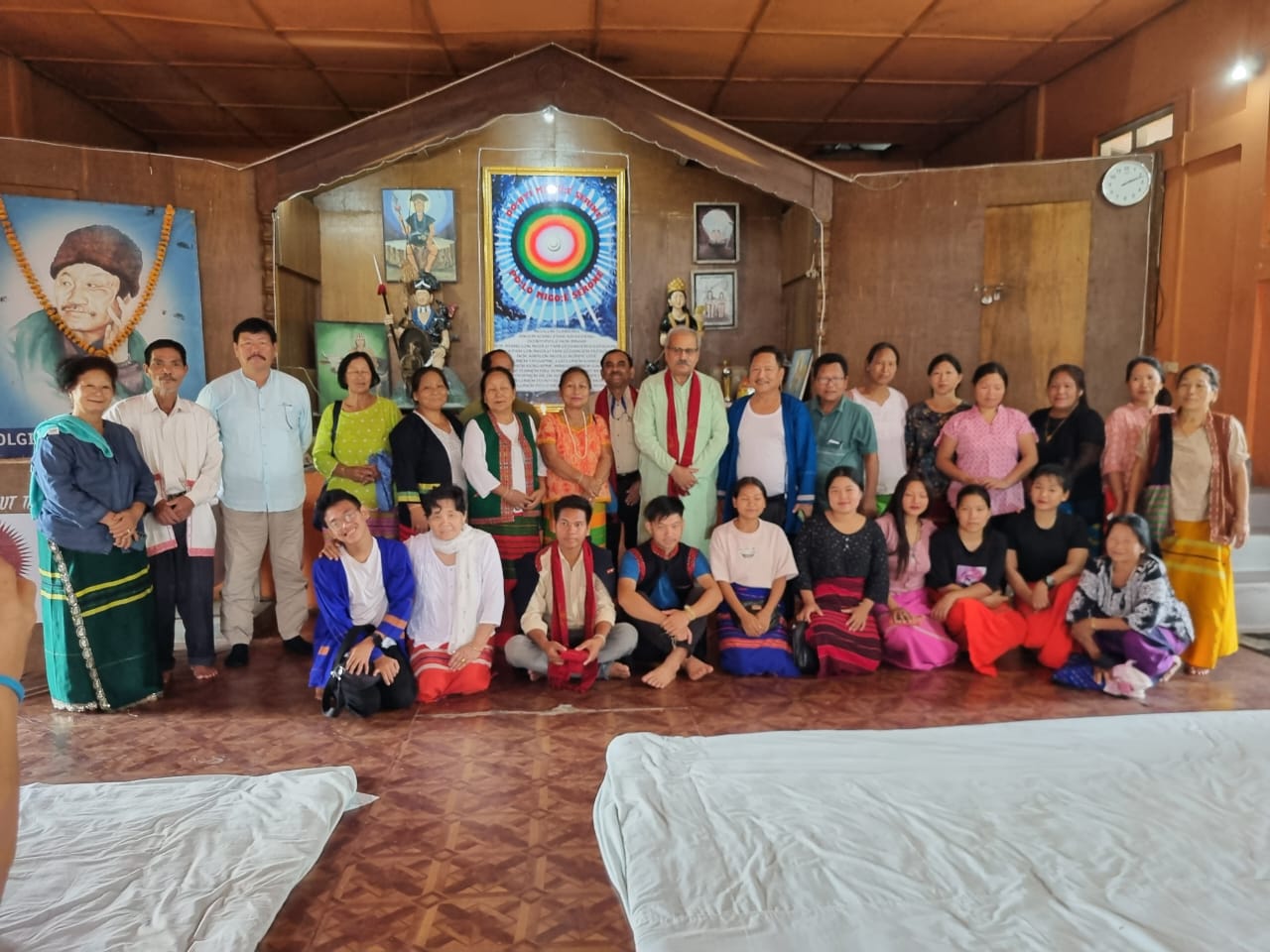
Guided by Pandey, a retired SE of GoAP, they visited various schools besides Donyi-Polo Yelam Kebang (DPYK) whose president Ajem Tayeng informed that first Gangging was set up in 1986 by late Talom Rukbo and its number has risen to 345 for the belivers to offer prayers. When he pointed out that rapid drug addiction and conversion of innocent tribal population from their indigenous religion to foreign religion were two burning issues confronting the present tribal society.
While the team was highly impressed with the Gangging and traditional practices being explained to them, Rai assured to look into the issue of addiction related to nation security by proactive by FANS steps. However, he added that “Today’s fight is for protection of thoughts, existence, identity, tradition and values of life. Our tradition, history and life are facing external threat due to conversion. Moreover, China’s expansionism in our neighborhood is not only a threat for India but for the whole world and humanity. Liberation of Kailash-Mansarovar and Tibet from China cane alone ensure development, prosperity, security and peace in this region”.
Addressing around 100 Donyi-Polo believers, Pandey advocated protection and popularization of state’s tradition, identity, culture & religion while ensuring safety of state’s border inhabitants for national security.
Other present were DPYK secretary general Tajom Tasung, general secretary Besing Yasung, Women Wing president Oni Tako Taki and social workers Er Tapi Darang & O Tapak.
Fearing that time-tested Donyi-Poloism would face the impact of modernity, Talom Rukbo had pioneered to strengthen and popularise the indigenous faith in 1964. He had built a Donyi Polo Temple (Gangging), a center to worship sun and moon, at Pasighat in 1989. The movement has been rejuvenating rich cultural mosaic of Arunachal Pradesh with the roots germinating to strengthen their faith further. The movement intensified very fast to propagate the ancient religion Donyi Poloism that gave Talom Rukbo the sobriquet Gogli Bote.
Donyi-Poloism, a religion that makes no distinction, is more relevant in the present day context as its believers pray for the greater welfare of the entire humanity while practicing the much needed tolerance towards other cultures, they said without mincing any words.
“Culture is our identity and if it is lost, our identity is lost,” the faith believers reemphasize to drive home the message that indigenous faith is the mother of all religions as has been proved across the world.
They were right, as I remember mitakuyeoyasinwas the outcome of the International Conference of World Elders of Ancient Traditions and Culture conducted at Jaipur during February 5 to 10, 2006. Fulbright scholar Vijay Swami, Tashi Tom from Tawang and Willa Namchoom from Chowkham from Arunachal who were among the 250 delegates from 42 countries spread across five continents and representing 257 traditions were astonished to find the striking similarities in dresses, ornaments, food habits and rituals.
“Yes, we belong to the world community as nature worshippers despite the geographical barriers are the same across the world,” was the admiring comment of Donyi-Polo believer Dr Joram Begi.
Swami, in his article ‘Continuing traditions in developed nation’ wrote that there are about three billon people, called Native Americans, who live in a typical traditional style in the high-tech, tip-top, eye-catching modern America. Their lifestyle has been uniquely blended with the modern world without affecting in any way their age old culture, value system and sometimes even their dress and hairstyle. They have great pride and respect for what they are and the White Americans too appreciate them with dignity. This has been well projected in various museums in Philadelphia and Washington DC through displays, pictures and documentaries.
Jolene Rickrd, Guest Curator, had rightly put it in 2004 and displayed in National Museum of American Indians that “Claiming our future on our own terms-that is self determination. Self determination means control of our lives and our land, knowing our traditions and understanding our relationships to each other, insisting on our right to be who we are. We know that our future depends on integrating traditional knowledge with the modern world. One without the other is a world out of balance.”
Arunachalee communities as such do not need any interference from outside in any way in their faith, traditions, customs and practices. If Native Americans, living in America itself, could keep their traditions intact today in spite of displacement and intimidation, it is not too late for the Arunachalees, believes Swami.
Since Rukbo represented Donyi-Polo Mission at the Interventional Association for Religious Freedom meetings in 1984 and 1985 and at its Bangalore meeting in 1986 and pleaded for recognition of Donyi-Poloism as a full-fledged religion, the indigenous renaissance has reached the length and breadth of the state and there are about 400 Kargu Gamgis, and if Rang-Fra faith is added, the number stands at 528.
The news published in 16.11.17 edition of this daily -Donyi-Polo movement- End of an era- is a glittering example of spread of this movement.
 Simpleton lady Gongam Kamsi toeing social reformer Talom Rukbo had given a new dimension to Donyi-Poloism by making Lord Donyi-Polo statues with pebbles collected from Dirkong river herself and installed in a temple in Naharlagun ‘E’ sector giving a new thrust to the movement to receive appreciating from the believers.
But like any mortal being, Kamsi ‘Ato’ left this mortal world on 16.09.17. Alas…there was hardly anyone to take care during her last days. The neighbours said that one Malati didi took personal care till her last breath. Her departure after devoting entire life to Donyi-Polo reminds famous poet Alexander Pope, who in his “Ode to Solitude” wrote: “Thus let me live, unseen, unknown; thus unlamented let me die; steal from the world, and not a stone tell where I lie”.
On every Donyi-Polo Day (December 31), besides organizing various rituals in her temple, she would invariably distribute cakes after offering to Lord Donyi-Polo. She was lovingly called ‘Ato’ by all for her loving and caring personality.
The followers of Donyi-Poloism worship a variety of gods and goddesses that enliven the nature. These gods are believed to partake in universal balance of Donyi and Polo, and to be multiple manifestations or identities of Sedi-Donyi–Polo, each with specific functions and roles. It is believed that they take care of the earth and humanity. The main deities in Donyi-Polo are Donyi and Polo, Kine Nane, Doying Bote, Pedong Nane and Guumin Soyin. However, the Abotanis (Apatani, Galo, Nyishi, Tagin, Na, Mishing, Adi-Lhoba) share a myth telling about their descendance from the progenitor Abotani.
Donyi-Poloists describe the “Donyi-Polo” nature of the universe as the eyes of human conscience. Happiness is given through right action, and right action is that which follows the order of nature (Donyi-Polo). Donyi-Poloists describe “Donyi-Polo” nature of the universe as the eyes of human conscience. Happiness is given through right action, and right action is that which follows the order of nature (Donyi-Polo). The ethical dimension of Donyi-Polo means purity, beauty, simplicity, and frankness.
Right conscience naturally guides man. According to the traditional belief, love, compassion, equality and selflessness are naturally ordained by Donyi-Polo; they are inscribed in nature. The ethical dimension of Donyi-Polo also means purity, beauty, simplicity and frankness.


 20

