
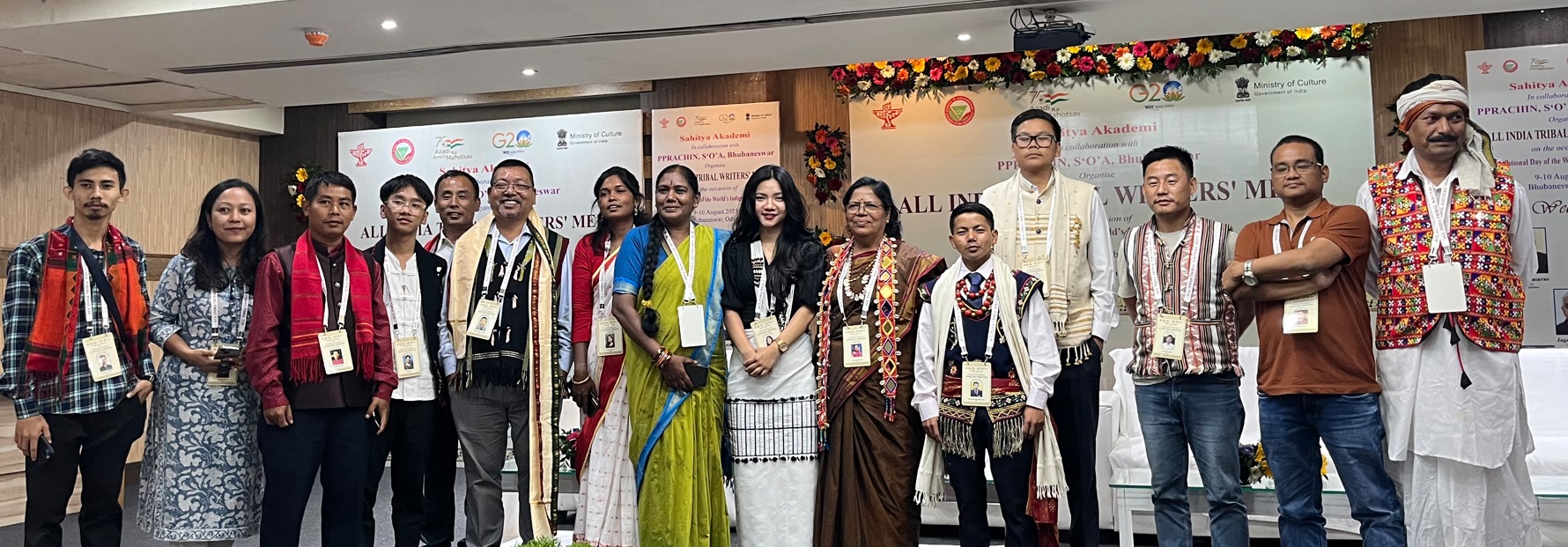
BHUBANESWAR, Aug 10: A two-day All India Tribal Writers meet was hosted by Sahitya Akademi in Odisha capital Bhubaneswar coinciding with International Day of World’s Indigenous People.
Over 50 tribal writers from 16 states enthusiastically took part in the event, showcasing their cultural heritage through poems and short stories in their respective native languages along with translations in English and Hindi.
The meet focused on critical aspect of digitizing tribal literature, recognizing its significance in preserving traditional knowledge while two writers represented Arunachal Pradesh.
Dr Jomyir Jini, presented three poems that combined Galo & Hindi languages (Igin aur Oyok), with English translation (I must go) and Galo rendition (Nokkv lvkor korpw maanam vm) while Wanggo Socia with his short story titled Culture of Beggars (Bhikhmango ki Sanskriti) in Nocte, delved into the intricate facets of indigenous culture.
Jini, reflecting on the event, expressed gratitude to the Sahitya Akademi for organizing the meet, a platform that amplified the voices of tribal writers.
The event, taking place on an important Day and part of Azaadi ka Amrit Mahotsav, resonated deeply with him.
She hailed Sahitya Akademi as a prestigious literary institution and an honour to represent the state on this distinguished stage.
Jini’s poems, rooted in her culture, resonated with fellow tribal writers, fostering unity and understanding across regions.
In an intriguing exchange, writers from different parts of India noted the linguistic similarities between their cultures and Arunachal Pradesh.
Jini’s experience in multiple languages, including her native tongue, Galo, instilled in her the drive to learn more about her heritage.
Socia shared his gratitude for representing his state in the meet. He acknowledged the event’s celebration of the power of literature, enabling writers to convey messages that resonate deeply with people.
As the event concluded, the discourse on digitizing tribal literature highlighted its pressing need.


 20

