
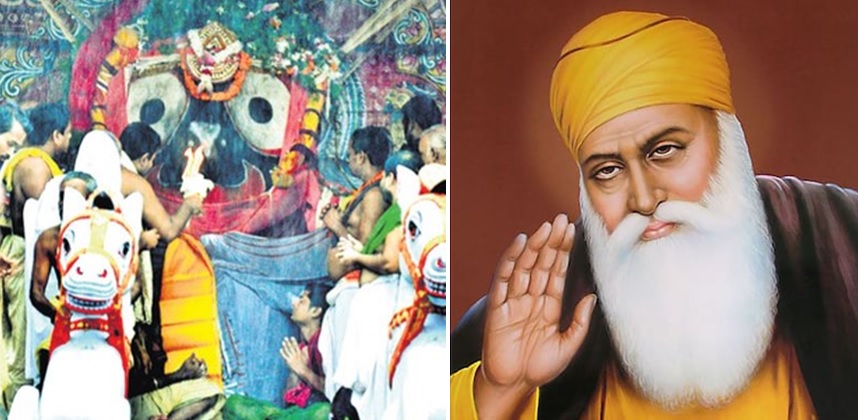
Aarati of lord Jagganath Guru Nanak
- It is ‘universal anthem’: Rabindranath Tagore
Beyond the Horizon
By Pradeep Kumar
The ancient concept of aarti is strictly followed in various temples and gurudwaras across the world, but it was Guru Nanak, first Sikh guru, who while watching aarti in Puri’s Lord Jagganath Temple had spontaneously sung a bhajan, said Sardar
Avatar Singh, before reciting it:
Dhanasari Mahalla Pehla Aarti
Ik Onkar Satgur Parsaad
Gagan Mein Thaal Rav Chand Deepak Bane
Taarika Mandal Janak Moti
Dhoop Mal-Aanlo Pawan Chavro Kare
Sagal Banraay Phoolant Joti
Kaisi Aarti Hoye Bhav Khandna Teri Aarti
Anahata Sabad Vaajant Bheri – Rahao
Sahas Tav Nain Nan Nain Hae Tohe Kau
Sahas Moorat Nanaa Ek Tohi
Sahas Pad Bimal Nan Ek Pad Gandh Bin
Sahas Tav Gandh Iv Chalat Mohi
Sabh Meh Jot, Jot Hai Soye
Tiskae Chanan Sabh Meh Chanan Hoye
Gur Sakhi Jot Pargat Hoye
Jo Tis Bhaavae So Aarti Hoye
Har Charan Kamal Makrand Lobhit Mano
An-Dino Mohe Aahi Pyaasa
Kripa Jal Dehi Nanak Saring Kau
Hoye Ja Te Tere Naam Vaasa
Naam Tero Aarti Majjan Muraare
Har Ke Naam Bin Jhoothe Sagal Paasaare.
Naam Tero Aasano Naam Tero Ursa
Naam Tera Kesaro Le Chhitkaare!
The sardarji, former accounts officer (AO) from Rajasthan, was interacting with few retired persons, namely former Indian Statistical Service officer Rajendra Kumar, former AE(E) from Ayodhya D C Srivastav, former UP Govt employee Srivastav former Bihar Govt employee Surendra Kumar Choudhury and editor of this daily, who became acquainted during daily morning walk around Vibhutipura Lake in Bengaluru and hold casual talks before dispersing. They are either with their sons or daughters, serving in this “Silicon Valley of India”, nation’s leading software exporter and a major semiconductor hub.
Interestingly, Singh, Kumar and Srivastav (who studied Hindi literature) were all sayars, but Singh was unbeatable as he would either recite gurubani or quote a Punjabi or Hindi adage at every turn of discussion, reflecting depth of his knowledge. One would wonder how destiny forced him to be an AO instead of a poet or writer.
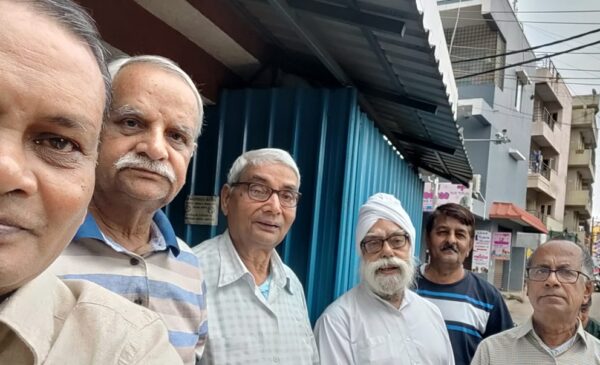
Kumar, Srivastav, Singh, Srivastav & Choudhury (L to R)
The arati deconstructs our narrative of worship by bringing to our awareness so we partake in the incessant celestial aarti (lamp lit offering) in action, the shabad extends to the prayer offerings authored by Bhagat Ravidas, Bhagat Kabir and Bhagat Dhanna, he said.
Guru Nanak, who was at Puri for 24 days in 1506, had expressed his deep awe at what he saw, and reverence to the “ultimate creator” whose glory, he said, could not be contained in anything humans had to offer. Then Puri king had become his disciple followed by establishment of gurudwara there, Singh recalled.
The gist of the aarti is that the creator’s grandeur is too much to be sung with a small set of lamps and incense; the sky itself is the grand platter, the stars are the lamps, the wind is the celestial fan and the flower-filled forests are the scent. The Sikh aarti, which has verses of four people, besides those of Nanak, represents the essence of Sikhism.
The subsequent inclusion into the aarti of the compositions of cobbler Ravi Das, barber Bhagat Sain, weaver Kabir and farmer Bhagat Dhanna, all men of humble stock, signify “the all-encompassing Sikh faith.” The Sikh aarti with addition of five more compositions is sung in raga Dhanashri at the conclusion of the day’s last prayer, the Rehraas Sahib, also composed by him. “The aarti is the preamble to Sikhism; it is half of what Sikh religion stands for,” Singh added.
Such is the poetic expression of Nanak’s composition that Rabindranath Tagore translated the aarti into Bengali and recited it daily. The late actor, Balraj Sahni, on a teaching tour to Shantiniketan, had asked Tagore why he had not written an international anthem. “It has already been recited (by Guru Nanak),” Tagore had told Sahni, as he called it the “universal anthem,” according to the actor’s autobiography.
The connection between Jagannath Puri and Guru Nanak and other icons of Bhakti movement, including Chaitanya Mahaprabhu and Namdev, runs deep.
Globe trotter Guru Nanak had not only visited famous Muslim pilgrimage Mecca-Madina in Saudi Arabia, but had also toured tribal land of Arunachal Pradesh through wikipedia has no reference.
“I have a deep attachment to the place; this Gurdwara was researched and then rebuilt by me with the help of my troops. We served the place for about 2 years seeing through its development. I was dropped suddenly with my Gun Battery near Segang and Segang lama told me about visit of Guru Nanak and meditation nearby at Pemoshubu. A gurdwara with three rooms was built on the ground donated by Segang lama. My unit personnel and Segang villagers led by GB helped to construct it to receive the Guru followed by celebration of Vaisakhi there by large number valley people and our soldiers”.
Its details have been given in my book ‘Amazing travels of Guru Nanak’ published by SGPC and in an article Guru Nanak’s visit to Arunachal Pradesh which appeared in Sikh Review. Dr Grewal adds.


 20
