
- Why China denies or issue stapled visas to Arunachalees?
By Our Staff Reporter
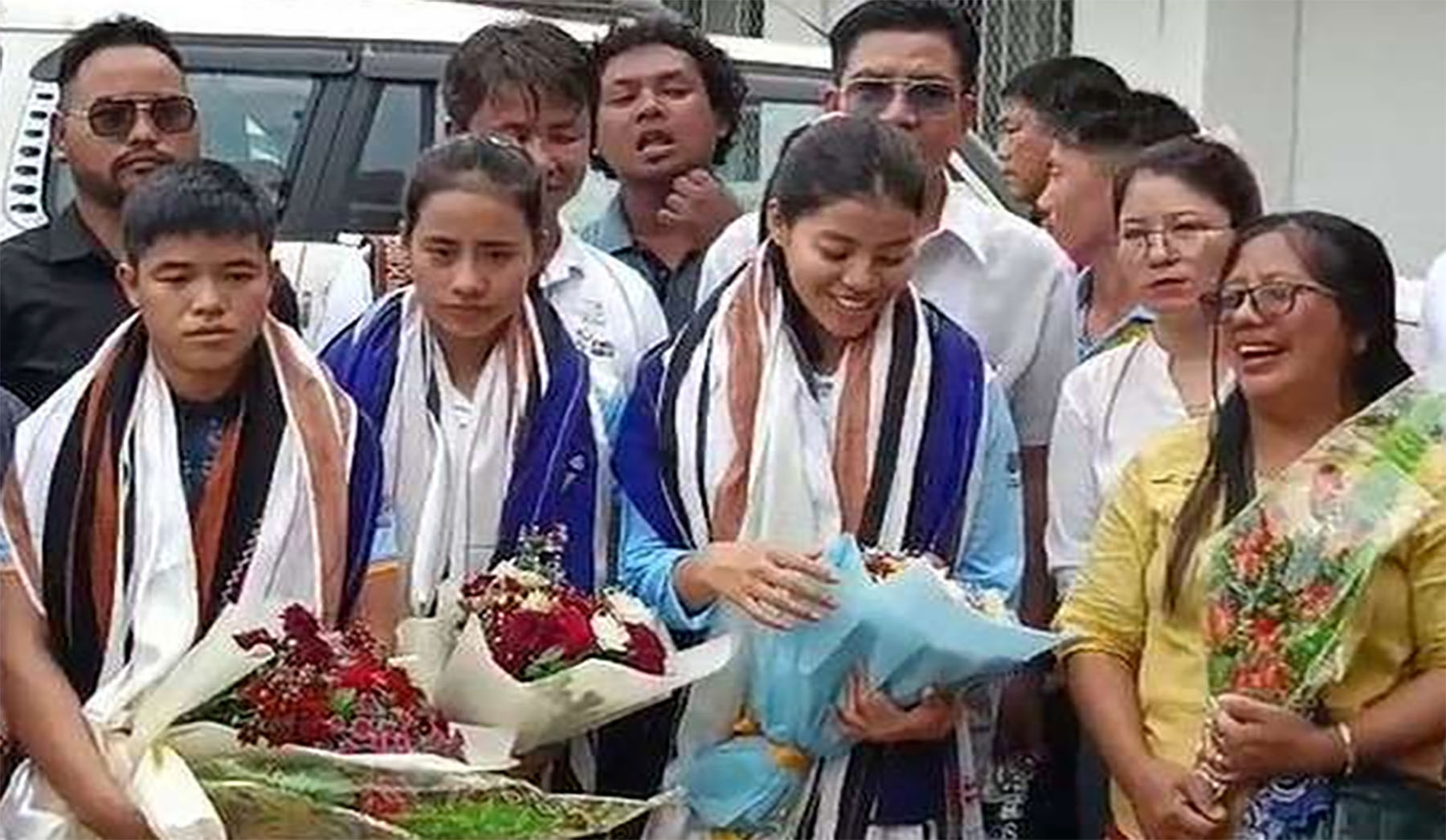
NAHARLAGUN, Sept 26: The three Wushu players from Arunachal Pradesh, who have not been able to travel to Hangzhou, China for the 19th Asian Games after being denied visa by Chinese authorities, returned to their home state on Tuesday.
The three female Wushu players — Nyeman Wangsu, Onilu Tega and Mepung Lamgu — from Arunachal Pradesh were scheduled to fly out to China on Wednesday night from IGI Airport, but could not take the flight as two of them were given stapled visas by the Chinese authorities after first being denied accreditation by the Hangzhou Asian Games Organising Committee (HAGOC).
The Indian Govt has refused to take the stapled visa and the two players could not take the flight. One player, who was given the accreditation, was told at the airport that her visa was only to Hong Kong and therefore she too did not board the flight. The trio was given warm welcome on their arrival at Naharlagun Railway station here.
Lamgu said, “What can we do about it Even Union Minister (Anurag Thakur) boycotted his trip (to Asian Games) this is a big thing. We will do our best next time…” while Wangsu said, “Our game has started there (China), we feel hurt when we see that, we didn’t get to play there…but we won’t back down, we will keep going forward and try to give our best in the future.” Tega said, “We’re all sad, our coach is especially sad because it was his biggest dream to see us participate in Asian Games…we will work harder and will participate in the upcoming game…”.
Meanwhile, Union Sports Minister Anurag Thakur while addressing the issue said, “As per the Olympic charter, the players should have been granted visas. China should have granted the visas. Arunachal Pradesh is and will remain an integral part of India. India will not bow down….”
Agency adds from New Delhi: The stapled visa issued to Indian nationals from Arunachal Pradesh once again cropped up casting a shadow over strained India-China relations.
Three wushu players from Arunachal Pradesh, who were part of India’s Asian Games contingent, were issued stapled visas, which is not acceptable to India.
Chinese inference is that if the Chinese visa is embossed on an Indian passport, held by Indian citizens from Arunachal Pradesh, it may be tantamount to recognising Indian sovereignty over Arunachal Pradesh, says Rup Narayan Das.
In July, these three players could not travel to Cheng in China to participate in the World University Games.
India has strongly responded to the discriminatory visa given to Indian citizens from Arunachal Pradesh contending that the Chinese authorities have, in a targeted and premeditated manner, discriminated against Indian sportspersons from Arunachal Pradesh by denying them accreditation and entry to the Asian Games currently being held in Hangzhou, China.
The practice of issuing stapled visas instead of a proper visa by the Chinese embassy in New Delhi to Indian citizens from Arunachal Pradesh and earlier in respect of Indian citizens from Jammu and Kashmir has been a contentious issue in India-China relations.
In 2010, Lieutenant General B S Jaswal, then the Northern Army commander, was issued a stapled visa by the Chinese embassy in New Delhi, on the ground that he commanded a disputed territory (Jammu and Kashmir), to visit China to participate in a defence exchange program, it created disquiet in India.
Subsequently, the issue was discussed during then Chinese Premier Wen Jiabao’s visit to India in December 2010.
New Delhi witnessed a welcome change of attitude when the Chinese embassy issued proper visas to journalists from Jammu and Kashmir, accompanying then Prime Minister Dr Manmohan Singh when he participated in the BRICS summit in Sanya, China, in April 2011. Since then, there is no instance of a stapled visa being issued to residents of Jammu and Kashmir.
The Chinese embassy in New Delhi, however, continues with the practice of issuing stapled visas to Indian citizens from Arunachal Pradesh.


 20
