
By Pradeep Kumar
ITANAGAR, Oct 02: A pilot training academy (PTA) will be set up near Donyi-Polo Airport at Hollongi, 30-km from Arunachal Pradesh capital Itanagar, Chief Minister Pema Khandu said, adding the Airports Authority of India (AAI) has given the land on lease to New Zealand Aviation Academy for the purpose.
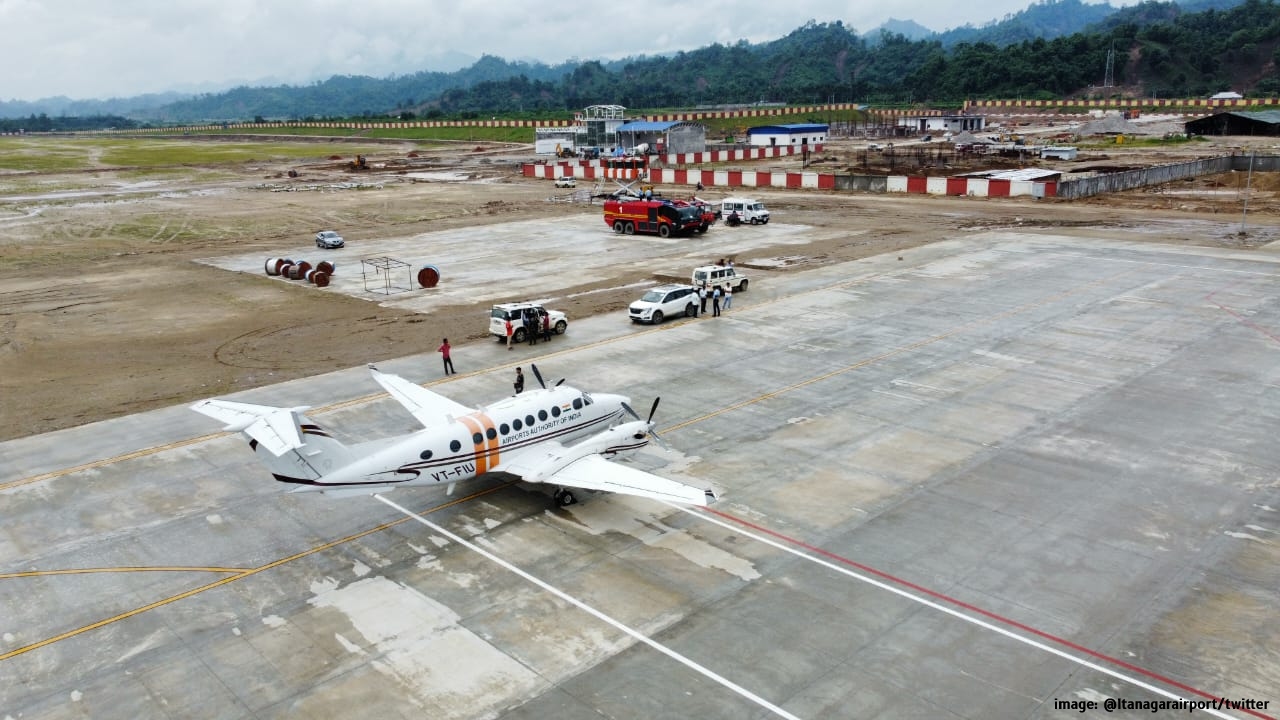
“Great news for aspiring pilots! New Zealand Aviation Academy shall be setting up a pilot training academy at Hollongi, Arunachal Pradesh. @AAI_Official has provided the land on lease for the academy. Our youngsters won’t have to go out for training. Congratulations,” Khandu posted on X, earlier Twitter, sharing a photo of Donyi Polo Airport at Holongi.
Donyi Polo Airport, also known as Hollongi Airport, was built by the AAI over an area of 320 hectares. The foundation stone of this 16th airport of Northeast India was laid by Prime Minister Narendra Modi on 09.02.19. Its construction had started on 15.12.20 and inaugurated on 19.11.22 with IndiGo starting flight services to Kolkata and Mumbai from 28.11.22.
The airport has a single 2,300 metre runway oriented east–west in the first phase, to serve narrow-body aircraft and can be extended to 2,800 metres to land wide-body aircraft. The airport apron measures 160 metres by 115 metres linked to the runway by two taxiways. It has night landing facilities and navigation facilities, like DVOR and instrument landing system.
This state with tough hilly terrain and unpredictable weather has so far recorded highest crashes of helicopters and aircrafts, including of Indian Air Force and civil. A pilot training academy is necessary as its students during training would face the challenges of tough hilly terrain and unpredictable weather to become pilots capable of flying in such harsh conditions. The PTA would not only add a new feather to the state’s cap but, would also check high number of air crashes, causing huge losses including lives. The following records are glittering proofs.
Chopper service is essential in this hilly landlocked state for carrying essentials, men and machines and patients. It was famous federal pilot Biju Pattanaik’s Kalinga Airlines that had maintained the lifeline of the NEFA from 1956-57 by flying from DST Rowriah (Jorhat) to drop rations throughout the NEFA and at times landing at Anini and Ziro.
Though the invaluable service of the crew members, at times at life’s risk, is highly praiseworthy, choppers are proving to be the proverbial ‘flying coffins’ in this Himalayan state, particularly in the Tawang sector, with numerous air pockets and treacherous terrain dotted with high hills and very unpredictable weather conditions.
The ‘air-maintenance’ sortie from Tawang, located about 9,000 feet above the ground, is helicopter-aided support for forward army posts on the China frontier, at altitudes of 8,000 ft to 14,000 ft where winds are high and oxygen density almost 30% lower, and where supplies are either para-dropped or the helicopters make touch-and-go landings. The IAF service is essential for national security.
From ‘Yamdoot’ to ‘flying coffins’: The Vayudoot operating in the state (Along, Daporijo, Pasighat, Tezu, Ziro and also Lilabari) during the 80’s had earned an obnoxious name, ‘Yamdoot’, after the door of one of the aircrafts (a Dornier aircraft)collapsed after it took off from Ziro airfield. In a bizarre turnaround, a Pawan Hans chopper’s door went ajar midair over Namsai while it was on a routine passenger sortie, resulting in the fall to death of flight attendant Dhananjoy Roy on August 6, 2010.
Crash history:
Nov 19, 2011: AIF’s MI-17, a multi-utility helicopter, blasted into flames midair 5 minutes after take-off from Tawang helipad, killing 12 defence personnel, including 3 pilots.
Aug 6, 2010: Pawan Hans helicopter (24-seater MI-172) cabin crew Dhananjoy Roy fell to his death while trying to shut the unfastened chopper door that had flung open midair when on its way from Namsai to Tezu.
June 9, 2009: Russian-made AN-32 aircraft while returning from Mechuka after an Army ration sortie crashed over Tato, killing all 13 defence personnel on board.
May 8, 2001: A Pawan Hans chopper piloted by DGM Capt VK Dhir and carrying state Education Minister DeraNatung, education secretary SangeLhaden, union HRD ministry’s Dy secretary SK Jain and two others crashed into a high hill near Sessa in West Kameng district due to poor visibility, killing all on board.
Feb 26, 2001: IAF’s MI-8 chopper while returning from Tali after a ration sortie crashed near Ziro, killing all 6 crew members including two pilots.
Nov 14, 1997: Union MoS for defence NVN Somu and three top officials, including Maj Gen Ramesh Nagpal died when their four-seater Cheetah hit a 1300 ft peak 40 km from Tawang.
In 1989: An Antonov AN-32 on a ration sortie from Rowriah had reportedly crashed into China side without any trace of the crew members at its wreckage. The defence ministry had ordered a court of inquiry. (The detailed story was filed by me in The Arunachal Times quoting then DST director A Majumdar).
After the 19.11.11 crash, then Lok Sabha member Takam Sanjoy had blamed the defence ministry for not giving due importance to this Himalayan state despite its strategic location. He had demanded an IAF training centre considering the number of air crashes, particularly in Arunachal, saying after the humiliating defeat in the 1962 Chinese aggression it is time to learn the lesson.
The Tawang–Guwahati daily subsidized helicopter service, a part of PM’s massive package, was announced for Arunachal on 30.01.08.
In a memorandum to then Civil Aviation Minister Vayalar Ravi, Sanjoy had raised the issue of ‘pilots not being acquainted with the topography and terrain and operating the choppers without having regular flying license” to justify his demand for an IAF training centre.
On 03.06.19, Arunachal Pradesh recorded the latest IAF AN-32 aircraft crash killing all eight crew members and five passengers on board, because the aircraft had entered the wrong valley due to navigational error in bad weather and the pilots were unable to come out of it safely.
The Lok Sabha Standing Committee on Defence, in its report submitted to the Speaker on 03.06.19, had stated that when it wanted to know about the court of inquiry during the examination of demands for grants of Air Force, it was informed that the findings of the court of inquiry was completed and the reasons for the accident are “aircraft entered in the wrong valley due to navigational error in bad weather” and “the crew were unable to fly the aircraft safely out of the blind valley due to poor visibility and clouding.”
The committee in its report stated that “Obsolescence is also a critical issue concerning safety of pilots and aircraft”.
IAF had procured AN-32s built in Ukraine from the former USSR in 1980s. India and Ukraine have contract for upgrading the IAF’s AN-32 before the end of their service life, which is 25 years. The ill-fated aircraft was not among the upgraded AN-32s.


 20

