
Beyond the Horizon
By Pradeep Kumar
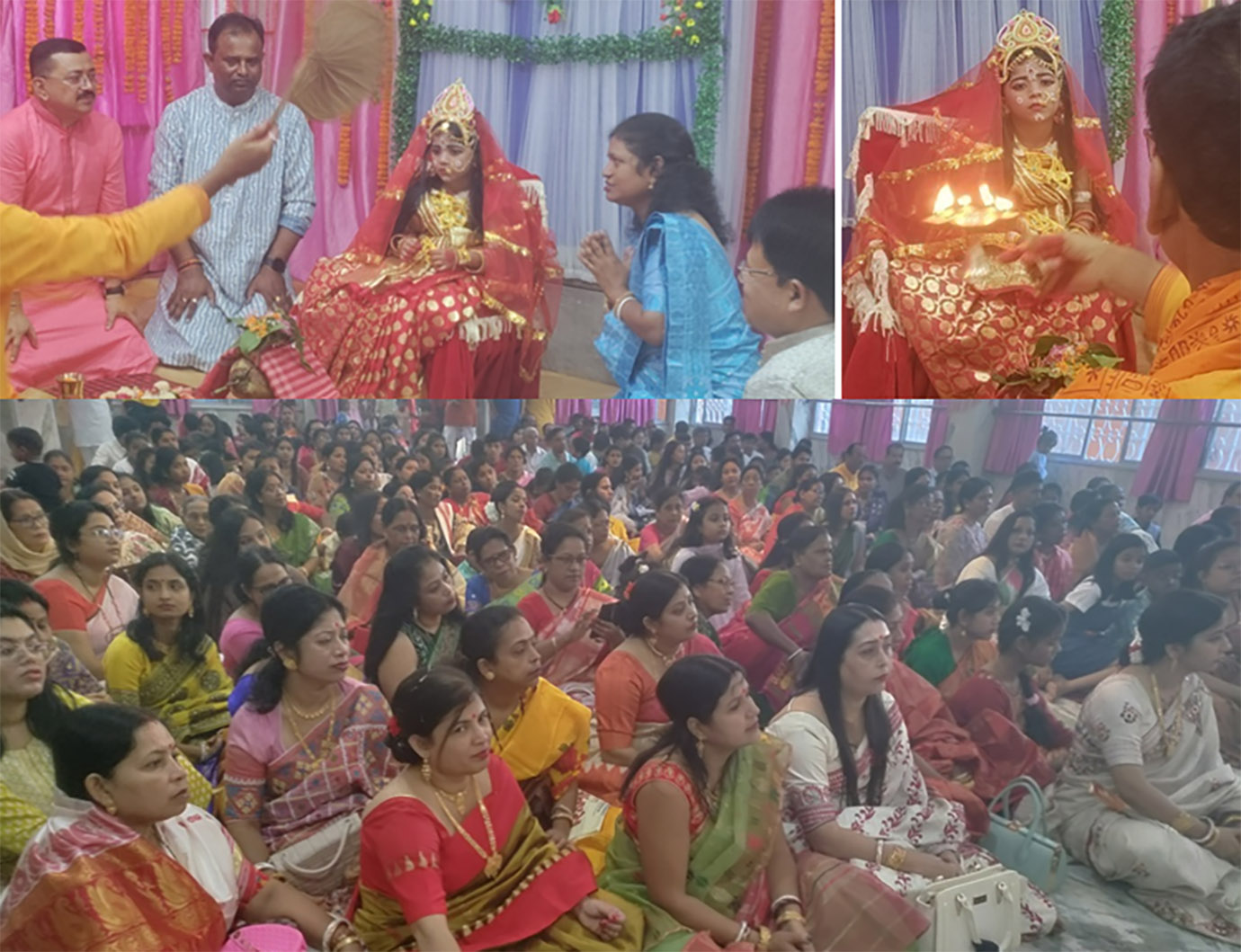
Though people irrespective of castes, creeds and religions thronged all Puja pandals to pay obscene to Devi Durga, but Naharlagun Kali Bari pandal made a difference by conducting Kumari Puja, an annual event in Itanagar Ramakriaha Mission and Naharlagun Community Hall pandals.
Five-year-old Drishti Goswami, daughter of Pradip Goswami and Monica Goswami, flanked by Kali Bari pandal committee president Pradip Dutta, Tapan Sakalabaidya, Sitesh Das and Baby Chakraborty, was worshipped as per religious customs by pandit Ratan Bahaduri by chanting hymns;
Yaa Devi Sarva-Bhutessu Vishnumaayeti Shabditaa,
Namas-Tasyai Namas-Tasyai Namas-Tasyai Namo Namah.
(To that Devi who in all beings is called Vishnumaya, salutations to her, salutations to her, salutations to her, salutations again and again)
Thunderous ululation (hula huli) sound of hundreds of woman devotees rented the air.
Those present sought blessings considering her as living embodiment of Devi Durga. “It was an excellent felling,” quipped the intelligent tiny tot, when asked.
Kumārī Pūjā is performed, especially on Ashtami (8th) and Navami (9th) day of navarati festival. The ceremony primarily involves worship of nine girls, representing the nine forms of Goddess Durga (Navadurga). As per Hindu philosophy, these girls are considered as the manifestation of the natural force of creation. Legend says that it was on the 9th day of Navaratri that Shakti had taken the form of Goddess Durga, on request of all gods to kill the demon Mahisasura.
As per custom, the feet of these girls are washed as a mark of respect, made to wear new clothes and worshiped to recognise feminine power as feminine gender is universally considered as creative forces.
Nine forms of Devi Durga worshipped during Navratri are: Shailputri (pratipada); Brahmacharini (dwitiya); Chandarghanta (tritiya); Kushmanda (chaturthi); Skand Mata (panchami); Katyayani (shashthi).
As per custom, all devotes offered flowers to pay obeisance to Devi Durga as the hymns rented the air.
Om Sarva Mangala Mangalye Shive Sarvartha Sadhike,
Sharanye Tryambake Gauri Narayani Namostu Te.
(O consort of Shiva, fulfiller of all our goals! Our only refuge! O three-eyed Gauri! O Narayani! Our salutations to you)
Srishti Sthiti Vinashanam, Shaktibhute, Sanatani,
Gunashraye, Gunamaye, Narayani, Namostu Te.
(The power beyond all creation, preservation and destruction! O eternal one! O ground of Gunas and embodiment of Gunas! O Narayani! Our salutations to you)
Sharanagata Dinarta Paritrana Parayane,
Sarvasyartihare Devi! Narayani! Namostu Te.
(Ever devoted to the salvation of the lowly and suffering who seek shelter with you! O destroyer of all misery! O Divine Mother! O Narayani! Our salutations to you)
The tradition of Shakti worship is integral to Sanatan Dharma. Durga being universal mother is unifying factor of nature and existence of life. She is portrayed with various feminine emotions as a Kumari kanya, a consort, a mother, a warrior princess, a regal queen, a high priestess and a yogini.
Devi Durga was also worshipped in Ramakrishna Temple and Kali Bari of New York, the most populous city in the United States and considered world’s most important city and capital of the world. One Saurav Bhattacharjee with his wife Suchita Bhattacharjee of West Bengal’s Jalpaiguri, a relative of Dibyendu Bhattacharjee, were seen taking part in the festival on Ashtami.
It is believed that Durga Puja originates in India in the aftermath of Battle of Plassey in 1757, but spread to countries across the world, including Canada, Australia, Singapore, United Kingdom, The United States, Germany, France, the United Arab Emirates, Bangladesh, Nepal, Sri Lanka, Finland, Colombia, Nigeria, Ireland and Malaysia with much enthusiasm and religious fervor by erecting pandals in temples and community centers.


 20

