
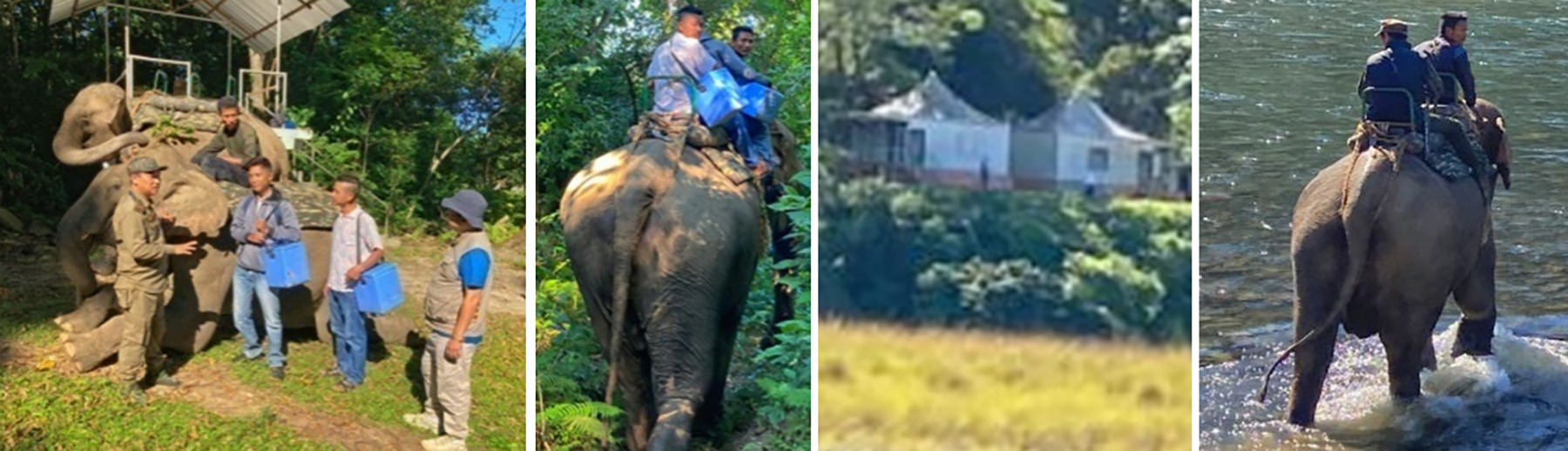
Lakhi carrying lifesaving vaccines & vaccinators to Deban AB-HWC; her attendant Sumit Gogoi and mahout Ganesh Tamang returning after delivering vaccines
- Stepping up immunization for a healthier tomorrow
NAHARLAGUN, Dec 22: Lakhi, 36, mother of two healthy elephants, gets up to carry lifesaving vaccines and vaccinators to protect lives of children living across Noa-Dihing River in hard-to-reach hamlets in Changlang district of Arunachal Pradesh despite undercurrents of the river turning treacherous.
Delivering vaccines on elephants, rowboats and drones is part of alternative vaccine delivery microplanning for routine immunization in the district bordering Myanmar. Her support for routine immunization in the district is possible with collaboration between Health Department of Miao sub-division and Environment and Forest Department, Namdapha National Park and Tiger Reserve (NNPTR) of the district, which is her home.
Lakhi sits patiently with her nephew Samraj, 13, who goes on forest patrolling as NNPTR forest officer Tage Mali (1st from left) and Miao sub-division medical officer in-charge Dr Jongsam Handsome (1st from right) brief vaccinators in first picture before Lakih crosses the river to Ayushman Bharat Health & Wellness Centre (AB-HWC), Deban, 2-km away, H&FW department sources told this daily.
“Communities live in isolated and remote areas there, wildlife department helps medical teams in every possible when they arrive to supply medicines in far-flung villages. We provide resources, manpower and logistics support, like boats and elephants, manpower and logistics to help medical teams to carry supplies to remote villages,” Mali said, adding “we have eight elephants to carry food rations, medicines and personnel to areas cut-off during floods besides conduct routine patrolling and carry rations & personnel to remote anti-poaching camps.”
‘Vaccines should reach beneficiaries safely for schedule immunization to save lives. District’s tough terrain poses challenges for which we have to ensure that all vaccines reach destinations on time from cold-chain point in Miao. Elephants are useful for routine immunization and health outreach drives to remote areas during monsoon months (June to September) when the river overflows and the roads get waterlogged,” Dr Handsome said.
The elephant travel amid tall high elephant grass to drop the vaccinators across the river from where the vaccinators walk over bamboo bridges, elephant grass and woodland carrying vaccine carrier bags weighing 5-kg to reach Buddisatta village, home to 93 of 20 families besides to AB-HWC, Deban.
“The AB-HWC was set up 10 years ago that changed life of our community. With electricity, tap water in every home and a new BSNL tower increasing IT connectivity, our troubles are 95% solved. The vaccines and education, upcoming building for Deban middle school for local children and neighbouring Nandankanan, Punyabhumi and Anandapur-II villages for a healthy and prosperous future,” said Lama village GB Kingong Wangi.
The vaccinators were accompanied with WHO National Public Health Support Network (NPSN) team offering technical and monitoring support for routine immunization and vaccine-preventable diseases to the GoAP with special focus on strengthening services in hard-to-reach areas.
Deban AB-HWC serves 929 households with a population of 4936. “We have three ASHAs for 10 villages. ASHA workers go house-to-house before an immunization session to urge mothers to get their children immunized at Deban AB-HWC on scheduled day to ensure that no child is left out,” said ASHA Bobita Chakma. “The closest CHC is three hours away in Wakru, so when ASHA didi tells me about immunization session, I make time to bring my daughter Purani for immunization,” said Ruby Chakma.
“The health department has procured an ambulance to bring pregnant women to the CHC and district hospital for institutional delivery and the sick for treatment. We may soon hire a driver for the ambulance by 2023 end,” said Dr Handsome.
“There are 13 enlisted children for vaccination today, but more have come because mothers of children who have missed during scheduled vaccines at neighbouring AB-HWCs have also brought their children here. Vaccine hesitancy is very low in this region, if parents fail to come, it’s because they cannot leave the field or have other young children to care for, While women usually accompany newborns and babies, children over 2 years often come with their fathers on bikes,” said ANM Rokon Ronrang.
Under GoI’s Universal Immunization Programme, Close to 2.67 crore children and 2.9 crore pregnant women are immunized free of cost against 12 vaccine-preventable disease annually in the country, including Arunachal Pradesh.
Vaccines are provided against nine diseases, like diphtheria, pertussis, tetanus, polio, measles, rubella, severe form of childhood tuberculosis, hepatitis B, meningitis and pneumonia (caused by hemophilus influenza type B). Vaccination against rotavirus diarrhea and pneumococcal pneumonia are provided in some states and are currently in the process of being scaled up to cover the entire country, while Japanese Encephalitis vaccine is provided to children in endemic districts at national level. (Pictures-Sanchita Sharma/WHO India)


 20
