
Beyond the Horizon
By Pradeep Kumar
Yaa Kundendu tushaara haaradhavalaa,
Yaa shubhravastraavritha
Yaa veenavara dandamanditakara,
aa shwetha padmaasana
Yaa brahmaachyutha shankara
prabhritibhir Devaisadaa Vanditha
Saa Maam Paatu Saraswatee
Bhagavatee Nihshesha jaadyaapahaa
(May the Goddess Saraswati protect me. She is fair like the jasmine-colored moon, and whose pure white garland is like frosty dew drops. She is adorned in radiant white attire, on whose beautiful armrests the veena, and whose throne is a white lotus. She is surrounded and respected by the Gods. Please remove my weariness, sluggishness, and ignorance).
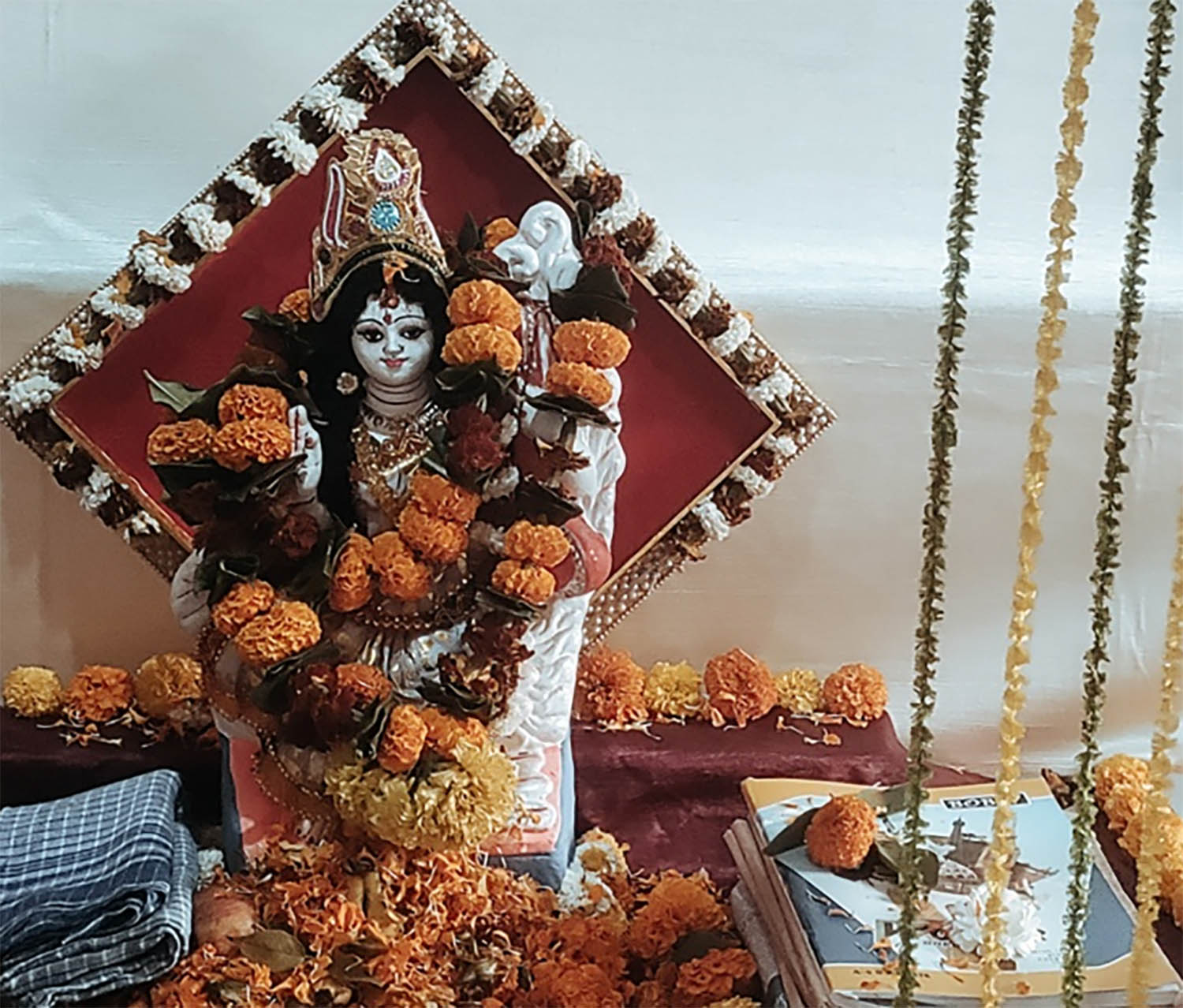
Devi Saraswati prayers rented in all educational institutions across the world on Wednesday. Today being Vasant Panchami, 5th day of spring, all devotees and students were propitiating her on Saraswati Puja to seek her blessings to earn knowledge. The male and female members of Rashtriya Swayamsevak Sangh also worshipped her in their Balsore, Bhadrak and Jajpur zone headquarters at Balasore to justify the adage: “Knowledge is power, means the more you know, the better off you will be”.
Saraswati, one of the Tridevis with goddesses Lakshmi and Parvati, is Hindu goddess of knowledge, music, flowing water, abundance and wealth, art, speech, wisdom, and learning. She is a pan-Indian deity and revered in Jainism and Buddhism.
The earliest known mention of Saraswati as a goddess is in. She has remained significant as a goddess from Vedic period as mentioned in Ridveda through the modern times. She is generally depicted with four arms holding four symbols: a book, a rosary, a water pot and a veena.
In Buddhism, she is venerated in many forms, including East Asian Benzaiten (Eloquence Talent Deity).
Saraswati, is a Sanskrit fusion word of saras meaning “pooling water”, but also “speech”; and vati meaning “she who possesses”. Originally associated with Saraswati River, this combination means “she who has ponds, lakes, and pooling water” or “she who possesses speech”. Rigveda describes Saraswati as the best of mothers, of rivers, of goddesses.
Her importance grew in later Vedas composed after the Rigveda and in later Brahmana texts and the word meaning evolved from “waters that purify” to “that which purifies” to “vach (speech) that purifies” to “knowledge that purifies”, and ultimately into a spiritual concept of a goddess that embodies knowledge, arts, music, melody, muse, language, rhetoric, eloquence, creative work and anything whose flow purifies the essence and self of a person.
Saraswati is known by many names, including Brahmani (power of Brahma), Brahmi (goddess of sciences), Bharadi (goddess of history), Vani and Vachi (both referring to the flow of music/song, melodious speech, eloquent speaking respectively), Varnesvari (goddess of letters), Kavijihvagravasini (one who dwells on the tongue of poets). Other names are Ambika, Bharati, Chandrika, Devi, Gomati, Hamsasana, Saudamini, Shvetambara, Subhadra, Vaishnavi, Vasudha, Vidya, Vidyarupa, and Vindhyavasini. In Triuvalluva Maalai, a collection of 55 Tamil verses praising Kural literature and its author Valluvar, she is referred to as Nāmagal.
Outside Nepal and India, she is known in Burmese as Thurathadi or Tipitaka Medaw, in Chinese as Biàncáitiān, in Japanese as Benzaiten and in Thai as Suratsawadi or Saratsawadi.
Saraswati first appeared in Rigveda, the most ancient source of Vedic religion and associated with the waters (Apas) and storm gods (Maruts) and forms a triad with sacrificial goddesses IIa and Bharati representing abundance and might, according to Catherine Ludvikdic. She was associated with the Milky Way indicating that she was seen as descending from heaven to earth, according to Witzel. Her association with the combative storm gods called Maruts is related to her fierce fighting aspect.
Saraswati also governs dhi (Rigveda), the inspired thought especially that of rishis, intuition or intelligence associated with poetry and religion. Since speech requires inspired thought, she is also inextricably linked with speech and with the goddess of speech, Vac, as well as with cows and motherhood. Saraswati is seen as a deity that can grant dhī (Rigveda) if prayed to. In Brahmans, Saraswati-Vac’s role expands, becoming clearly identified with knowledge, thus is “the mother of the Vedas”.
In other Rigvedic passages, Saraswati is praised as a mighty and unconquerable protector deity while Shatapatha Brahmana states that “as all waters meet in the ocean…so all sciences (vidya) unite (ekayanam) in Vāc”.


 20

