
Beyond the Horizon
By Pradeep Kumar
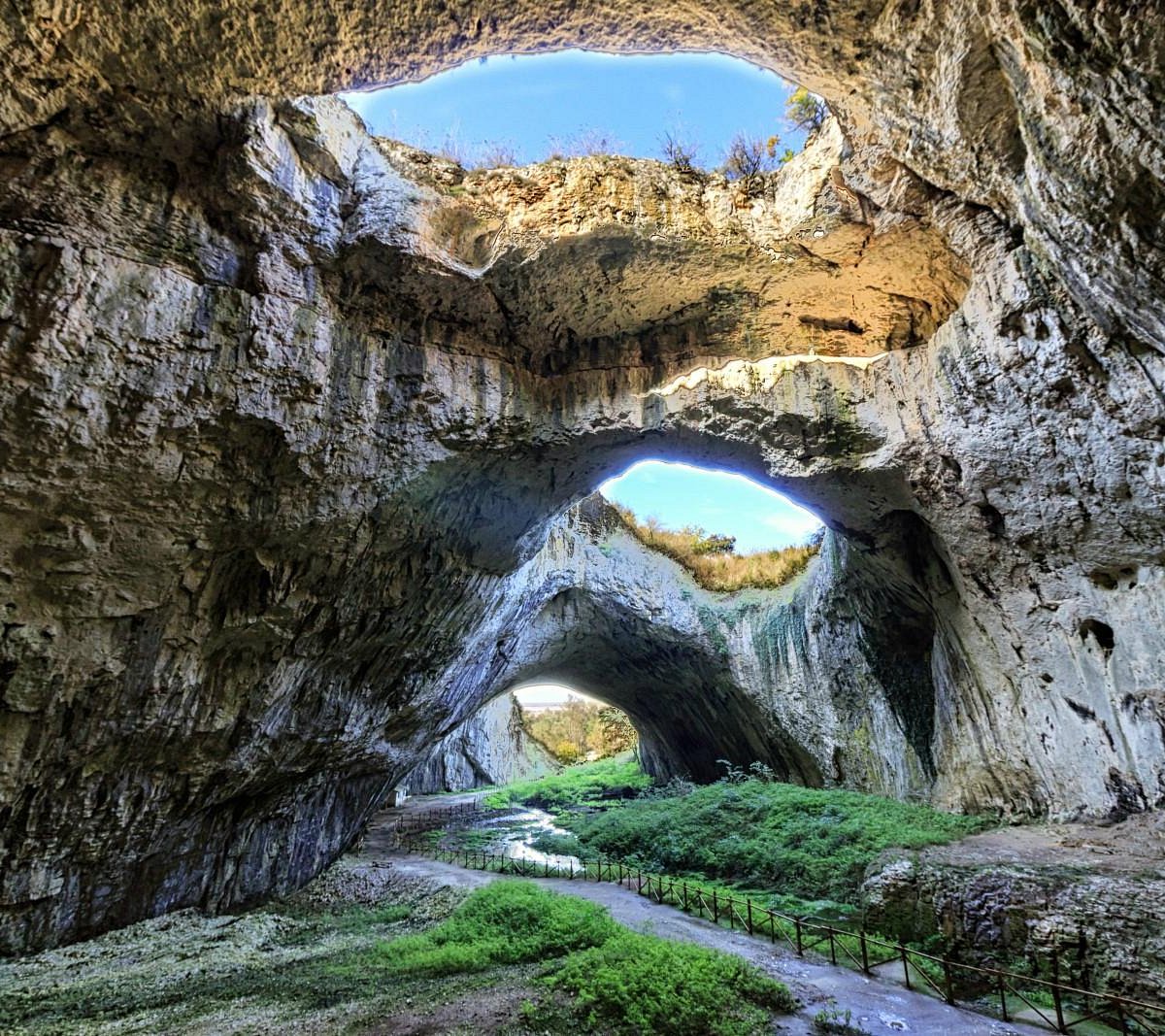
Devetàshka cave is a large karst cave around 7-km east of Letnitsa and 15-km northeast of Lovech, near Devetaki village on the east bank of Osam River in Bulgaria. The site has been continuously occupied by Paleo humans for tens of thousands of years, served as a shelter for a variety of animal species during extensive periods and is now home to nearly 30,000 bats.
A narrow path by the river leads from the village to the cave. It can also be accessed directly along a 1,300-ft long dirt road (No 301) and a concrete bridge, now part of a public park, including a waterfall. The 2-km long karst cave formed from dissolution of soluble rocks, characterized by sinkholes and an underground river. It is rich in speleothems, stalagmites, stalacites, countless rivulets and majestic natural domes.
The site is 115-ft wide and 98-ft tall at the entrance. The cave widens after around 130-ft forming a spacious hall with an area of 26,000 sqft), a height of 200-ft that can reach up to 330-ft. Several large openings in the ceiling allow daylight to lighten the vast interior, due to commercial use of the site during the 1950s.
Rediscovered in 1921, excavations began only in the 1950s and revealed almost continuous human occupation since the late Paleolithic era. Earliest traces of human presence date back to Middle Paleolithic around 70,000 years ago. The site also contained one of the richest sources of Neolithic cultural artifacts (6,000 to 4,000 BC).
Besides significant archaeological findings, Devetashka cave provides a habitat for a wide diversity of animal residents. During the breeding season of mammalian species in the cave from early June to the end of July, the site is entirely closed to visitors.
Twelve species of protected amphibians and reptiles, including the Aesculapian snake (Zamenis longissimus), the Triturus (Triturus cristatus), the European tree frog (Hyla arborea), Hermann’s tortoise (Testudo hermanni), 82 bird species can be found in the area, 13 of which are included in the Red List of International Union for Conservation of Nature (IUCN) , 34 species of mammals, four of which are included in the the Red List and 15 species of bats are also found in Devetashka cave.
Presence of Triturus during breeding season proves the uniqueness of Devetashka cave
Triturus, a genus of newts comprising the crested and the marbled newts, which are found from Great Britain through most of continental Europe to westernmost Siberia, Anatolia, and Caspian Sea region. Their English names refer to their appearance: marbled newts have a green–black colour pattern, while the males of crested newts, which are dark brown with a yellow or orange underside, develop a conspicuous jagged seam on their back and tail during their breeding phase.
Crested and marbled newts live and breed in vegetation-rich ponds or similar aquatic habitats for two to six months and usually spend the rest of the year in shady, protection-rich land habitats close to their breeding sites. Males court females with a ritualised display, ending in the deposition of a spermatophore that is picked up by the female. After fertilisation, a female lays 200–400 eggs, folding them individually into leaves of water plants. Larvae develop over two to four months before metamorphosing into land-dwelling juveniles.
Historically, most European newts were included in the genus, but taxonomists have split off the alpine newts (Ichthyosaura), the small-bodied newts (Lissotriton) and the banded newts (Ommatotriton) as separate genera. The closest relatives of Triturus are Europen brook newts (Calotriton). Two species of marbled newts and seven species of crested newts are accepted, of which Anatolian crested newts was only described in 2016. Their ranges are largely contiguous but where they do overlap, hybridization may take place.
Devetashka cave was shown in the action movie The Expendables 2, filmed in 2011. The Supreme Administrative Court of Bulgaria had declared that several activities during filming violated Bulgaria’s environmental regulations. A contractor hired by The Expendables 2 crew was subsequently fined for trimming the shrubbery in front of the site. After a fatal accident during the filming of a stunt, the production team again clashed with the authorities over damages to the cave. Loud noises, bright lights, crowds of people and fires in close proximity to the cave might have caused the displacement of large numbers of bats from the cave. However, by late 2012, the majority of the bats had returned to the cave.


 20

