By A O News Service
VYASA VIHAR, Mar 16: “Media is an actor but not a conduit between the state and the society. Though the media is committed to democracy but ‘Why journalists should like democracy which is strict?’ wondered New Delhi’s central Jamia Millia University journalism and mass communication (J&MC) head Prof Biswajit Das here, about five-km from Balasore, on Saturday.
He was speaking virtually on ‘Media and governance’, during technical session of concluding day of two-day International Media Conclave (IMC), organized by J&MC department of Fakir Mohan University (FMU) here, with subtheme ‘Navigating the nexus: Media, Politics & Democracy; and chaired by Banaras Hindu University J&MC Prof Sisir Basu.
Referring to the disastrous outcome of Mandal Commission Report in 1979, Prof Das said that the media has moved far away from the colonial era to carve its own image for which leaders now have their own team for publicity. There is total collapse of public and private institutions evoking public anger.
“We have not ventured into making media an institution as there is no public debate on “Media vs Democracy’ with limited self regulation and university is a right institution for such debates,” he said as one of the six resource persons.
Referring to a question about fragmentization of readers from editor of a Bengali daily and J&MC head of a Bangladesh University Dr Md Golam Rahman, he cited example of India’s first ham radio set up at Gurgaon in 1935 and said that the commoditization led to reconstruction and introspection from interpretation in national interest with ‘Nation first’ spirit.
“The collapse of public system due to privatization changed the meaning of Nehruvian concept of unity in diversity. But it is time to celebrate mechanism of diversity as “More diversity contributes to a healthy democracy,” Prof Das added.
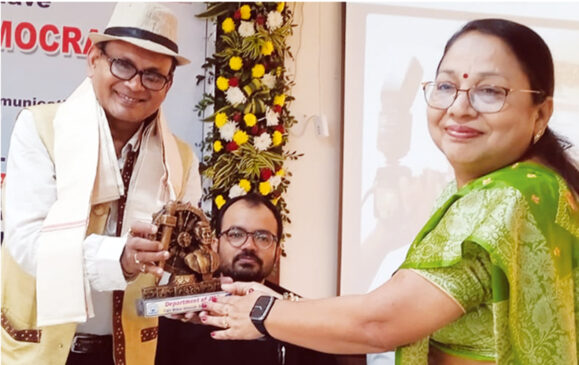
Editor of this daily Pradeep Kumar, who was welcomed by J&MC HoD-cum-IMC convenor Dr Bharati Bala Patanaik, in his paper (page-8), said. “‘Media, Politics and Democracy’ is a dynamic and complex landscape that plays a pivotal role in shaping socio-political fabric of India and my introspection is: if money culture is glittering, media is mein diya (increasing tendency of modern mass media in politics to blur and confuse boundaries between journalism, entertainment, public relations and advertising), Indian politicians have changed definition of democracy to “off the people, buy the people, far the people”, by evolving a new democracy, called ‘Dancecracy’, as the ruled dance as the rulers wish them to dance, which needs qualitative transformation to serve the masses.
Highlighting biasness of media towards the ruling Govt, Rajasthan J&MC Prof Sanjeev Bhanawat cited examples poor coverage of submission of details of electoral bonds by the SBI to the Election Commission of India as directed by the Supreme Court (SC), how former SC chief justice Ranjan Gogoi was made a Rajya Sabha member for his landmark verdict in the Ram Janmabhumi-Babri Masjid title dispute despite existing rule that no retired SC judge should hold any office of profit, lack of media’s role in New Education Policy-2020.
The god fell asleep after creating humans, but humans developed mobile phone that keeps all awake, he said taking a dig at modernity and called upon conscious citizens, particularly journalists, to redefine role of media.
Assam University J&MC department Dr Syed Murtaza Alfraid Hussain spoke about Union I&B Ministry draft put in public domain on 15.01.24 for public consultation. This evoked numerous reactions including from Editors Guild of India, Indian Broadcasting & Digital Foundation against vague and unconstitutional terms used besides “as prescribed by the Govt” used 60 times in the draft.
“The news interestingly passes through various regulations, like Content Evaluation Committee and Indian Telegraph Act, 1885, which governs use of wired and wireless telegraphy, telephones, teletype, radio communications and digital data communications,” Dr Hussain added.
Pointing out that media has never been inclusive, expert Subharnshu Chaudhury said that mobile is not democratic while social media is more social. There is hardly any Television Rating Point (TRP) installed in NE India in comparison to rest of India, he said suggested a News Commission to regulate news for the people to tell their stories to make the media logical.
PTI representative from New Delhi Thirumoy Banerjee said that politics make maximum news for which the journalists have to have their right political sources despite a challenging task. While Indian journalists consider criticism by the Govt as a honour, but China’s official Global Times editor had to face the Govt ire for publishing a news about Taiwan in June 2020, which was true but against the Govt.
A research on role of journalists was conducted in 19 countries and 57% respondents had attributed social media as good. Thus, this seminar is timely and those who matter should take note of its outcome, he added.
Summing up the session, Prof Basu lauded all resource persons for their though provoking but educating presentations and exhorted the students to read a book – Age of Surveillance – written by Shoshana Zuboff to broaden their knowledge on every aspect of media as it has reflected right from Dak Post to various emerging straps of media and 56 types of personalities who influence media and how.
The third technical session on “Media, Political & Democratic Accountability”, chaired by Dr Santosh Kumar Biswal and co-chaired by Moti Pangkam, saw presentation of many papers followed by question-answer session.
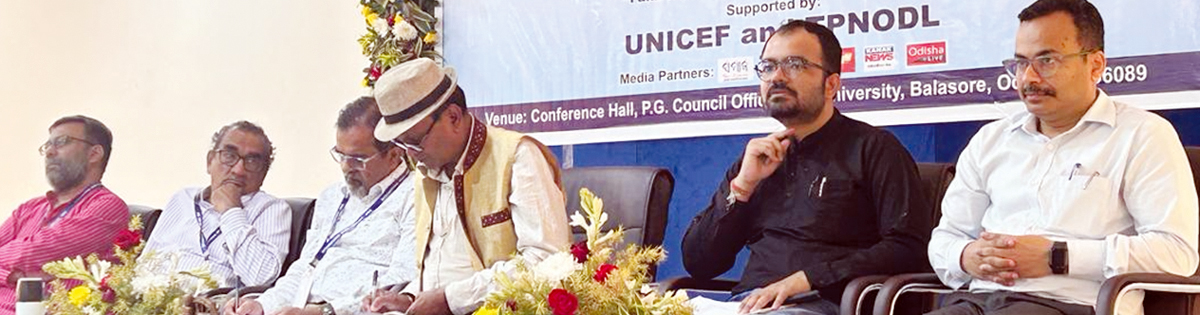
Around 100 experts, mainly journalism and mass communication (J&MC) professors or senior faculty members of various universities and students pursuing J&MC besides senior working journalists, including from Bangladesh, had threadbare discussions on the genesis and present status of ‘Media, Politics and Democracy’. The J&MC department led by Dr Patanaik besides assistant professors Moti Pangkam & Smrti Padhi and PRO Ashes Kumar Nayak were on their toes to ensure success of the IMC, supported by UNICEF and TPNODL with Samaj, Sambad, OTV, Kanak News and Odisha Live as media partners.


 20