
From Our Correspondent
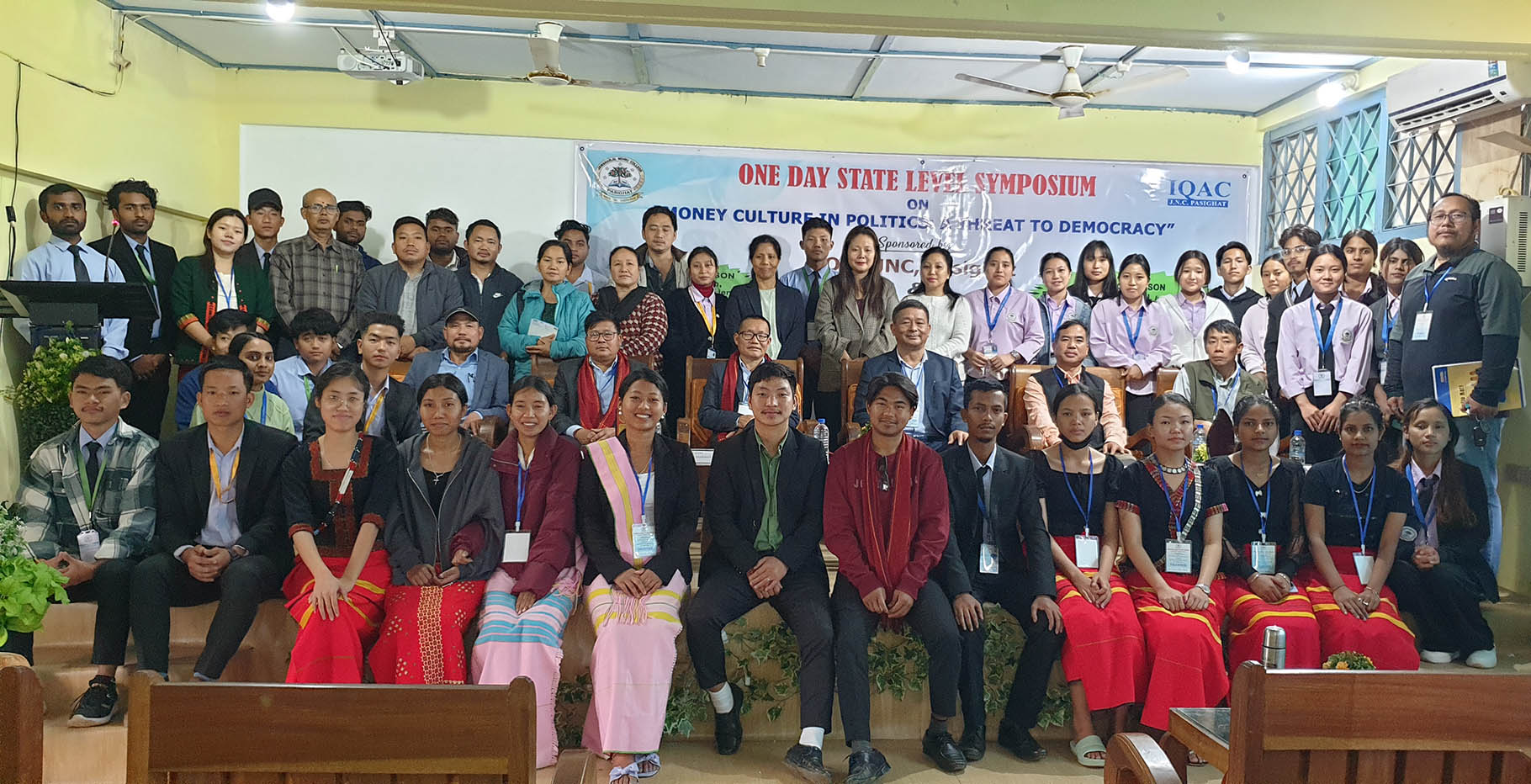
PASIGHAT, Apr 03: In view of simultaneous Assembly and Lok Sabha elections in offing, political science department of Jawaharlal Nehru college (JNC) conducted a state level symposium on current hot topic ‘Money culture in politics-a threat to Democracy’ here on Tuesday with RGU’s Prof. Nani Bath and group captain (retd) Mohonto Pangging Pao as resource persons.
The symposium was organized in two sessions, inaugural and technical.
“Everyone is part of politics today. Even if you are not interested in politics, politics is interested in you,” said East Siang DC Tayi Taggu, in his inaugural address as chief guest. The masses, particularly the voters, have to stop taking money from contesting candidates in lieu of votes to prevent money culture in politics.
Supporting DC’s view, APU registrar Narmi Darang as guest of honour and Doying Gumin College principal Dr. Egul Padung as special guest said that ‘money culture’ is a bane in politics that prohibits genuine and poor candidates from contesting in elections.
“There are several anomalies in election process, including in polling booths, which I have personally seen in Pasighat. Some political parties and their workers buy voter IDs for use by others to cast votes in favour of their candidates”, Padung claimed and added “the polling agents remain silent spectators without acting against such illegalities”.
Mohonto said that the low population of the state is the root cause of money culture in politics. “In an average, in each assembly constituency there are 5,000 to 12,000 voters in Arunachal. Buying 3,000 to 7000 voters ensures victory of a candidate and it is easier for a rich public leader to buy voters. So, lesser population of the state is also a reason behind money culture in electoral politics in comparison to other states where population per constituency is more than a lakh for which buying of votes is not possible”.
Mohonto also suggested for delimitation of assembly constituencies by reducing existing 60 to increase population in each assembly constituency which would not be easy for a leader to buy votes that would prevent money culture.
Resenting money culture in electoral politics and student politics, Prof. Bath said that he is contemplating on filing a PIL with like-minded people against provision of the Constitution in which a candidate in Arunachal Pradesh is not required to give proof of income source resulting in huge accumulation of money for which many leaders resort to corruption.
“The PIL would seek to scrap that particular provision facilitating to deal with corruption and money culture successfully,” he said, adding that ‘money culture in politics is a real threat to democracy’.
JNC HoD (political science)-cum-symposium coordinator Danggen Dameng said that topic was chosen keeping in mind prevailing money culture in politics, which has been raised often by Chief Minister Pema Khandu. He hoped that deliberation of the hot topic would create mass awareness, particularly among the voters, candidates and elected leaders.
JNC political science alumni Tapin Lute Tamin elaborating on the topic highlighted the menace of money culture that has even invaded student politics.
The symposium was also graced by East Siang Dy. Commissioner, Tayi Taggu as Chief Guest, APU registrar Narmi Darang as Guest of Honour and, Pasighat Principal, Dr. Egul Padung as Special Guest besides
JNC principal Dr. Tasi Taloh, vice principal Dr. Leki Sitang, Kamki DPGC vice principal, Dr. Gomo Karbak, V/P, HoDs and faculty members of various departments and students attended the symposium.


 20
