
By A O News Service
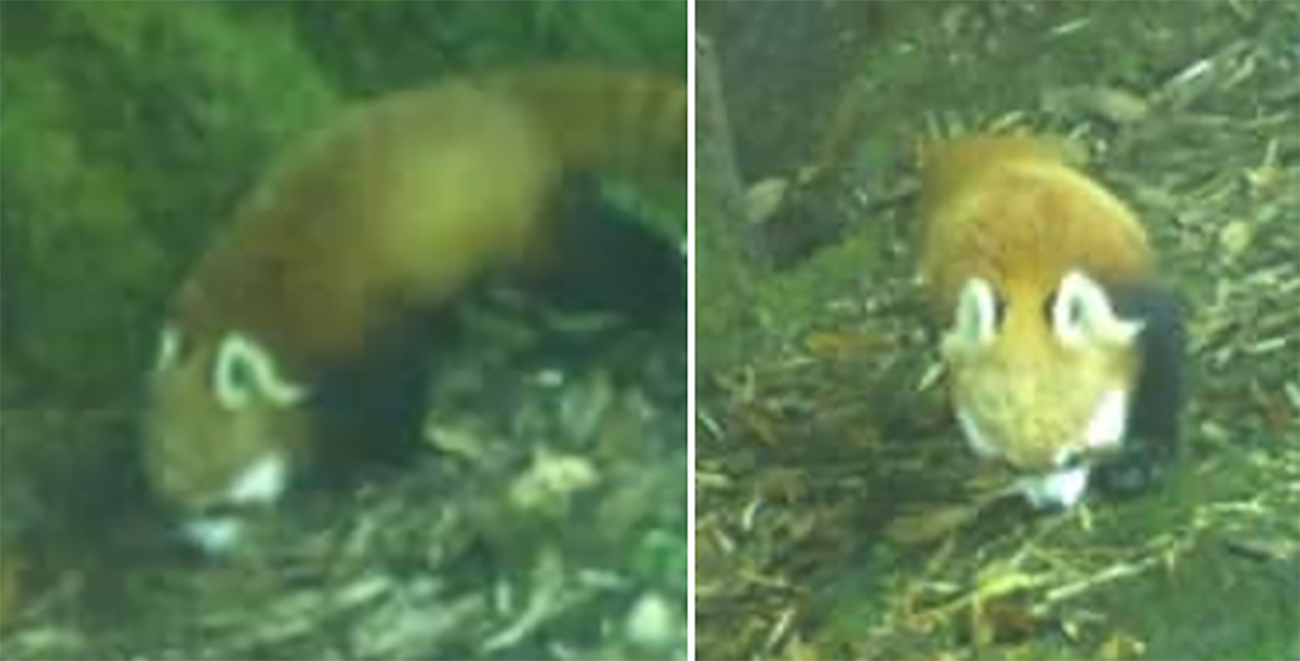
ITANAGAR, July 02: A Red Panda, which is also called as lesser Panda was sighted by a team of forest department officials at Mayudia in Lower Dibang Valley district of Arunachal gladdening panda lovers.
This is the first time that the elusive red panda has been captured on camera in the area which comes under the Mehao Wildlife Sanctuary. The sanctuary is gifted with virgin natural lush green forest and lakes. The Mehao Wildlife Sanctuary harbours some rare varieties of orchids and is spread over an area of 281.5 sqkm.
Mayodia Pass, 56-km from Lower Dibang Valley district HQs Roing, located at 2,655 M elevation, is a popular local tourist attraction due to the November to March winter snow fall which is heaviest in January and February.
In March last, a camera trap installed in Eaglenest Wildlife Sanctuary (EWS) by the Wildlife Institute of India in collaboration with the EWS in Singchung sub-division of West Kameng district had also captured a red panda.
The red panda is a small arboreal mammal found in the forest of India, Nepal, Bhutan and northern mountains of Myanmar and southern China. It is the state animal of Sikkim which hosts annual Red Panda Festival.
It has dense reddish-brown fur with a black belly and legs, white-lined ears, a mostly white muzzle and a ringed tail. Its head-to-body length is 51–63.5 cm with a 28–48.5 cm tail and weighs between 3.2 and 15 kg. It is well adapted to climbing due to its flexible joints and curved semi-retractile claws.
The red panda was formally described in 1825. Two currently recognised subspecies – the Himalayan and the Chinese red panda, though genetically diverged – were known about 250,000 years ago. The evolutionary lineage of red panda (Ailuridae) stretches back around 25 to 18 million years ago, as indicated by extinct fossil relatives found in Eurasia and North America.
Listed as Endangered in the IUCN red list of Threatened Species and under Schedule-I of the Indian Wildlife (Protection) Act, 1972, the red panda has the highest legal protection. WWF India has been working since 2005 in the eastern Himalayan region to conserve this species.
The exact number of red pandas in the wild is unknown, but it’s estimated to be less than 10,000. This is a 40% decline over the past 20 years, with a 2015 estimate putting the population at 10,000 scattered throughout south-east Asia, which is half of what it was in 1997. Red pandas are declining throughout their range as a result of deforestation, increased agriculture, hunting and pressure from growing human populations.


 20
