
Beyond the Horizon
By Pradeep Kumar
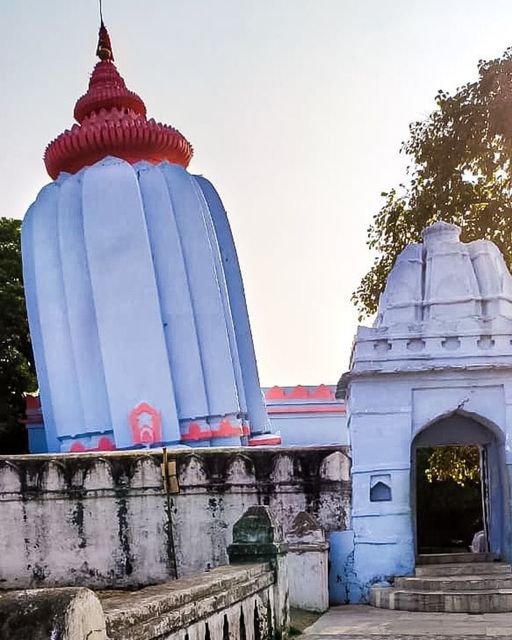
Leaning Temple of Lord Shiva, located in Huma village on the bank of Mahanadi River, 23-km south of Sambalpur city in Odisha, dedicated to the Lord Bimaleshwar Shiva as presiding deity, is one of only two leaning temples in the world.
It is not known if this structure is leaning by design or for another reason. Although the edifice leans, the pinnacle of the temple is perpendicular to the ground.
This temple was built in the reign of 5th king of Sambalpur Baliar Singh. The worship of Siva is said to have been initiated by a milkman, who daily crossed the river to a place on the bank where the underlying rock cropped out. He used to offer milk daily, which was at once drunk up by the rock and this miracle led to enquiries, which led to construction of present temple.
Huma is a place of pilgrimage and also visited by strangers due to curiosity to see the different kind of fish in the river. A great fair is held at the foothill in March annually on of Sivratri. Special type of fish found here are called Kudo fish, which are so tame that they eat sweets and other foods from the hands of those who bathe close to the temple.
During auspicious days, they are called by their names and given prasad of the God. None tries to catch them as they are believed to be the assets of the God.
From the investigation into the tilted structure of temple, no one has satisfactory reply. The surprising thing is, the main temple tilted to one direction and other small temples tilted to some other direction. And within the temple complex of temple, everything found to be in tilted condition including the boundaries. The angle of inclination is not changed since last half century according to villagers and priests.
However the structure is tilted may be due to some geological reason, may be the earth crust is un-even in structure. It is not possible to judge whether the angle is increasing or not. For that some sort of measurement mechanism has to be in place assess it correctly.
The second leaning tower in the world is Pissa
The Leaning Tower of Pisa (Italian: torre pendente di Pisa or the Tower of Pisa (torre di Pisa), is the campanile or freestanding bell tower of Pisa Cathedral. It is known for its nearly four-degree lean due to unstable foundation. The tower is one of three structures in Pisas Cathedral Square, including the cathedral and Pisa Baptistery.
The height of the tower is 55.86 m from the ground on the low side and 56.67 m on the high side. The width of the walls at the base is 2.44 m. Its weight is estimated at 14,500 tonnes. The tower has 296 or 294 steps; the seventh floor has two fewer steps on the north-facing staircase.
The tower began to lean during construction in the 12th century due to soft ground which could not properly support the structure’s weight. It worsened through the completion of construction in 14th century. By 1990, the tilt had reached 5.5 degrees. The structure was stabilized by remedial work between 1993 and 2001, which reduced the tilt to 3.97 degrees.
Architect: The identity of the architect of the tower is a subject of controversy. The design had long been attributed to a man named Guglielmo and to Bonanno Pisano, the latter a well-known 12th-century resident artist of Pisa known for his bronze casting, particularly in Pisa Duomo. Pisano left Pisa in 1185 for Monreale, Sicily, only to return and die in his home town.
A piece of cast bearing his name was discovered at the foot of the tower in 1820, but this may be related to the bronze door in the façade of the cathedral that was destroyed in 1595. A 2001 study seems to indicate Diotisalvi was the original architect, due to the time of construction and affinity with other Diotisalvi works, notably the bell tower of Pisa’s San Nicola and the Baptistery.


 20
