
Resolve Tibet Act in global domain
Prof. Rimpoche’s visit to Arunachal Pradesh is relevant in view of Resolve Tibet Act, 2024.The US Congress had passed Promoting a Resolution to Tibet-China Dispute Act or Resolve Tibet Act, 2024, which aims to promote a peaceful resolution to Tibet-China dispute according to international law and the United Nations (UN) Charter through peaceful dialogue without preconditions and empower the international community to stand up for justice and peace in Tibet.
President Joe Biden on 12.07.24 had signed into law a bill which enhances U.S. support for Tibet and promotes dialogue between China and HH the Dalai Lama toward a peaceful resolution of the dispute over the status and governance of the remote Himalayan region. The Act was passed by the House of Representatives last February and the Senate cleared it in May.
It is the third notable act by the US Govt on Tibet, following Tibetan Policy Act, 2002 and Tibetan Policy & Support Act, 2020. The Act aims to enhance US support for Tibet and empower US State Department officials to actively counter disinformation about Tibet by the Chinese government. It underlines the Tibetan people’s right to self-determination and human rights, noting China’s duty as a signatory of international human rights covenants and recognizes and addresses the distinct historical, cultural, religious and linguistic identity of Tibetan people.
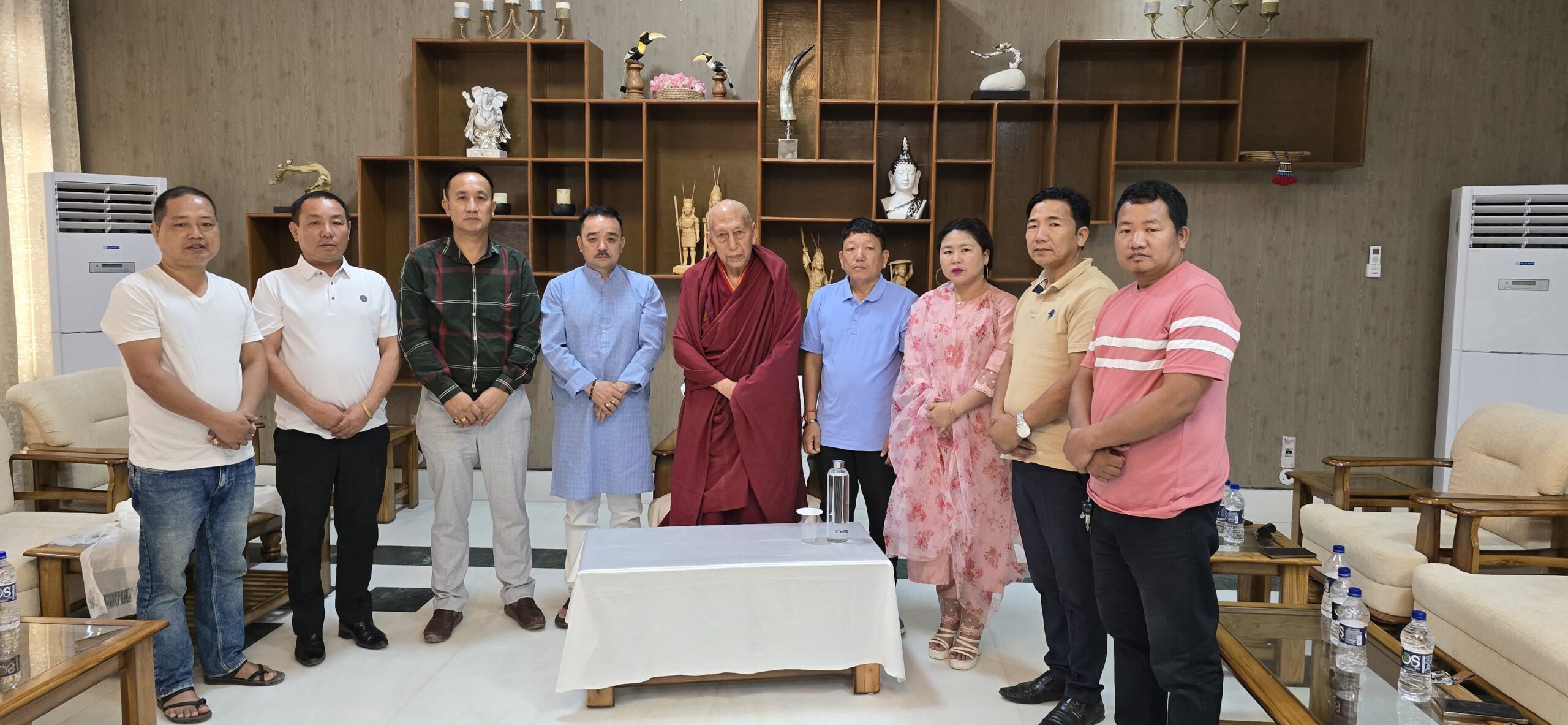
ITANAGAR, Aug 31: A delegation of Tibet Support Group of Arunachal Pradesh (TSGAP) led by president Tarh Tarak called on His Eminent Prof. Samdhong Rimpoche, former Prime Minister of Tibetan Govt-in-Exile, Central Tibetan Administration (CTA) at State Guest House here on Friday.
While briefing activities of TSGAP, established in 2013 under the aegis of Core Group for Tibetan Cause India, Tarak also highlighted its future action plans in the state.
Reiterating the TSGAP’s support to ongoing Tibetan freedom struggle, Tarak also assured to work for basic welfare of Tibetan community living in this state besides conduct a series of programmes involving other organisations to raise mass awareness about Tibetans and Tibet issues to give new thrust to the movement.
Assuring continued support for the Tibetan cause on humanitarian ground, Tarak wished to see His Holiness the 14th Dalai Lama and thousands of Tibetans from around the world return honourably to Tibet soon to lead dignified life.
Highlighting relations between Tibet and Arunachal Pradesh before independence, TSGAP vice president Hinium Tachu advocated early freedom of Tibet from the clutches of Peoples Republic of China to facilitate restoration of age-old barter trade among the peoples of Tibet and Arunachal Pradesh.
While blessing the TSGAP, octogenarian Prof. Rimpochoe advocated for peace and tranquillity in the society and hoped that the BJP-led Govt. under dynamic leadership of Chief Minister Pema Khandu would for greater interest of the state people and also strengthens support for the Tibetan cause.
Appreciating TSGAP for its continued support for Tibetan Cause, he called for evolving a long term policy on Tibet issues and involving the younger generation by making them aware of the issues to carry it forward.
Tibet would definitely be free from Chinese hegemony, hoped Prof. Rimpoche, who is on a three-day trip and arrived here on Friday to the welcome of a TSGAP team led by its president Tarak & secretary general Nima Sange, members of Itanagar Buddhist Culture Society, Tuting Memba Welfare Society, Khamba Welfare Society and Mon Mimang Tsokpa.
Prof. Rimpochoe would conduct a preaching session on ‘Lap pa Sum’ (three higher training and ways to practice it) at Buddhist Gompa Itanagar during 8.30 to 10.30 am on Sunday, according to a TSGAp relese.
AONS adds: It may be recalled here that in 1945–1949, the Nationalist Govt of Republic of China lost the renewed Chinese Civil War against the Chinese Communist Party. In Tibet, the era of de facto independence ended after Tibet was annexed into newly formed People’s Republic of China in 1950–1951. The next nine years saw His Holiness trying to evade a full-scale military takeover of Tibet by China on one hand and placating the growing resentment among Tibetan resistance fighters against the Chinese aggressors on the other.
His Holiness made a historic visit to China from July 1954 to June 1955 and met with Mao Zedong and other Chinese leaders, including Chou Enlai, Zhu Teh and Deng Xiaoping. From November 1956 to March 1957 His Holiness visited India to take part in 2500th Buddha Jayanti celebrations. When young Dalai Lama was taking his final monastic examinations in Lhasa in 1958/59 winter, disheartening reports of increasing brutality against his people continued to pour in.
On 10.03.1959, General Zhang Chenwu of Communist China extended a seemingly innocent invitation to HH to attend a theatrical show by a Chinese dance troupe. When the invitation was repeated with new conditions that no Tibetan soldiers were to accompany the Dalai Lama and that his bodyguards be unarmed, an acute anxiety befell the Lhasa population. Soon a crowd of tens of thousands of Tibetans gathered around the Norbulingka Palace, determined to thwart any threat to their young leader’s life and prevented His Holiness from going. On 17.03.1959 during a consultation with the Nechung Oracle, HH was given an explicit instruction to leave the country. The Oracle’s decision was confirmed when a divination performed by HH produced the same answer, even though the odds against making a successful escape seemed terrifyingly high.
A few minutes before 10 pm, HH disguised as a common soldier, had slipped past the massive throng of people along with a small escort and proceeded towards Kyichu River, where he was joined by the rest of his entourage, Khampa bodyguards, who were from Eastern province of Kham and some members of his immediate family.
Three weeks after escaping Lhasa, HH Dalai Lama his entourage on 31.03.1959 had reached at Khenzamani, a border close to the LAC, under Zimithang circle of Tawang district in Arunachal Pradesh, from where they were escorted by Assam Rifle personnel to Bomdila and Tawang. Then Indian Govt had already agreed to provide asylum to HH and his followers in India. Soon after his arrival in Mussoorie on 20.04.1959, HH met the PM and both talked about rehabilitating the Tibetan refugees.
On 29.04.1959, the 14th Dalai Lama in exile re-established the Kashang, which was abolished a month earlier by the Chinese Govt on 28.03.1959 and later became permanent head of the Tibetan Administration and the executive functions for Tibetans-in-exile.


 20

