
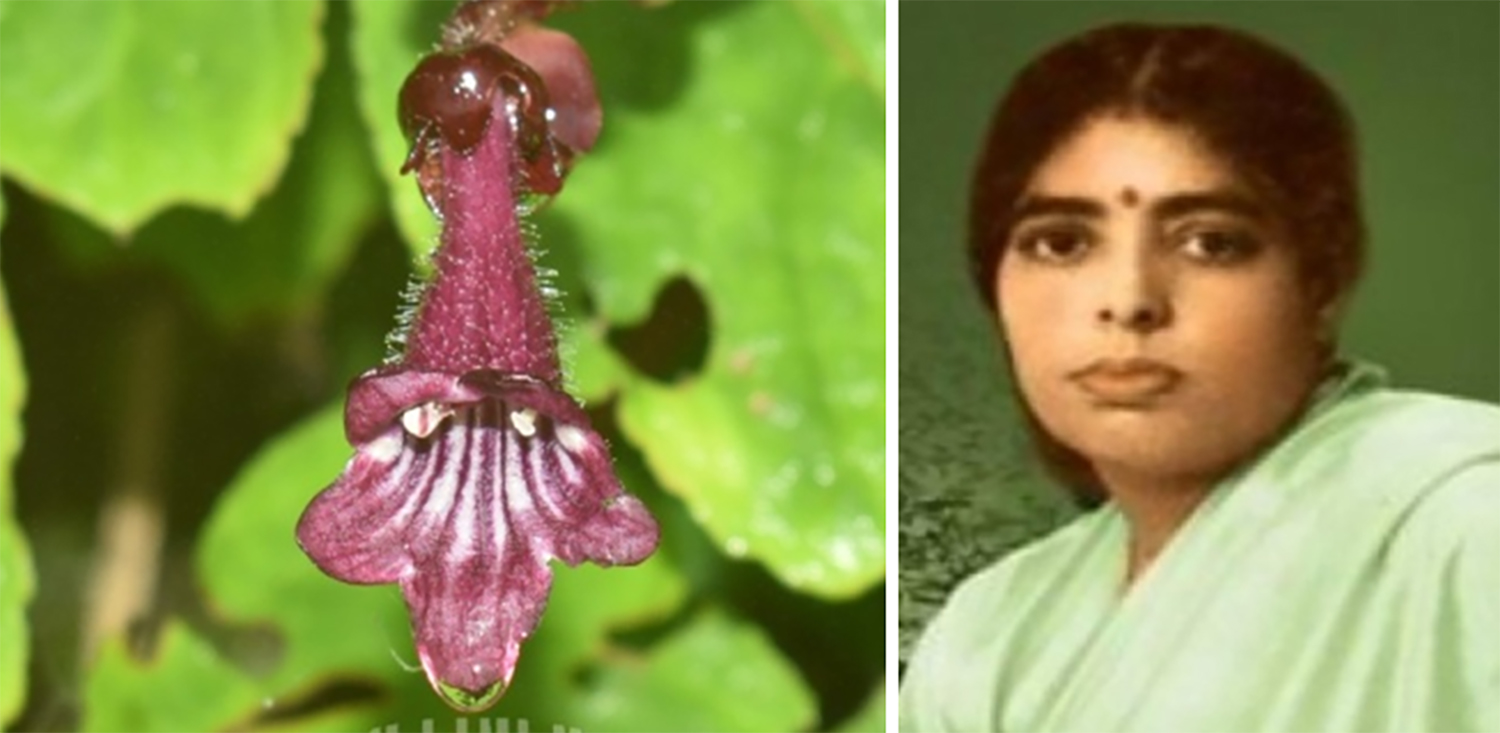
- New plant named after noted botanist
By A O News Service
ITANAGAR, Sept 26: Himalayan state of Arunachal Pradesh, known as treasure trove and one of the 12 biodiversity hotspots of the world, has sprang up another surprise.
A new plant species has been discovered and named Didymocarpus janakiae in honor of Dr EK Janaki Ammal, first Indian woman to earn a doctorate in botany in the United States in 1932, breaking both gender and caste barriers.
The species was discovered by Rhuthuparna S.B. and Dr. Vinita Gowda of Tropical Ecology and Evolution Lab, Department of Biological Sciences, Indian Institute of Science Education and Reserach (IISER), Bhopal, during field surveys conducted in NE India, including Arunachal Pradesh, from July to September 2023, the flowering season for Indian Didymocarpus.
“D. janakiae is described from sub-tropical forests of West Kameng district at an elevation of 2,300 meters above sea level. It belongs to plant genus Didymocarpus, commonly known as stone flower, which is part of African Violet family (Gesneriaceae). The genus consists of 111 species, 27 of which are present in India, including the newly described species D. janakiae. They grow in pristine, undisturbed habitats like moss-covered rocks, indicating the quality of the ecosystem,” the authors said.
Their findings have been published in The Nordic Journal of Botany. Dr. Vinita Gowda is an associate professor, while Rhuthuparna S.B. is an IISER Ph.D. scholar.
This is the second species named after late Dr. Janaki Ammal. The first was Magnolia kobus Janaki Ammal, a Magnolia species named by the Royal Horticultural Society in Wisley, England, in 1950s to recognize her work. Magnolia kobus is a deciduous tree that produces cup-shaped white flowers in the spring.
Didymocarpus janakiae is a lithophytic herb found on moss-covered rocks. The type locality is near West Kameng district HQs Bomdila in a sub-tropical forest at an altitude of 2,315 meters. “To the best of our knowledge, based on our extensive field surveys, this species is known only from one location in Arunachal Pradesh,” the authors said.
The area where the species was found lies outside protected areas and is under rapid development, including road construction, adversely affecting the quality of its habitat.
“Despite conducting surveys at multiple other potential locations within Arunachal Pradesh and throughout the NE India (except Tripura), West Bengal, and Sikkim, no additional populations were found,” the authors said.
“One of the most striking aspects of this discovery is conservation status of Didymocarpus janakiae. With a limited known population of fewer than 20 individuals found in a single location near Bomdila, the species faces a critical threat due to habitat degradation caused by rapid development activities like road construction. Therefore, the species has been suggested to be considered as Critically Endangered as per IUCN guidelines, underscoring the urgent need for conservation efforts to safeguard the survival of this newly discovered plant species,” they emphatically said.
“Dr. Janaki Ammal is an inspiration to many aspiring young researchers in STEM today, as well as to all researchers in the TrEE lab, IISER, Bhopal,” they said, adding she had published her Ph.D. thesis titled “Chromosome Studies in Nicandra Physaloides” in 1932. After returning to India, she has joined Maharaja’s College of Science in Trivandrum as a professor (botany) and taught till 1934, when she had joined Sugarcane Breeding Institute in Coimbatore as a geneticist, working alongside Charles Alfred Barber.
In 1945, she had co-authored “The Chromosome Atlas of Cultivated Plants” with biologist C.D. Darlington. In her later years, she returned as an Emeritus Scientist to Maduraivoyal, near Chennai, having a field research station for advanced studies in botany. She passed away in 1984. (With Wikipedia inputs)


 20
