
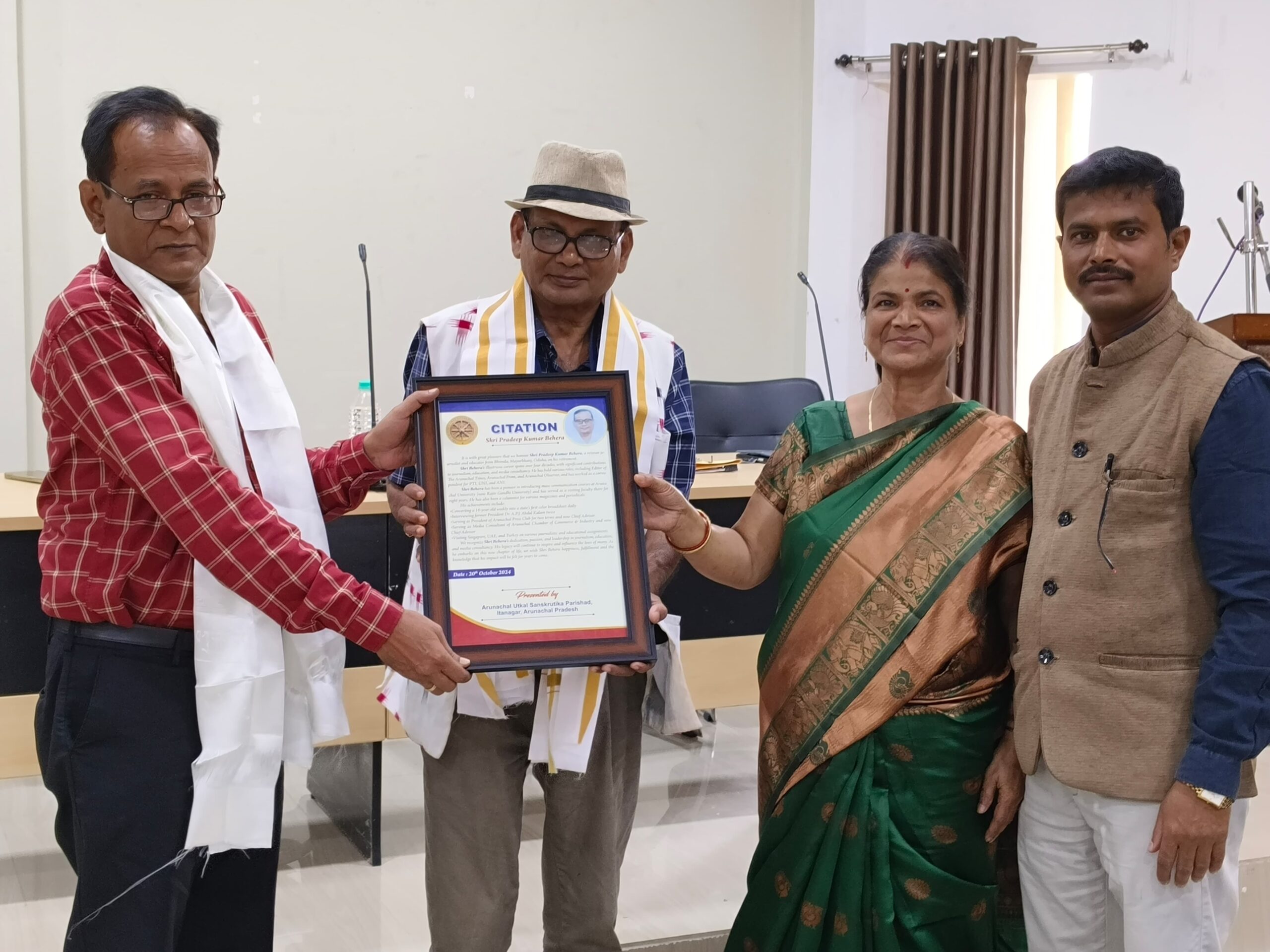
RONO HILLS, Oct 20: Senior members of Arunachal Utkal Sanskrutika Parishad (AUSP) led by president Dr Manjula Mohapatra in a function in Rajiv Gandhi University (RGU) here on Sunday felicitated senior Oriyas for their invaluable contributions to Arunachal Pradesh in their respective fields.
They were state’s pioneer print and electronic journalist Pradeep Kumar Behera, present RGU care taker vice chancellor Prof Sushanta Kumar Nayak, RGU English Prof Bhgawat Nayak and NERIST librarian Durga Madhab Sahu, according to assistant Prof Prasanta Nayak.
Responding to the gratification, Behera said that media is not limited to print and electronic categories as it means ‘mein-I’ and ‘diya-gave’. The society gives everything to its members, which calls for giving back to the society after demitting their profession or position.
Utkal or Kalinga (present Odisha) was formed on 01.04.1936 as a state much before India gained freedom for which this day is celebrated as Utkal Diwas. First Utkal Diwas was celebrated in Raj Bhawan in 1991 at the initiative of then Governor Surendra Nath Diwvedi.
He had invited many Odias working in the state, including journalist Pradeep Kumar Behera, RGU Prof P K Panigrahi and NERIST librarian Durga Madhba Sahu, on 14.04.1991 that gave birth to the AUSP.
Utkal Diwas was celebrated by AUSP at Raj Bhawan in 1992 when famous Odia classical singer and music director Prafulla Kar had joined the celebration along with Odias from across the state. This day’s celebration was organised at Itanagar’s Siddhartha Hall in 1993 and 1994 when Udayan cultural team came from Odisha at the initiative of the governor to present cultural programme. The AUSP has been celebrating Utkal Diwas ever year since then.
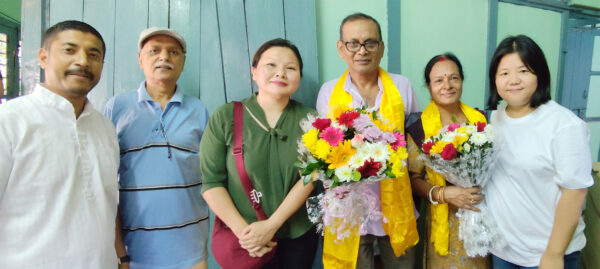
Arunachal Observer chief DTP operator Snehangshu Bhowmik, Arunachal Front former accounts officer Om Prakash Sharma, Arunachal Observer DTP operator Sapna Pango and The Pioneer scribe Shirap Zangmu, came to Behera’s residence on Sunday to felicitate him.
While Behera had taught mass communication diploma to Bhowmik and Pango in RGU extension centre at Naharlagun ADC office, Zangmu had worked under him in Arunachal Front. “We would miss you deeply,” they all said in remorse.
Justifying the adage “work is worship”, Behera despite his busy schedule attended a programme of Digambar Jain Samaj at Naharlagun Jain temple in the evening, where former ISRO scientist Rajmal Jain, addressed all senior Jains and their families on Jain philosophy, particularly Ashtap Prasharan.
Along with Hinduism and Buddhism, Jainism is one of the three most ancient Indian religious traditions still in existence and an integral part of South Asian religious belief and practice. While often employing concepts shared with Hinduism and Buddhism, the result of a common cultural and linguistic background, the Jain tradition must be regarded as an independent phenomenon rather than as a Hindu sect or a Buddhist heresy, as some earlier Western scholars believed, the scientist said.
The Jainism means “to conquer” refers to ascetic battle as believed to be Jain renunciants (monks and nuns) must fight against the passions and bodily senses to gain enlightenment, or omniscience and purity of soul. The most illustrious of those few individuals who have achieved enlightenment are called Jina (literally “conqueror”) and the tradition’s monastic and lay adherents are called Jain (follower of the conquerors) or Jaina. This term came to replace a more ancient designation Nirgrantha (Bondless), originally applied to renunciants only he said after two Jain nuns blessed the invited guests.
Jainism has been confined largely to India, although the recent migration of Indians to other, predominantly English-speaking countries has spread its practice to many Commonwealth nations and the United States. It is estimated that there are more than six million Jains, the vast majority of whom live in India.
Many Jains have been working as mostly traders across the state, particularly in Capital Complex, whose children have grown up to take over the responsibilities.


 20

