
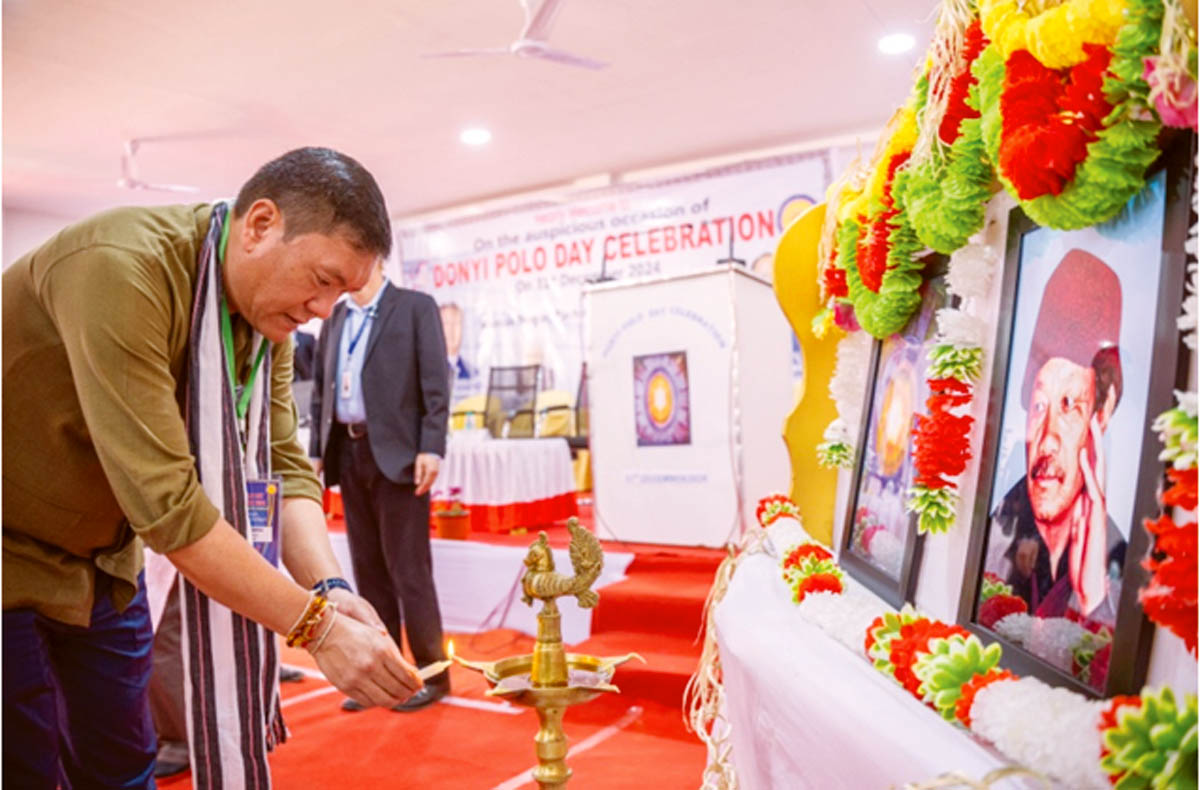
ITANAGAR, Dec 31: Chief Minister Pema Khandu, addressing Nyedar Namlo dedication ceremony here on Tuesday, disclosed plan to set up a university-level institute in Arunachal Pradesh for promotion, documentation, research and education on indigenous culture, faith and languages of the state in collaboration with the US-based International Centre for Cultural Studies (ICCS).
Notably, the ICCS has a centre in the state called Research Institute of World’s Ancient Traditions Cultures and Heritage (RIWATCH) at Lower Dibang Valley HQs Roing, which is exceptionally doing well to document, preserve, promote and conduct research on Idu Mishmi culture and language.
It may be recalled Khandu had an exclusive meeting with ICCS founder Prof Yashwant Pathak here on the sidelines of silver jubilee celebrations of the Indigenous Faith and Cultural Society of Arunachal Pradesh (IFCSAP) here on December 28 last.
Speaking after dedicating a Donyi Polo Nyedar Namlo to the people at Pachin Colony here to mark Donyi Polo Day, Khandu said that the idea stemmed during his discussion with Prof Pathak to further boost indigenous culture movement and put significance of preserving state’s indigenous culture and faith on a global platform.
“Let there be research and documentation of our indigenous faiths and culture at the highest level. Let us produce scholars on indigenous culture and languages. Let our indigenous priests adorn the professor’s gown and teach young minds about the age-old chants,” he said.
While admitting that the proposal is in its nascent stage and much work lies ahead, he expressed optimism that the same would be realized in the coming years with cooperation of ICCS.
“If it comes up, it would be a huge boost to our movement to preserve our indigenous culture, faith and languages to preserve our identity. When a research center (RIWATCH) of much smaller scale can do wonders, think what a university can do,” he wondered?
Extending greetings to the people of Donyi-Polo faith, Khandu urged them to ‘practice what they preach’. He said that only speaking about Donyi Polo and its significance won’t bear fruits unless Donyi-Polo faith is practiced in daily life.
Underscoring the role IFCSAP could play in preservation of state’s indigenous culture, he suggested that under its leadership brainstorming sessions could be held with all stakeholders to find out basic reasons for erosion of indigenous culture and faiths.
“Unless we realize and pinpoint the causes of cultural erosion, we will not be successful in preserving our culture and faith in the long run. IFCSAP should take the responsibility to find out the causes,” he reasoned.
When his attention was drawn to the fact that earlier December 31 (Donyi Polo Day) used to be a holiday but not now, Khandu assured that there is no ‘ill-intention’ of the GoAP in doing so. In fact, December 31 was earlier celebrated as IFCSAP Day, which was declared a holiday by the GoAP, he said.
“However, as the IFCSAP Day was fixed on December 1 to commemorate birth anniversary of late Talom Rukbo, considered father of state’s indigenous faith movement, the holiday too got shifted. I assure you all that from next year, Donyi Polo Day (December 31) would be a declared local holiday in Donyi Polo believers inhabited areas,” he said.
Pasighat Donyi Polo Yelam Kebang chief advisor Kaling Borang, a compatriot of late Talom Rukbo, was resource person of the day.
Indigenous Affairs Minister Mama Natung, IFCSAP president Dr Emi Rumi, Indigenous Affairs Minister Taba Tedir, MLA Kaling Jerang, advisor to CM Tai Tagak (all former), senior leader Kamen Ringu, among others, were present. (CMO)
CM’s New Year gift
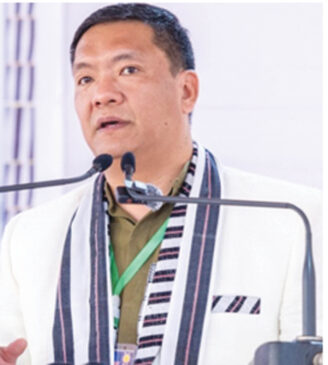
The announcement of CM is a befitting New Year gift for all Donyi Polo believers. The faith movement launched by Donyi-Polo believer Golgi Bote Talom Rukbo in 1964, has been rejuvenating the rich cultural mosaic of Arunachal Pradesh with the roots germinating to strengthen their faith further. Since Rukbo represented Donyi-Polo Mission at the Interventional Association for Religious Freedom meetings in 1984 and 1985 and at its Bangalore meeting in 1986 and pleaded for recognition of Donyi-Poloism as a full-fledged religion, the indigenous renaissance has reached the length and breadth of the state and there are about 400 Kargu Gamgis, and if Rang-Fra faith is added, the number stands at 528.
Donyi-Poloism, a religion that makes no distinction, is more relevant in the present day context as its believers pray for the greater welfare of the entire humanity while practicing the much needed tolerance towards other cultures, they said without mincing any words.
“Culture is our identity and if it is lost, our identity is lost,” they reemphasized again to drive home the message that indigenous faith is the mother of all religions as has been proved across the world.
They were right, as I remember Mitakuye oyasin (in Lakota language) “we are all related” was the outcome of the International Conference of World Elders of Ancient Traditions and Culture conducted at Jaipur during February 5 to 10, 2006. Fulbright scholar Vijay Swami, Tashi Tom from Tawang and Willa Namchoom from Chowkham from Arunachal who were among the 250 delegates from 42 countries spread across five continents and representing 257 traditions were astonished to find the striking similarities in dresses, ornaments, food habits and rituals.
“Yes, we belong to the world community as nature worshippers despite the geographical barriers are the same across the world,” was the admiring comment of Donyi-Polo believer Dr Joram Begi.


 20

