
By Pradeep Kumar
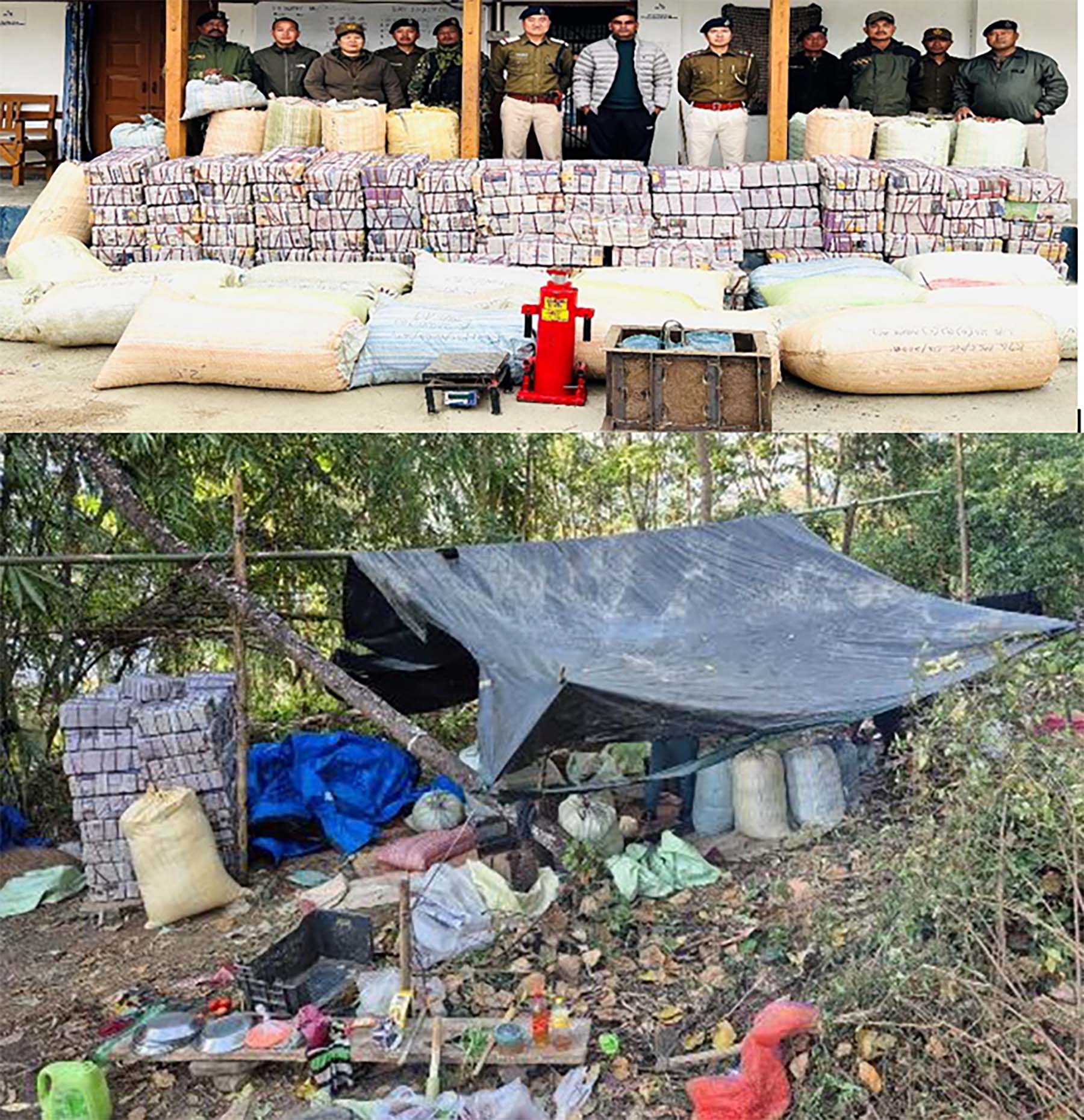
ITANAGAR, Jan 20: Arunachal Pradesh, geographically 14th largest state of India spread in 83,743 sqkm bordering Bhutan,in the west, Myanmar in the east and disputed 1,129-km border with China’s Tibet Autonomous Region, has created a record with seizure of higest ever suspected cannabis weighing 1.654.22 kg worth ₹ 1.33 crore.
A Kalaktang police station team led by officer in-charge Padi Payang and SI David Tagi, under Operation Dawn 2, conducted a raid as per credible intelligence input in and around Betchilling village around 2 pm on January 18 under supervision of Bhalukpong ASP-cum-Kalaktan SDPO Pawan Yadav to achieve the success, West Kameng SP Sudhansu Dhama told this daily over telephone on Monday.
Seizure rings alarm bell
Such large quality drug discovery in western parts of the state, particularly in West Kameng district, inhabited mostly by religious Monpa tribe, is a matter of concern It is enough to ring alarm bell for the officers involved in anti-drug operations to zero down to the source to nip the bud before the menace grips the younger generation.
On seeing the approaching police team from great distance, two unknown persons fled away from the spot leaving behind huge consignment in interior of jungle area surrounding the village. Even after thorough search of the area, both suspects were untraced. Accordingly, information regarding the same was sent to nearby PS and Assam police for coordination.
After conducting all legal formalities with with audio-visual recording in presence of executive magistrate, a case was registered with the PS under relevant sections of NDPS, the SP said.
Total seizures included: Crushed rectangular suspected cannabis in 108 packets weighing 1080-kg each and and 33 gunny bags containing 574-kg, total 1654.22-kg; 50 ton hydraulic piston jack for crushing; modified iron trunk and one iron frame and modified weighing machine. These subsidiary materials were used to press the cannabis and make them convenient to hide for movements.
All the efforts are being made to apprehend the accused person involved with the help of intelligence inputs being collected from various sources.
It may be recalled here that older Mishmi men only used to grow opium in the past for personal consumption, according to records, but soon youngsters and even women started growing it and many people from outside Pradesh hired large plots of land to commercially grow opium illegally, especially in the plains.
The Mishmi Hills, part of the eastern Himalayas, has become notorious for illegal opium cultivation, locally called kaani, over the past few decades.
The transition from the centuries-old tradition of growing opium for ritual purposes changed only after the Supreme Court in 1996 banned felling of trees for timber mills. By 2000 agricultural land was interspersed with commercial opium cultivation, which slowly increased year by year as growing opium, like cash crop, become major source of income in the poor region.
People have been cultivating poppy Illegally in Anjaw, Lohit, Upper Siang, Lower Dibang Valley, Tirap, Changlang and Longding districts as cash crops, like oranges, pineapples and ginger – to make fast and easy money even as per 2019 records. Under development, no job opportunity, poor education penetration and limited infrastructure were attributed to such in the past.
Anjaw, Lohit, Tirap, Changlang and Longding all share porous border with Myanmar, part of the Golden Crescent of Myanmar, Laos and Thailand, Golden Crescent, located along the confluence of the Ruak and Mekong rivers, spread in approximately 950,000 sqkm area, is second the largest opium-producing areas of the world, after Afghanista.
The districts of Anjaw, Lohit and Namsai once had India’s densest forests. Large tracts of opium poppies have replaced jhum cultivation in the hills or biodiverse rich forests in the plains.
Lot of cross-border trade as people from outside, mostly rich traders from other parts of India, buy opium poppy in various forms, take it to Assam’s towns and sell it to insurgents, who in turn use it to buy arms. Some of it reportedly winds up in Myanmar.
India’s NE has had a series of long running insurgencies since the independence of India. Although casualty levels have fallen across the decades, sporadic violence is still common in the region, with militant factions using any means at their disposal – including shadow taxes on businesses in the region – to continue their operations.
The best example is Y D Thongchi, who while serving as EAC (1986-87) in Changlang district, had seized 95-kg hashish sending a shock wave across the country. Hashish per kg was Rs one lakh in global market then. The Central Bureau of Narcotics (CBN) continues to destroy illicit cultivated opium areas, like approximately 3,600 hectares in 2022, but the cultivation continues.
While a major tribe has lost a generation to opium, every leader, including Chief Minister Pema Khandu and DCM Chowna Mein, in their public addresses, invariably makes a fervent plea to younger generation to refrain from drug consumption.
Say No to Drugs! Spreading awareness against drug addiction is key to eliminating the drug menace,” CM’s message in X is a clear indicator of the intensity odf drug menace in the state.


 20

