- Water may lead to World War-III: Penpa Tsering
ITANAGAR, Jan 24: Neighboring country China’s refusal to enter into binding international water treaties and its selective sharing of hydrological data has raised concerns in NE region, Chief Minister Pema Khandu said here on Friday and advocated urgent need for cooperative governance of shared water resources in Asia.
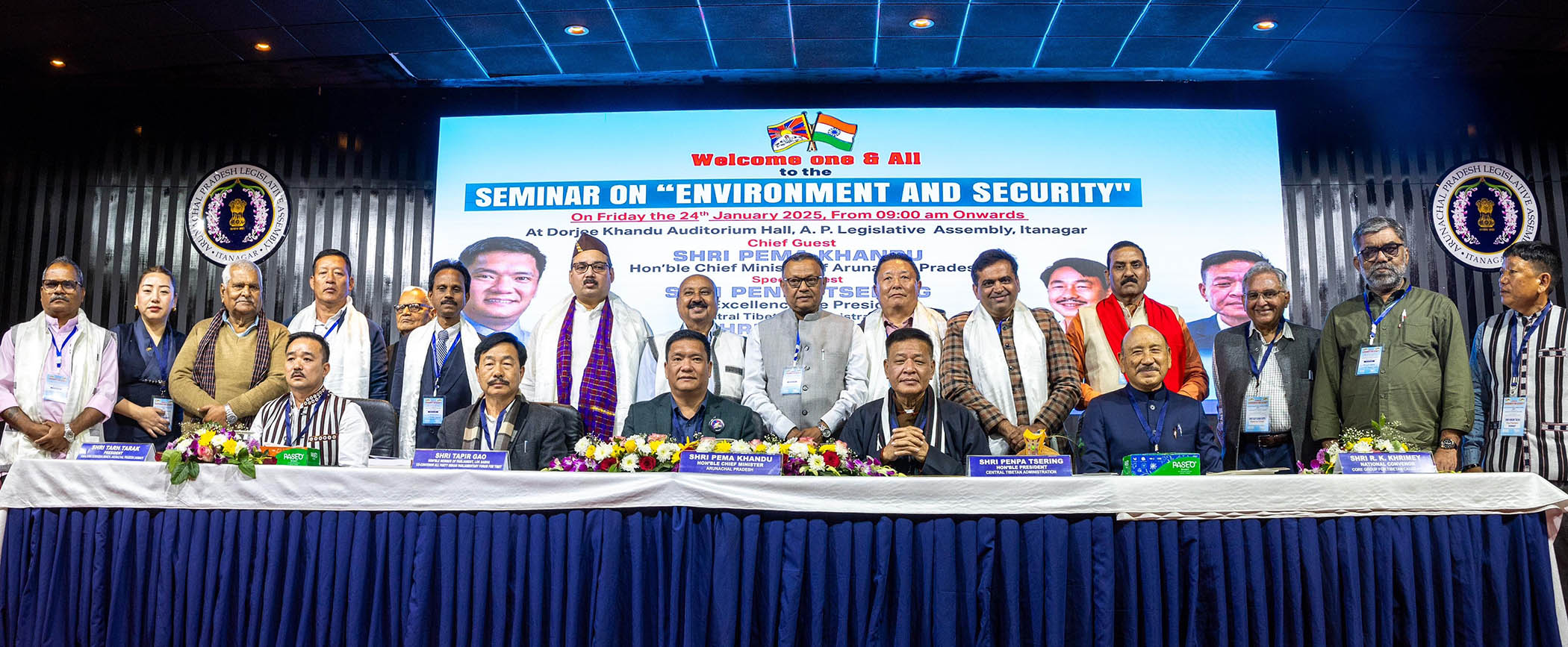
Addressing inaugural function of a seminar, titled ‘Environment and Security’ at Dorjee Khandu auditorium of state Legislative Assembly, he drew attention of all stakeholders towards Chinese plan to construct the world’s largest hydropower project on the Yarlung Tsangpo River, which enters Arunachal Pradesh as Siang and becomes Brahmaputra in Assam before flowing into Bangladesh as Meghna.
He pointed that the 60,000 MW dam would allow China to control the timing and volume of water flowing downstream, which could have devastating effects during periods of low flow or drought. The mighty Siang or Brahmaputra River would dry-up during winters disrupting life in the Siang belt and the plains of Assam, he cautioned.
Conversely, according to Khandu, sudden releases of water from the dam could cause severe flooding downstream, particularly during monsoon seasons, displacing communities, destroying crops and damaging infrastructure. Furthermore, the dam would alter the sediment flow, affecting agricultural lands that rely on the river’s natural replenishment of nutrients, he said.
“China’s construction of world’s largest hydropower dam poses significant risks to the water security, ecology and livelihoods of millions of people downstream in Arunachal Pradesh, Assam and Bangladesh. The potential disruption of water flow, flooding and ecosystem degradation could have far-reaching consequences on us,” he said.
Highlighting that all major rivers of India originate from the Tibetan Plateau, Khandu was of the opinion that the Chinese Govt’s rampant exploitation of Tibet’s natural resources pose a serious threat to the very existence of these river systems, upon which millions of Indians depend for survival.
“Tibet is often referred to as the “Water Tower of Asia,” supplying water to over a billion people in the region. Its environmental health is critical not only to China and India but to much of Asia. Therefore, India, given its direct dependency on Tibet’s rivers and climate patterns, has a significant role to play in global environmental conservation efforts,” Khandu said.
Appreciating Tibet Support Group of Arunachal Pradesh and Core Group for Tibetan Cause for organizing the seminar, Khandu hoped that the discussions that would unfold here will play a vital role in finding solutions to mitigate the alarming environmental situation in Tibet, which poses significant risks to the entire region.
Khandu went on to elaborate on the relationship of India with Tibet, especially in the context of Buddhism that dates back to the 8th century when the Nalanda school of Buddhism was at its peak.
“Buddhism, since, centuries has been the connecting bond between India and Tibet, transcending to our state. Nalanda became the epicenter for the study of Buddhist philosophy, logic, ethics, and meditation, and its influence spread far and wide, including to Tibet, where it played a key role in shaping Tibetan Buddhism,” he said. Tibetan refugees settled in different areas of the state are different from those of Chakma & Hajong refugees, Khandu said, and expressed concern over Tibet annexed by China as Tibet with vast natural resources is water tower of Himalayan region.
Since the invasion of Tibet by China in 1950, at least 93 major dams have been constructed, in fact China doesn’t have any water treaty signed with the United Nation (UN), therefore it is the duty of GoI and GoAP to take precautionary measures before it’s too late, he added. (CMO)
Our Staff Reporter adds: The seminar, which focused on environmental situation in Tibet and its relation to India’s security, was also addressed by special guest Dharamshala-based His Excellency Central Tibetan Administration Sikyong (President) Penpa Tsering and Lok Sabha member Tapir Gao, who is also co-convenor of All-Party Indian Parliamentary Forum for Tibet.
“Tibet people under Chinese occupation are living in violation of human rights, intellectuals and religious restrictions. There is gradual destruction of Tibetan’s language, religion, culture and heritage by Chinese Communist Party,” he said.
“Tibet alone supplies around one billion water and would be bio-hotspot, if water drives a World War-III,” he feared, and advocated a midway solution, which should be initiated by India through peace talks.
Lok Saba member-cum- All-Party Indian Parliamentary Forum for Tibet co-convenor Tapir Gao also address the gathering, including state lawmakers, Core Group for Tibetan Cause in India national convenor R K Khrimey, former Tibetan Cause in India Core Group national co-convenor-cum-Tibetologist Vijya Kranti, Core Group for Tibetan Cause in India national co-convenor Surendra Kumar, Arunachal Pradesh Tibet Support Group president Tarh Tarak and secretary general Nima Sangey, Arunachal Indigenous Tribes Forum and several CBOs representatives.


 20