
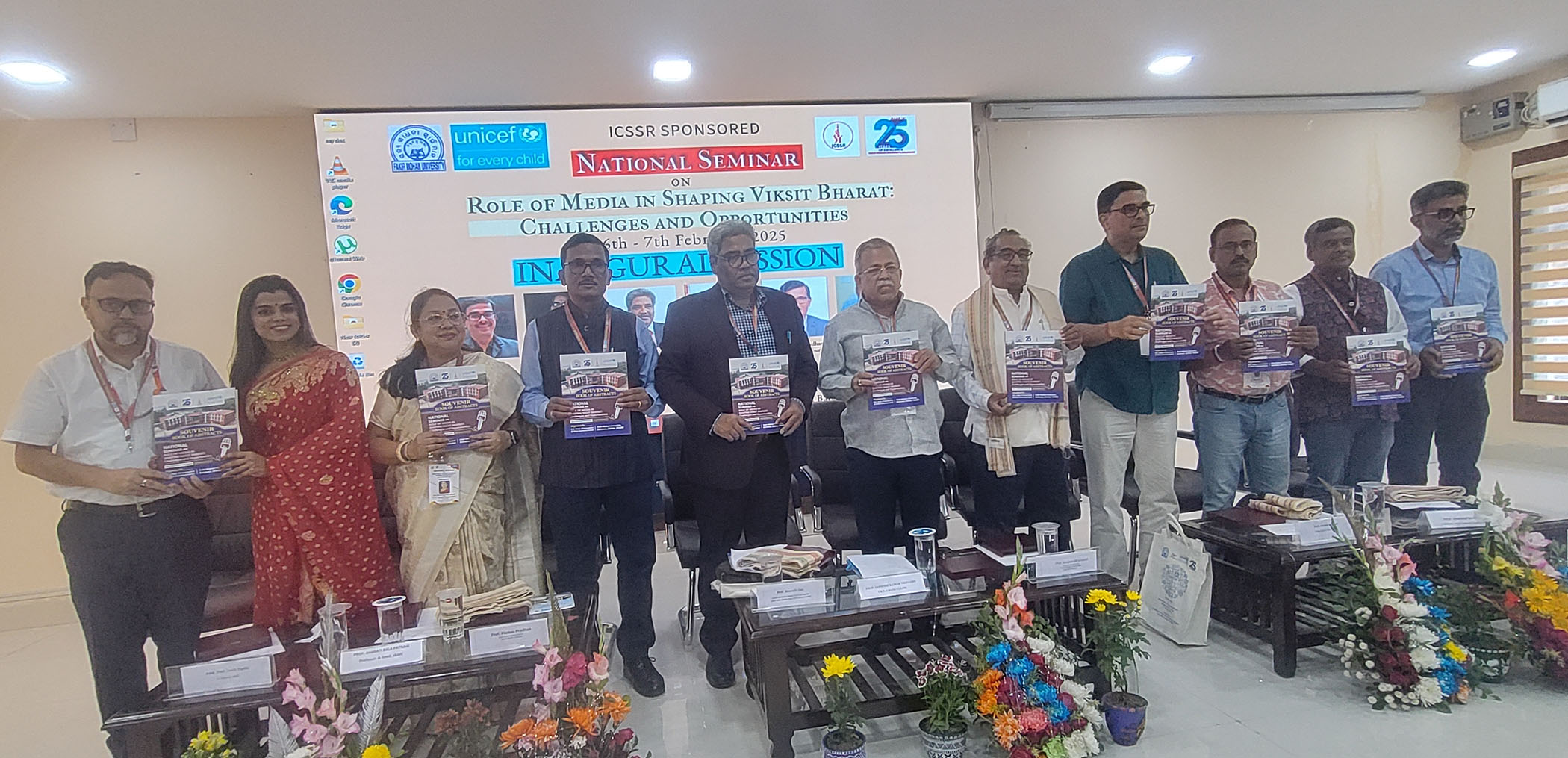
- Efforts on to impart quality & effective education: VC Tripathy
By Pradeep Kumar
BALASORE, Feb 06: The present mission of achieving Vikshit Bharat by 2047 is nothing but an inertia of the past and shock of present, New Delhi-based Jamia Milia Islaima University’s Centre for Culture, Media & Governance founder director Prof Biswajit Das, said in his inaugural address as keynote speaker of two-day national seminar, organized by Fakir Mohan University (FMU) PG department of mass communication, here on Thursday.
The seminar on ‘Role of Media in shaping Vikishit Bharat: Challenges and Opportunities, sponsored by New Delhi-based Indian Council Social Science Research and Uniceff, has been organized with vice chancellor Prof Santosh Kumar Tripathy, PG Council chairman Prof Bhaskar Behera, HoD (mass communication) Prof Bharati Bala Patnaik, assistant Prof Dr Smiti Padhi, assistant professors Dr Ashok Kumar Nayak and Moti Pangkam as chief patron, patron, convenor, co-convenor and members of organizing committee respectively.
The event with Jaipur-based University of Rajasthan former head of Centre for Mass Communication Prof Sanjeev Bhanawat, Odisha’s Dhenkanal-based IIM regional director Prof Anand Pardhan, Aligharh Muslim University’s mass communication Prof Pitabas Pradhan saw unveiling of seminar’s souvenir and Prof Bhanwat written book – Digital Media: Navigating challenges, seizing opportunities.
“India has failed to become a developed nation in 78 years like media equally failed for lacking value in news. Turn any page of newper, you would see only advertisements. This means media has lost it prime objective of highlighting people’s issues and became companies as revenue generating industry,” Prof Das said while giving a synopsis of media since 1947 that lacked hierarchy, sense and priority.
“British nobility or ‘peerage’ was distinct because it had a structured hierarchy of titles, like Duke, Marquess, Earl, Viscount and Baron, with each rank signifying a specific level of social status, and these titles were often hereditary, meaning they were passed down through family lineage, unlike many other European systems where nobility could be more fluidly acquired through merit or royal favor. Like the nobility, Scotch whisky made in Scotland and exported across the world the way media has been imposing the idea of development,” he said.
“Media offering 24X7 service, but TV has been termed as a dead medium for not being watched by urban population except largely by rural population for its rhetoric tendency. Neither it had any impact on woman empowerment nor would it have this way. One should realize the democracy within democracy before tom-tomming on development. Thus, the Vikishit Bharat could be achieved if media is Indianised based on sociology to highlight core human interest issues in right perspective,” Prof Das said with conviction.
Appreciating the VC for the FMU’s development, Prof Das recalled that though Balasore was a Portuguese and French colony, but the Britishers had landed here in 1633 and Trieste Company merchants set up a trading post in 1719 with a boat manufacturing unit at Balighat on the bank of Budha Balanga River here for trading by boats through Bay of Bengal en-route Chandipur, 13.2-km from here. Its model should be replicated in FMU to showcase the lost history, he suggested,
Terming Prof Tripathy unsatisfied (asantosh) for lack of FMU’s desired growth which has led to set new models, Prof Bhanawat said while drawing a parlance between little read Fakir Mohan Senapati, after whom the varsity is named and Varansi’s famous poet Munshi Premchand, saying both lyrically reflected the agonies of then suffering millions.
When he asked how many students read news papers daily, hardly few raised their hands prompting him to question what would be the future of India when time is changing posing new challenges with negativity?.
Targeting $ 35 trillion economy by increasing average Indian’s per capita income from present $ 3,000 to at least $ 18,000 is good, but one must think how much efforts are needed to achieve it, he said, adding that till media highlights core national issues and citizens make efforts whole heartedly it would remain a dream.
Terming the topic electrifying, Prof Pitabas Pradhan questioned: How close India is to the goal by 2047? Is it achievable or a day dream? What are the indicators of economic development? What are the opportunities? What the challenges? What is role of media?
Some indicators, like present GDP growth @8%, creation of 66 lakh networking, 1.46 lakh KM NHs, expanding Digital India, 23.5 trillion transactions and 25% Indians young, are positive, but skill gap is vast which should be prioritized or else AI would lead to unemployment. Thus, Microsoft has hinted at huge investment to create cloud to reduce the skill gap, he added.
Questioning the definition of development, Prof Pitabas Pradhan asked are we seeking growth for the sake of growth? Are we working to create dignified employment for the youth, betterment of farmers and marinades sections or completely neglecting them?
The media has to play a pivotal role to change the perspective of people to create a fell good situation for all visible and invisible segment of the society, he advocated.
While Prof Patnaik outlined the objectives of the seminar when India is aiming to be developed nation by involving all sections of people for the desired economic growth, Prof Behera described media as a jagrat prhari (alert watchman) to serve as a link between the Govt and the public and hoped that the outcome would be helpful for policy makers and researchers.
The Vikisht Bharat campaign indicates either the nation is not developed or developing, but accepting the reality is a positive indication, VC Prof Tripathy said, adding that the definition of development would change in India as 65% young would grow old by 20247, the way it had revered in China and Japan.
Pointing out that secretaries do not change but the ministers (kings) change, he said that the need of the hour is change of attitude to achieve the goal despite challenges.
Two senior journalists Ashok Pradhan of Times of India and Sibu Mohnaty of New Indian Express, who were felicitated, also spoke before the technical session started.
Papers were presented by Barooj Abid from Srinagar on ‘Digital media & rural divide’, Shreyashee Shahi (Ranchi) on ‘Digital literacy’ and Sakshi Somya on ‘Sustainable development’. The trio, presently pursing graduation in journalism & mass communication in Ranchi-based St. Xavier’s College, had arrived here with their guide Prof Neel Kusum Kullu. The invited media educationists from different corners of India made a difference. Is this not a glittering example of Vikshit Bharat?


 20

