
- Politicians made ‘Govt off the people, far the people, buy the people’
By Smiti Padhi
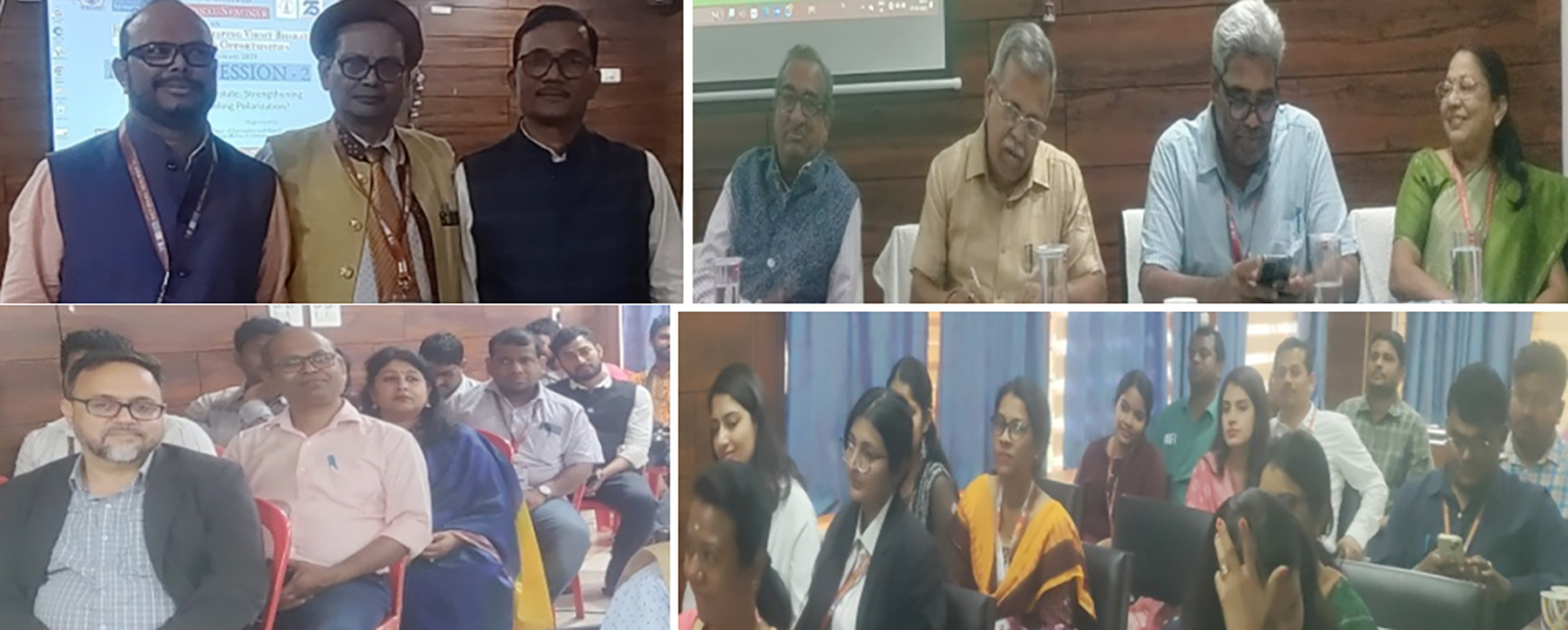
BALASORE, Feb 07: The time tested democracy would be under threat if the media as the Fourth Estate intended to serve the society turns the 4th flag to serve vested interest, said Jaipur-based University of Rajasthan former head of Centre for Mass Communication Prof Sanjeev Bhanawat, while taking part in discussion on ‘Role of Media in shaping Vikishit Bharat: Challenges and Opportunities’ on concluding day of two-day national seminar, conducted by Fakir Mohan University (FMU) PG department of mass communication, here on Friday.
His reaction came after Arunachal Observer editor Pradeep Kumar Behera, pioneer print and electronic journalist from Arunachal Pradesh, architect of mass communication department of Rajiv Gandhi University, speaking as guest of honour, recalled that 16th United States President Abraham Lincoln, in his Gettysburg Address in 1863 as part of the dedication of the Soldiers’ National Cemetery, had said that “this nation, under God, shall have a new birth of freedom and that government of the people, by the people, for the people, shall not perish from the earth”.
But regrettably, Indian politicians have changed Lincoln’s definition to “Government off the people, far the people, buy the people”. The Jharkand Mukti Morcha (JMM) bribery case in 1991 to save the then central Govt led by P V Narasimha Rao as well as huge cash recovered during Assembly and Lok Sabah elections across India are glittering example of change of definition of government.
Thus, after launching first newspaper – Echo of Arunachal- on 20.02.1988, serving as first anchor of AIR and DDK at Itanagar since 1996 and founding architect of mass communication department in Arunachal University (present RGU) in 1984 and serving as visiting faculty for eight years, I had redefined media simply as ‘mein’ (I) ‘diya’ (gave). On minutely analyzing communication process, one would realize the gospel truth. Thus, newspapers (print), TV, radio and cinema (electronic) and internet & wifi (digital) are only medium while media encompasses everything visible and invisible that affects our actions and emotions, he said.
After Aligharh Muslim University’s mass communication Prof Pitabas Pradhan earlier said that the media has been serving as a medium between the Govt and the public by functioning as a mirror, Prof Bhanawat pitched in to say, “Though media was initially termed as an ‘idiot box’ but pervaded entire Indian population. Thus, why to blame the media when media persons are also form the same society and function in an existing system. Blame them who manipulate holding the mouse.”
When Prof Pitabas lauded social media for revolutionizing the public platform, Kumar reacted to blame it for spoiling the young generations, when Prof Bhanawat intervened to advise not to blame as social media that gave freedom to express their opinions. It the creators to put the content, he said citing examples of films, like Toilet and Ek Prem Katha, which had changed people’s mindset. One has to be careful as role and responsibility has multiplied to what to put in public domain and what not.
“Our role is to understand the role of media which has been causing social polarization. Facts are subject to dispute as the society is polarized not to agree to any particular idea,” Odisha’s Dhenkanal-based IIM regional director Prof Anand Pardhan said. Talking about legacy of media and social media, he said nothing is out of context as democracy is witnessing conversion.
Jaamia Milia Islamia University’s Centre for Culture, Media & Governance founder-director Prof Biswajit Das said democracy has to embrace the diversity of people. The media, which has undergone transformation, has to serve the audience which has fragmented with passing time.
Addressing the valedictory function, Prof Bhanawat, who visited Chandipur in sea, said how life was closed associated liked to sea and human beings struggle like waves to survive and termed FMU a symbol of satyam, sadhan and swabhiman.
Though the Nalanda University library was burnt by Turko-Afghan general Bakhtiyar Khilji in the late 12th century that had burned for months to reduce lakhs of precious books to ashes, but Indian civilization survived, he said, adding that if all stick to the age-old culture Bikhist Bharat would be a reality.
Prof Bidhu Bhusan Das announced formation of Odisha Communication Association (OCA) with 16 founding members at the initiative of Prof Das, who earlier suggested to introduce certificate and diploma courses on child rights to turn FN}MU a training centre instead of only imparting teaching.
While HoD (mass communication) Prof Bharati Bala Patnaik termed the seminar with four plenary sessions very fruitful, assistant Prof Dr Smiti Padhi highlighting the proceedings said that 75 papers were presented, including virtual followed by screening of short documentary made by students and directed by Dr Padhi.
VC Prof Tripathy resented absence of students in the seminar saying that he was honest in his comment. He appreciated Prof Pitabas’s suggestion that FMU would facilitate resurgence of journalism as a subject of study.
“I was teaching mass communication before joining FMU for which facilitated setting up of a studio, which produces news Parichay, which is on Youtube,” he said and suggested for tspping more sources to make it vibrant and lively.
The seminar on ‘Role of Media in shaping Viksit Bharat: Challenges and Opportunities, sponsored by New Delhi-based Indian Council Social Science Research and Unicef, has been organized with vice chancellor Prof Santosh Kumar Tripathy, PG Council chairman Prof Bhaskar Behera, HoD (mass communication) Prof Bharati Bala Patnaik, assistant Prof Dr Smiti Padhi, assistant professors Dr Ashok Kumar Nayak and Moti Pangkam as chief patron, patron, convenor, co-convenor and members of organizing committee respectively.


 20

