
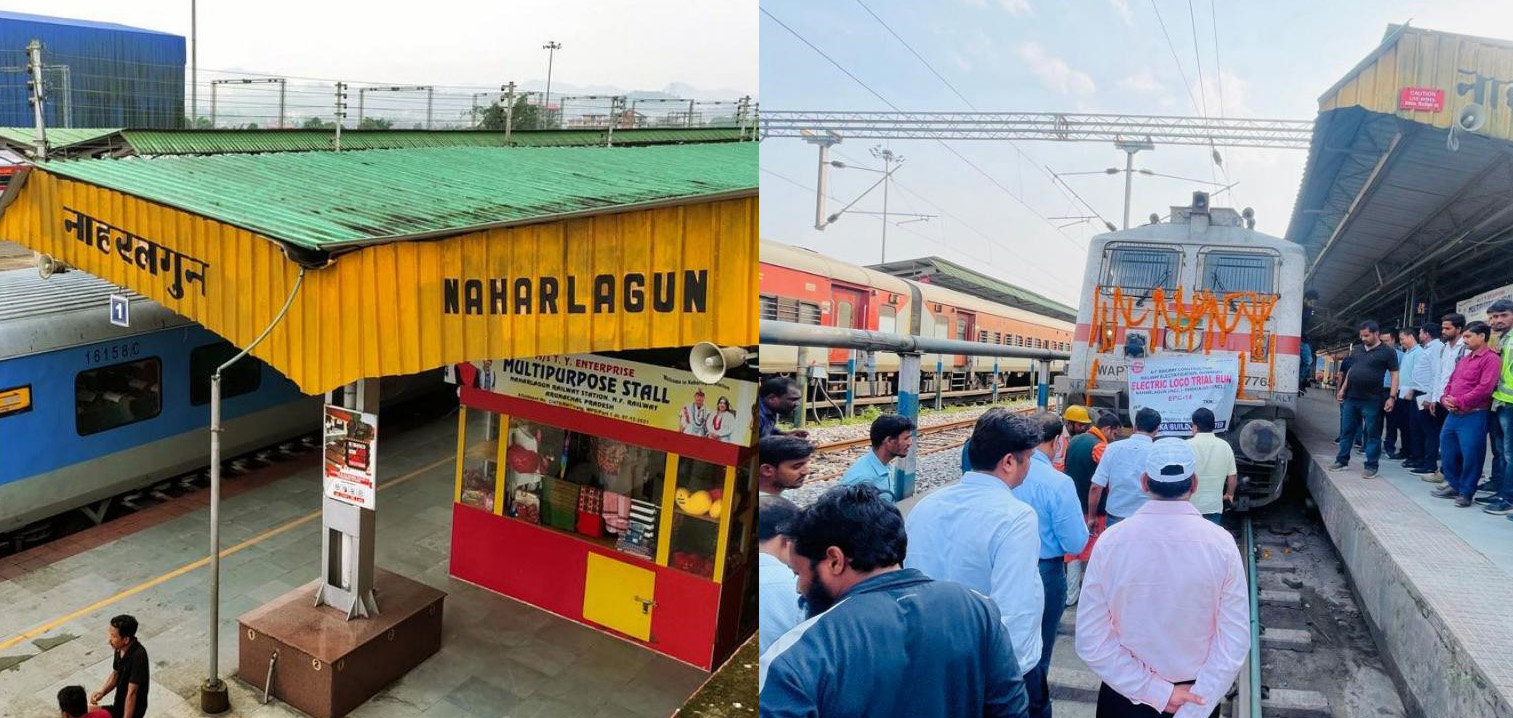
- High Time for rail network expansion
By Pradeep Kumar
NAHARLAGUN, Mar 20: The successful trial of electric train on the Harmutty-Naharlagun section of the Indian Railways on Thursday created a milestone to herald a new era of faster, efficient and greener railway journey fopr people of this land-locked state.
The electrification would not only boost railway connectivity for the state, but also facilitate plying of speedy Vande Bharat Express (VBE) to strengthen integrating this remote state with rest of the country through modern railway network.
The VBE has transformed rail travel in India, marking a new era of mobility with its indigenously developed semi-high-speed technology. This ultra-modern train has not only elevated passenger experience but has also contributed to the country’s economic growth.
Manufactured at Chennai’s Integral Coach Factory (ICF), the VBE is designed for a maximum speed of 160 kmph, but plying at 110 kmph with average speed of 120 kmph.
Several MPs in Lok Sabha have raised concerns whether its operational speed has declined over time despite its high-speed capability and also sought updates on the Govt’s plans, timeline, and strategies to ensure the train operates at its optimal speed.
Responding to these queries, Railway Minister Ashwini Vaishnaw explained that a train’s speed is influenced not just by the rolling stock but also by the track infrastructure along its route. He stressed that upgrading and improving railway tracks is an ongoing process across Indian Railways, which has geared up to launch first hydrogen train by March 31, Financial Express reported on March 6.
“In 2014, the speed potential of only about 31,000-km of track was 110-kmph and above, which has significantly been improved to about 80,000-km at present,” Vaishnaw said.
Currently, 136 Vande Bharat train services operate across the nation, running at full occupancy since their inception on 15.02.19. As India’s fastest train, it surpasses both the Shatabdi and Rajdhani Express in speed and efficiency.
But, Arunachal Pradesh capital complex had reverberated with the chug chug sound after Prime Minister Narendra Modi had flagged off first Naharlagun-New Delhi AC train service virtually from Itanagar’s Indira Gandhi Park on 20.02.15 during Statehood Day celebration.
Interestingly, the British rulers during 1858 to 1947 did more good to India than the Indian rulers did since then. For the Britishers came as traders and undertook development work intended to flourish their trade. Examples are aplenty. To quote former Railway Minister Lalu Prasad Yadav, who in his 2007 budget speech had said: “Even the foreign Govt of the British had understood this fact and from 1833 to 1900, had built 40,000-km of rail track whereas we constructed only 8,000-km of rail track between 1947 to 1995”.
Thanks to the UPA Govt, particularly Prime Minister Manmohan Singh, for realizing importance of the North East through its Look East Policy and giving the required thrust for its development, which in turn would push up the national GDP.
It was the British who had built the 180-km Rangia-Bhalukpong stretch in the then NEFA, albeit to transport huge timbers and tea chests to enrich their coffers. While Lalu in 2007 ordered surveys for gauge conversion of Rangia-Murkongselek and Tezpur-Bhalukpong link lines, besides updating of the surveys of the Harmuti-Itanagar railway line, it was the PM Singh who in 2008 had announced to put Itanagar on the rail map of India. The Planning Commission had approved several projects in 11th Five Year Plan to break prevailing isolation syndrome of NE region.
The ambitious 4.315-km Bogibeel road-cum-rail bridge, 198-km Lumding-Silchar-Jiribam gauge conversion, 100-km Ziribam-Imphal extension project to link Manipur, 108-km Kumarghat-Agartala, Jiribhum-Tulpul; Dimapur-Zuzba; Azra-Byrnihat; gauge conversion of Rangiya-Murkongsele, 84-km Badarpur-Bhairabi section for gauge link to Mizoram and 15-km Amguri-Tuli line were sanctioned to expand the NE rail network.
However, realizing huge untapped natual resources of eight NE states and strategic importance of Arunachal Pradesh which shares 1,129-km border with China and recorded numerous intrusion by PLA soldiers in the past, Modi Govt has attached top priority to NE development under ‘Act East Policy’ and railway network expansion is part of the process.
It is a fact that China in 1962 had attacked from Eastern sector (Twang) to defeat India. When China has developed very good road and rail line close to Arunachal boundary, but still Arunachal depends of trucks to transport all commodities from rest of India, including from Harmuti Junction where 500 MT of goods meant for Arunachal lands every month. Sooner goods train service is introduced from Naharlagun station the better.
The Indian Railways network as of 31.03.24 spanned 68,584-km route, making it the 4th largest in the world, and operates over 13,500 daily passenger trains, including 5,125 suburban EMU trains and over 9,100 daily freight trains. However, the railway density of NE is only around 10.79-km of railway lines per 1000-sqkm.
Thus, it is high time for rail expansion to put Parsuram Kund in global tourism map as it was pleaded by Arunachal Chamber of Commerce of Industries in February 2007 in a letter to Railway Minister Lalu Prasad Yadav, besides Namsai Golden Pagoda and Tawang Monastery.
Let ‘act East Policy’ translates the ministry’s 2019 proposals of railway lines: 378-km Bhalukpong-Tenga-Tawang, 247.85-km North Lakhimpur-Bame-Aalo-Silapathar and 227-km Pasighat-Tezu-Parsuram Kund-Rupai into reality by improving connectivity to northern and eastern frontiers of this state.


 20
