
By Pradeep Kumar
India shares 3,488-km border, including 1,129-km in Arunachal Pradesh with China, which with its ‘Dog-tailed Foreign Policy’ intrudes into Indian Territory often in above state claiming its own as ‘South Tibet’, prompting New Delhi to boost its strategic border infrastructures, like roads, bridges, airfields and tunnels along the Line of Actual Control (LAC).
Despite Indian Army’s defeat in 1962 Indo-China war, infrastructures to border areas remained neglected till 2008, when then Defence Minister AK Antony during his maiden visit to Tawang had sprang a surprise while addressing the troops by admitting his Govt’s neglect of the region.
“In the past, required attention was not given to this region. There is no point in finding fault with anybody. It’s our topmost priority now to develop infrastructure in the Northeast,” he had said and admitted in Parliament later that not developing infrastructure on the China border was a “well thought” decision.
Then Prime Minister Manmohan Singh, during his visit to Itanagar on 2008 had announced fast-track development for Arunachal Pradesh – whose territory is disputed by China – by way of some new projects amounting to over Rs. 4000 crore, which included a new rail link between Itanagar and Harmuti, grid-based power project to cover all border villages and a helicopter service between Guwahati and Tawang.
The Cabinet Committee on Security approved the raising of two new mountain divisions for Indian Army at a cost of Rs 650 crore each. The Army acknowledged that this was the first move taken by the Govt “to prepare for any possible long-term threat from China.”
Fulfilling vital strategic/security imperatives for rapid military deployment against China and Pakistan and enhancing regional connectivity to benefit people of many border states, 75 projects were taken up on priority in Jammu & Kashmir (19), Ladakh (11), Arunachal Pradesh (18), Uttarakhand (9), Sikkim (6), Himachal Pradesh (6), 2 each in West Bengal and Rajasthan and one each in Nagaland, Mizoram, and Andaman & Nicobar Islands.
To fulfil some aspects of the fast-track development, the Border Roads Organisation (BRO) had to make some major moves by mobilizing its equipment to make up for decades of delay in constructing roads, bridges and tunnels in mostly very challenging terrain, low temperatures and climatic conditions.
Within a decade BRO had made great progress facilitating faster movement for the Army, which riled the Chinese Communist Party and the People’s Liberation Army (PLA) enough for the latter to make major moves of grabbing Indian Territory as in Depsang in 2013, Doklum in 2017 and Eastern Ladakh in 2020.
In 2020, the then DG Border Roads, Lieutenant General Harpal Singh was reported to have said, “The foremost challenge facing the BRO is to induct up to 40,000 workers into sites in forward areas after the recent opening of passes. We are talking about migrant workers who play an important role in our construction projects. We are looking at how to make this workforce available at the earliest keeping the challenges posed by the pandemic in mind.”
The BRO’s peak working season extends from May to November. Migrant workers are a key part of the BRO’s workforce involved in building strategic roads, along the country’s northern border with China, scattered across Arunachal Pradesh, Jammu and Kashmir, Sikkim, Uttarakhand and Himachal Pradesh. Despite the problems caused by the Covid pandemic, BRO made commendable progress, which by 2025 amounts to coming a long way since 2008.
On October 12.10.24, Defence Minister Rajnath Singh had inaugurated 75 critical strategic infrastructure projects of the BRO virtually from Sukna, Siliguri, marking a significant milestone in the nation’s journey of development and connectivity witnessed by governors or chief ministers of 11states virtually.
Constructed during adverse weather and geographical conditions, the 75 projects encompass a wide array of developmental works aimed at improving accessibility and mobility in the nation’s remotest and most challenging regions. The breakdown of these projects is 22 roads, 51 bridges and two miscellaneous projects.
Among the 75 projects, Kupuk-Sherathang Road in Sikkim stands out as a critical link on a strategic route connecting Jawahar Lal Nehru Marg with the Zuluk axis, providing an alternative pathway for the efficient movement of Army troops, personnel, and machinery. This road plays a pivotal role in national security and military logistics, ensuring uninterrupted connectivity in this high-altitude region.
Another noteworthy achievement is North-South Road in Andaman & Nicobar Islands, which links to Indira Point, the southernmost tip of India. These projects not only signify developmental milestones but also assert the strategic importance of India’s border and island regions.
However, the BRO has completed over 450 projects worth Rs.16,000 crore over the past five years,. With the inauguration of these 75 projects, BRO has completed a total 111 infrastructure projects in 2024 itself at an overall cost of Rs 3,751 crore. This includes 36 projects worth Rs 1,508 crore, like state-of-the-art Sela Tunnel in Arunachal Pradesh, longest twin lane tunnel in the world, inaugurated by Prime Minister Narendra Modi in March 2024.
In July 2024, PM Modi conducted the “first blast” of the Shinkhun La Tunnel on the Nimu-Padam-Darcha Road which, along with Atal Tunnel, will provide all-weather connectivity to Leh. Constructed at an altitude of 15,800 feet, it will be the highest tunnel in the world. The 4.1 km-long twin–tube tunnel with unidirectional traffic would have cross passages at every 500 metres.
It will reduce travelling time by about 30 minutes and also serve as a vital link connecting Lahaul Valley in Himachal Pradesh with the Zanskar Valley in Ladakh. It will boost the security and economy of Ladakh and promote trade, tourism and development in general, bringing new opportunities and improving livelihoods of the local people.
The Chisumle-Demchok Road constructed by BRO at an altitude of 19,024 feet is the world’s highest motorable road over Umlingla, the world’s highest mountain pass connecting Chisumle to Demchok in Southern Ladakh, has been recognised by the Guinness Book of World Records.
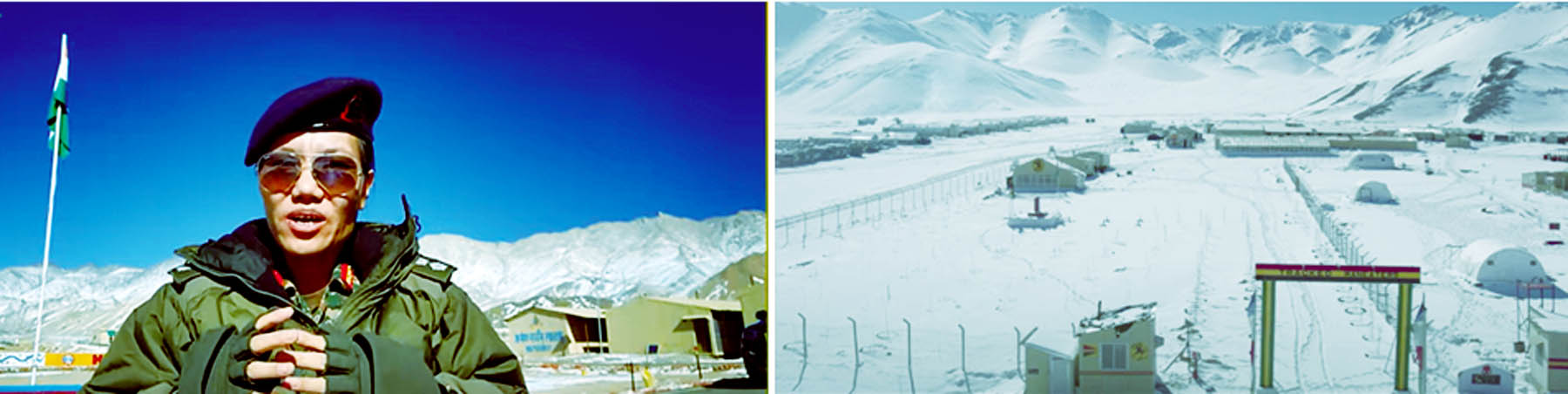
Col. Ponung Doming, a pioneering officer from Arunachal Pradesh, is leading the engineering task force at 15,300 feet in Ladakh, has shared with media her challenges, triumphs and the unyielding spirit of the Indian Army’s engineering corps in one of the world’s most extreme terrains.
From sub-zero temperatures and avalanches to logistical hurdles and reduced manpower efficiency, Col. Doming’s command is a testament to grit, innovation and leadership. She discusses the strategic importance of border infrastructure, how her team ensures all-weather connectivity in the region and the cutting-edge technologies revolutionising military engineering projects.
Beyond the technical challenges, Col. Doming reflects on her personal leadership journey—from being raised in Arunachal Pradesh to becoming a role modle for women across the country. She speaks about the power of self-reliance, importance of teamwork and the responsibilities that come with commanding an elite engineering force at the frontlines.
With India rapidly enhancing its border infrastructure post the Galwan incursion in 2020, Col Doming’s views sheds light on the country’s evolving strategic posture and the unsung heroes working tirelessly behind the scenes.


 20

