
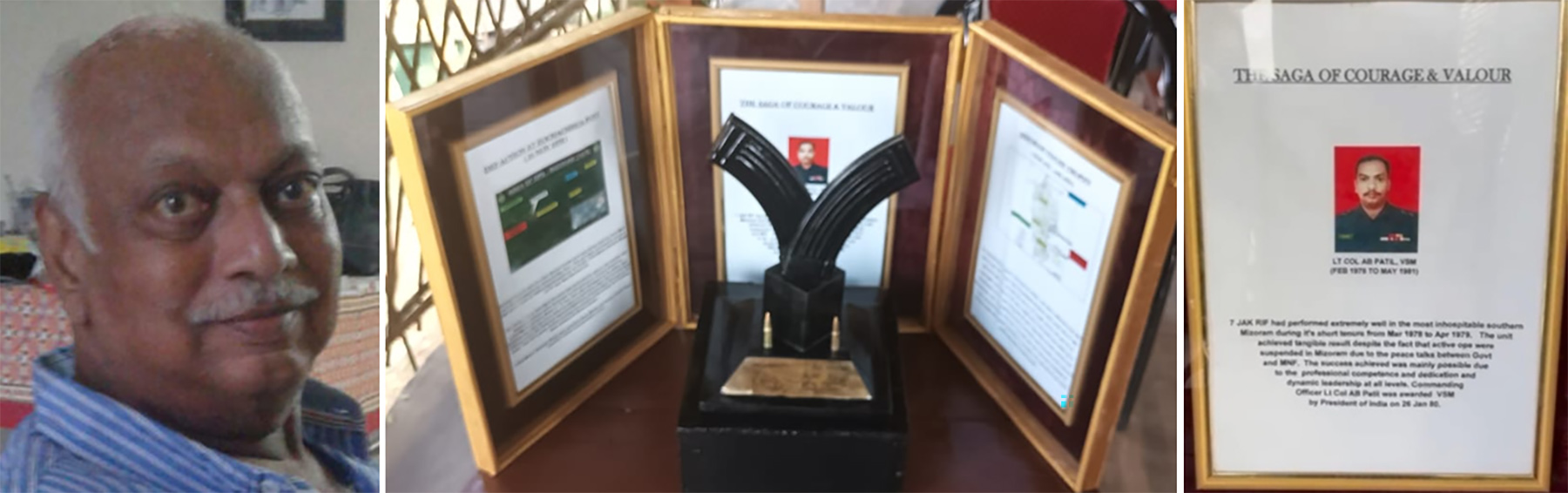
By Prdeep Kumar
ITANAGAR, Apr 20: Indian Army veteran of 1962 Indo-China War Col (Retd) Amar Patil, who arrived West Siang district HQs Aalo from Pune on Sunday, told this over telephone, “We would visit Mechukha and Dorjeeling in Shi-Yomi district on Monday and return to Aalo on April 24.We will return to Pune on April 25,”
“I had also commanded 7 JAK RIF in Mizoram in 1978-79 and at Chaubatia till 1981.The unit did extremely well in tri-junction area of India, Burma and Bangladesh and received one each of Sena Medals and Vishisht Sewa Medal, 10 COAS CCs and two personal for MSGs from Eastern Army Command,” he said, adding, “The magazines on trophy are replicas of AK 47 rifle magazines recovered from insurgents in Mizoram”.
It may be recalled here that Amar Patil as second lieutenant of Indian Army’s 2 Jammu and Kashmir Rifles had commanded the unit in Subansiri sector during the war when haviladar Shere Thapa had fired his light machine gun relentlessly killing 155 People’s Liberation Army (PLA) jawans of China, who had fallen into the Ngo River without anyone to count on October 18. Brave Thapa hiding in a very advantageous position had fired non-stop as his lone soldier-mate continued changing the carbines.
The PLA jawans had sneaked through the Tama Chung Chung Ridge. Thapa had positioned himself on a vertical slope – invincible high mountain ridge on one side, steep slope down to the Ngo stream, the source of the Subansiri River, on the other side. He had located the most strategic place, either to stop or kill the advancing Chinese soldiers. Thapa did not notice anymore Chinese after emptying all magazines with the fired brash khokas lying scattered.
He confidently came out of his bunker for a reconnaissance and peeped towards the heap of corpses with great satisfaction. A wounded but alive PLA soldier, lying on the heap along with his colleagues fired, killing him instantly. The corpses of the Chinese soldiers were piled up so much that the river failed to carry them. This is the folklore. The great soldier is highly revered in the area for his gallantry act.
Political interpreter Chader Mangha along with many villagers who used to carry supplies, arms and ammunition for Thapa’s Army section were witness to his bravery. Mangha, who died in 1994, was given a commendation certificate by the GoI in recognition of his service to the nation and promoted to the rank of political assistant.
Arunachal Eastern parliamentary Lok Sabha member Tapir Gao, who was apprised about the gallantry act of Thapa by Patil had called on Defence Minister Rajnath Singh in New Delhi on 25.09.20 and submitted a letter requesting him to award gallantry award posthumously to the great martyr.
Interestingly, the Chinese had respectfully buried him and left a small note praising his bravery. Even Thapa’s bravery was vouched by his commanding officer. Why none ever bothered to honour his brave act, even posthumously is intriguing?
However, Indian Army observers ‘Shere Thapa Martyrdom Day’ annually by placing wrath on his memorial at Limeking village, Upper Subansiri district.
After unveiling on 06.01.22 the bust statue of great warrior Thapa built by Border Road Organisation, Chief Minister Pema Khandu, had written on Facebook: “Little we know about havildar Shere Thapa, who single handedly delayed the waves of assault of Chinese Army for hours during 1962 war. It was at the Rio Bridge in between Taksing and Nacho in Upper Subansiri district that the brave heart laid down his life fighting for the country. Heartiest tribute to late havildar Shere Thapa.”
It is needless to recollect here that the Editor of this daily was first to break the news about Thapa to the world through ANI on 19.10.2012 – Forgotten Sino-India War hero Shere Thapa is no less a martyr than Jaswant Singh Rawat.


 20
