
- Mirathang spotted for HFRS
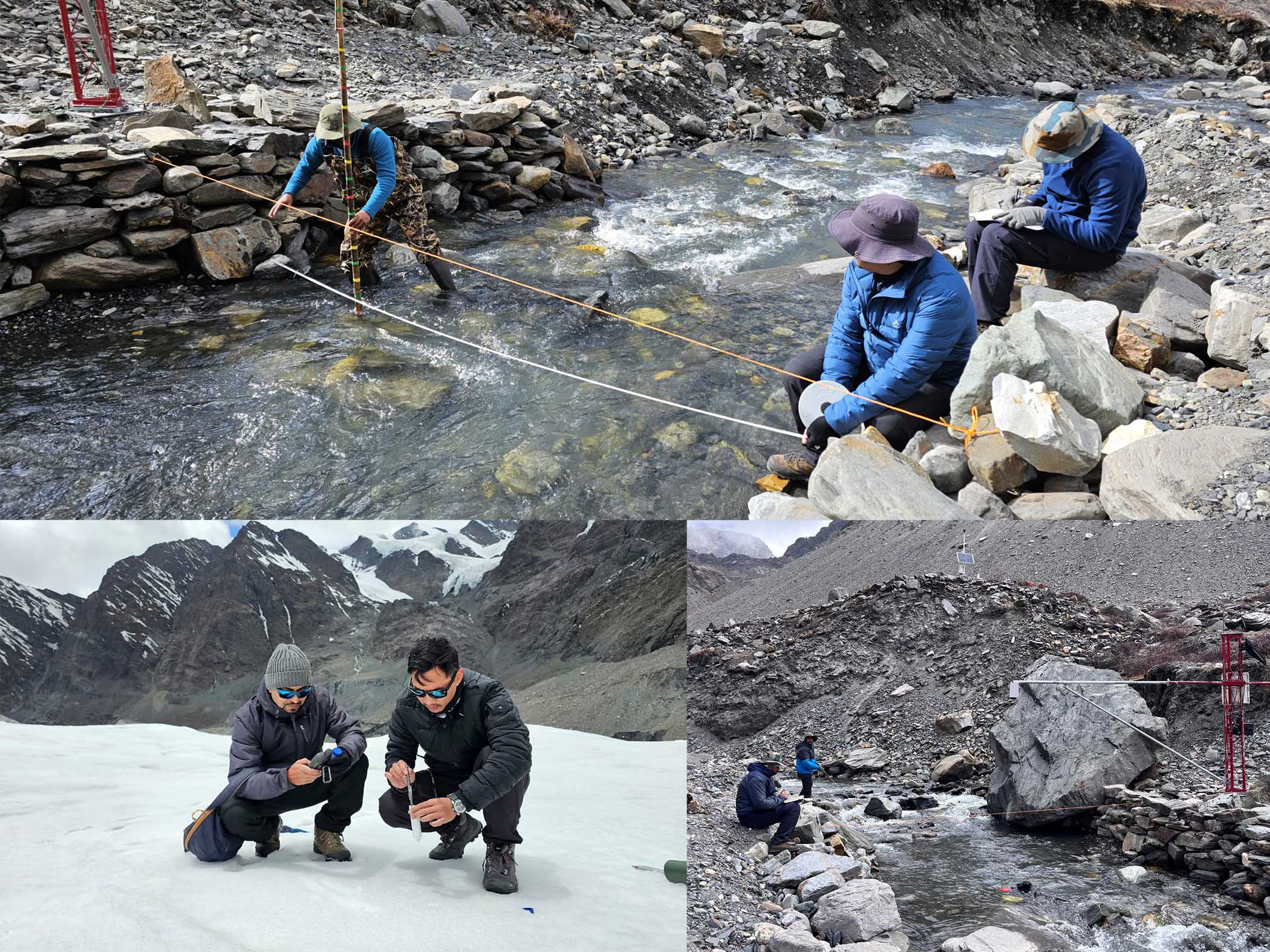
DIRANG, Apr 26: The Centre for Earth Sciences and Himalayan Studies (CESHS) headed by director Tana Tage along with Goa-based National Centre for Polar and Ocean Research (NCPOR), Ministry of Earth Sciences and Guwahati IIT conducted an eight-day 3rd high-altitude expedition to the Khangri Glacier in Gori-chen Mountain region which concluded on Saturday.
The joint team, comprising four scientists and engineers each from NCPOR and CESHS and one IIT expert, undertook detailed glacio-hydrological studies aimed at understanding the glacier’s health and associated water resources. Key activities included glacier mass balance measurements at 5032 msl aimed at understanding the glacier’s health and response to climate change.
As a pioneering effort in the region, the team conducted a comprehensive risk assessment of Rani Lake, a Category-B glacial lake—identified by the National Disaster Management Authority (NDMA)—for its potential to trigger glacial lake outburst floods (GLOFs). This involved a bathymetric survey to determine lake depth and volume along with terrain observations to evaluate moraine stability, drainage pathways, and downstream hazard potential.
To support continuous climate monitoring, the team also performed maintenance of an automatic weather station (AWS) and successfully retrieved winter-over data, ensuring uninterrupted acquisition of essential meteorological parameters critical for glacier and climate studies.
In addition, the team also performed maintenance of water level sensors and conducted direct measurements of glacier meltwater discharge, enabling accurate assessment of total runoff from the glacier system.
Marking another first-of-its-kind initiative, the team carried out a first-ever reconnaissance survey of a cluster of Category-B glacier lakes located at an altitude of 5300msl. These lakes, identified by the NDMA, were assessed for their risk potential to inform future hazard mitigation and disaster preparedness strategies. Reaching the remote site involved a strenuous high-altitude trek across rugged terrain, snow-covered passes, and rapidly changing weather conditions, indicating the logistical challenges faced by the scientists.
The team successfully identified a suitable site at Mirathang for establishing a long-term high-altitude field research station (HFRS) in order to make such expeditions more convenient, according to a CESHS release.


 20

