Anti-dam activist faces legal
action over public protest
By A O News Service
ITANAGAR, May 27: A young anti-dam activist, who allegedly led villagers to launch an “indefinite protest” against the Siang multi-purpose project in Siang district, is facing legal action, district sources told this daily on Tuesday.
Activist Ebo Milli, also a lawyer, on Monday said Siang district DC PN Thungon lodged a complaint with Boleng police station alleging violation of prohibitory orders over the protest at Beging village, where a study for PFR is to be carried out. The complaint was filed U/Ss 135, 191 and 324 of the Bharatiya Nyaya Sanhita and Sections 3 and 4 of Prevention of Damage to Public Property Act, 1984.
The DC in the letter said that Milli had led a “mob” of 80 to 90 persons under the banner of Siang Indigenous Farmers’ Forum (SIFF), on May 22 and 23. The SIFF members launched a fresh “indefinite” agitation, saying that the big dam to be built on Siang River would lead to displacement and result in serious adverse impact on their livelihoods and ecology.
Reacting to the complaint, Milli on Monday evening said the protest would continue.
From Our Correspondent
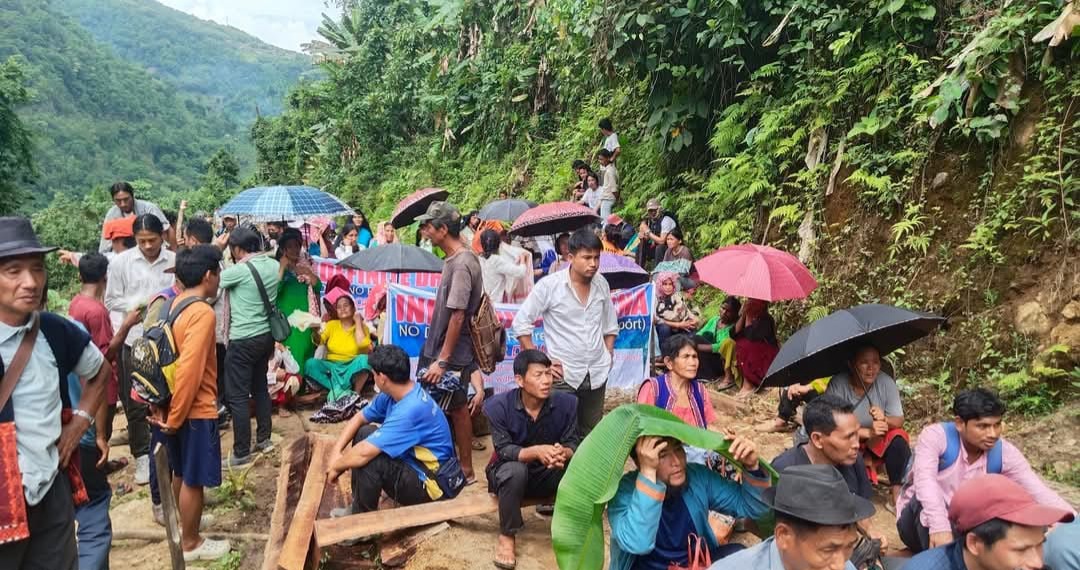
BOLENG, May 27: “No dam, go away” slogans rented the air in Beging village of Siang district against the proposed 12,000-MW Siang Upper Multipurpose Project (SUMP) since May 23 as about 400 villagers have gone on an indefinite protest against the deployment of armed forces in the area to conduct first phase sturdy for a pre-feasibility report (PFR).
As the GoAP deployed armed forces and drilling machines were brought in for the PFR, protesting villagers burnt a hanging bridge to prevent them from approaching the area.
Local communities’ main concerns are that the SUMP, being executed by the National Hydroelectric Power Corporation (NHPC) would lead to displacement, loss of homes and agricultural lands besides environmental impacts, like loss of rich biodiversity of the area.
To make matters worse, the SUMP is set to be India’s largest hydropower project, if built in a seismically zone-V area.
Though the villagers have been protesting against the project since several years, the protests now triggered by deployment of armed forces in the area on May 21 to helpd the NHPC to conduct the study. Around 100 personnel of the Central Armed Police Force (CAPF) were deployed in Siang, Upper Siang and East Siang the districts.
Beging villagers took out a march, epicenter of the protest, on May 23 in protest against the deployment. Spearheaded by Siang Indigenous Farmers’ Forum (SIFF), they reiterated their demands again. “We will die for our lands,” villagers could be heard telling army personnel deployed in the area.
Although it was meant to be a peaceful protest, emotions were high and some angry villagers burnt the bridge, SIFF youth wing leader Nith Paron said, adding that people have been now convinced to not resort to violence in any form and engage in only peaceful agitations.
A letter submitted to the Siang DC by the SIFF on May 23 said that they have initiated an “indefinite dharna” in protest against the deployment of armed personnel for the initiation of the pre-feasibility report for the SUMP.
The letter stressed on three points: First, the GoAP removes all CAPF personnel from three districts; second, the drilling machine brought to Beging for the survey be removed in four days and third the GoAP gives an assurance that “no further forceful activity for the PFR will be carried out without the free, prior and informed consent of the local communities.”
The letter specified that failure to meet these demands by the local communities will force them to ‘intensifying their democratic protest’.
The GoAP says the multi-purpose project is aimed at checking possible threats from the 60,000-MW dam being constructed by China in the upper reaches of the Siang, which is called Yarlung Tsangpo in Tibet, which on completion would be the largest on the earth.
Chief Minister Pema Khandu recently had said the project has been proposed by the Centre to maintain natural flow of water in Siang River throughout the year and flood modulation in case of huge volume of water released by China.
In mid December last year, villagers of Geku, Reiw and Parong in the Upper Siang districts had taken out marches protesting against the SUMP. The protests, similar to present, were also in reaction to a directive by the GoAP to deploy central and state armed forces in the area to implement the project.
While the GoI has claimed that the SUMP is a counter to the mega dam being built by China just upstream of the Indian border on the Siang river before it enters India, local communities are still worried and have repeatedly raised a number of concerns about the project.
Villagers worry that nearly 27 villages will be displaced, and their lands (either in whole or partly) will be acquired and/or submerged for the project. This will result in the loss of peoples’ homes and their agricultural lands. Agriculture is the mainstay of people in the area.
Secondly, the way that district authorities, the GoAP and the GoI have pushed forward with the project without taking local people into confidence is a matter of concern. Army deployment has become a regular phenomenon, and local communities have been resisting this actively.
“The whole scenario has been very sad and unjust for our people,” said Pasighat resident Katon Moyong, who had joined the protest on May 23.
“I came here to be part of the protest so that we can save our lands…save our mountains and rivers from this sheer humiliation against us – putting a 12,000 MW dam in our lands without our permission and consent. That is a punch in our hearts,” he said.
The protest is a “warning to the leaders behind it – CM Khandu, Prime Minister Narendra Modi or Amit Shah” to “back off from this so that our people can live peacefully,” Moyong said, adding “We are not against dams, but we are against large dams, like the SUMP”.


 20