
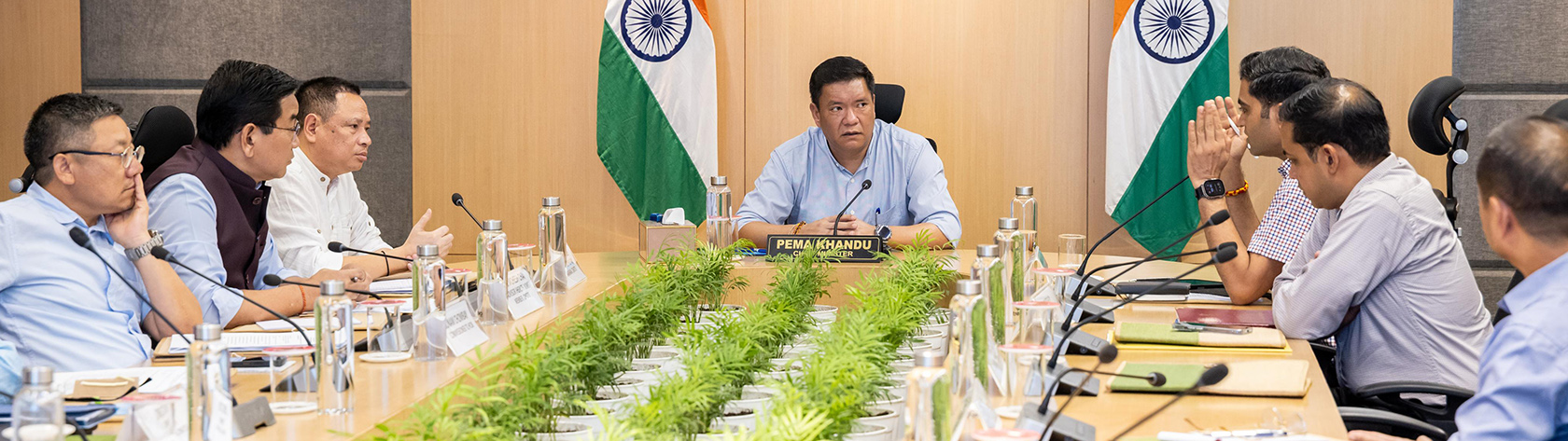
ITANAGAR, July 22: “Treatment alone isn’t enough. Real progress is when people don’t fall sick in the first place. We have to change how we think about healthcare, because a healthy society doesnot start in the operating room. It starts at home, in our communities, in how we live. That’s why the Health Department must focus on prevention, not just treatment. And that means real investment in awareness, education and lifestyle change,” Chief Minister Pema Khandu said with conviction here on Tuesday.
In his presidential address to first governing body meeting of Chief Minister’s Organ Transplant Society to implement newly launched Chief Minister’s Organ Transplant Scheme (CMOTS), an expansion and relaunch of earlier Chief Minister’s Renal Replacement Scheme (CMRRS), Khnadu emphasized the importance of a holistic approach to healthcare.
The CMRRS since its inception in last seven years has successfully supported over 200 kidney transplant patients across the state. Building upon this success, the CMOTS broadened the scope of support to include liver and bone marrow transplants in addition to kidney transplants now.
Under the new scheme, the GoAP will provide financial assistance up to ₹10 lakh for kidney transplants, ₹15 lakh for bone marrow transplants and ₹20 lakh for liver transplants.
The CMOTS launch indicated the GoAP’s continued commitment to accessible and equitable healthcare for all to ensure critical life-saving transplants are within reach of every eligible citizen. (CMO)
AONS adds: This announcement comes after state Health & Family Welfare Minister Biyuram Wahge along with MLA-cm-advisor to H&FW Minister Dr Mahesh Chai and Dr Moji Jini, director of TRIHMS, state’s lone medical college-cum-hospital, on July 11 had visited Chandigarh-based Postgraduate Institute of Medical Education and Research (PGIMER) to strengthen ongoing collaboration between two institutions.
The visit aimed to reinforce efforts to establish a robust renal transplant facility in the state and to request continued academic and technical support from the PGIMER. The team held constructive discussions with PGIMER Director Prof. Vivek Lal and a panel of expert doctors focused on technical roadmap, phased implementation strategy to ensure safe and effective transplant protocols tailored to the state’s unique healthcare landscape.
The visit also saw second batch of healthcare professionals of the state being trained in the PGIMER. A previous team comprising doctors and transplant coordinators had undergone extensive training under the institute’s mentorship. The current batch continues this partnership, ensuring capacity building and skill development for establishing a self-sustaining renal transplant ecosystem in the state.
“I have come here to thank you all. You have helped me accomplish such a significant thing. Our patients struggle to access transplant facilities and it is time we bring this critical service to our state. The PGIMER is a national institute of excellence and we are here to seek your mentorship, your support and your experience to help us build a transplant facility in Arunachal Pradesh,” the minister had said.
Lal elaborated on the pathways for in-service doctors from the state, including both sponsorship-based postgraduate training and short-term observer programmes that offer immersive exposure without interrupting essential services back home. Such dual-mode training strategies have already proven successful in other partnerships, including with the Indian Army. They are now being extended to the state, he said.
“It is truly remarkable that you have travelled from Arunachal Pradesh bypassing formal protocols, just to spend maximum time to understand our systems. Your dedication to improve health services of your state is exemplary. Thus, PGIMER stands committed to supporting Arunachal Pradesh with structured training programs, observer opportunities and shared clinical protocols,” Director Lal said to laud Wahge’s commitment,


 20

