
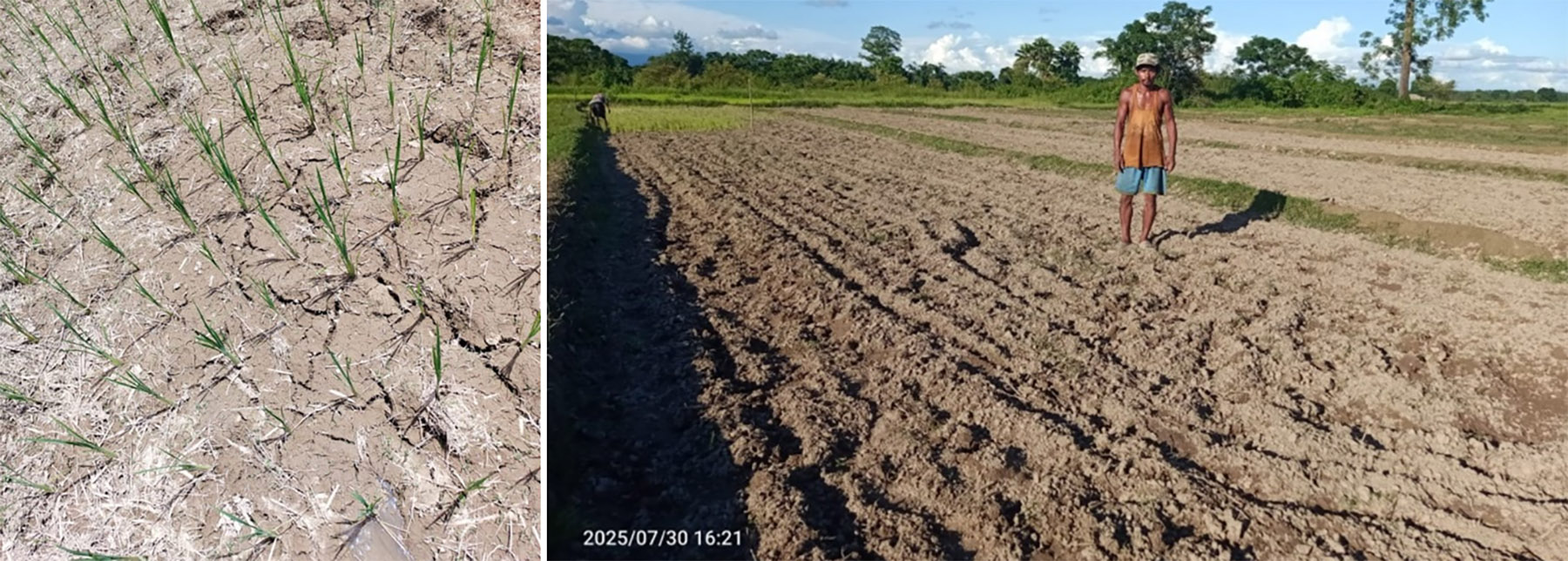
By Pradeep Kumar
ITANAGAR, Aug 01: The cruelty of adage “Excess water destroys the Earth, no water destroys the Earth (Jala bahuley shriti nasha, jala bihune shriti nasha) is visible on ground in many parts of North East, particularly Assam and Arunachal Pradesh. While part of Assam have recorded a40% rainfall deficit and five districts in western Assam have been declared drought-hit by Chief Minister Himanta Biswa Sarma on July 23, Arunachal Pradesh recorded deficit rainfall of -229 mm between June 1 and July 8 last against actual 595 mm and normal 366 mm, according to India Meteorological Department (IMD).
The farmers of Siang belt, once the rice bowl of the state, have been struggling for paddy cultivation without adequate rainfall this month, Arunachal Pradesh Congress Committee (APCC) president Bosiram Siram had told this daily. Many farmers were seen walking on their dry paddy fields in East Siang district on July 3 (sent by him in picture) and looking at the sky anticipating chance rainfall through they knew that time is gone and rainfall unlikely. They have to make alternate arrangement to earn their livelihood.
But, in a state which has no large industries, how daily wage earners would get work is a million dollar question. Thus, the central Govt in 2005 had introduced Mahatma Gandhi National Rural Employment Guarantee Act (MGNREGA) to provide a legal guarantee of at least 100 days of wage employment in a financial year to rural households willing to do unskilled manual work. This scheme aimed at enhancing livelihood security in rural areas.
This Act is currently implemented in rural areas across the country, covering 644 districts, according to nregaplus.nic.in. Rural Development Minister Giriraj Singh, in a written reply had informed Lok Sabha on 25.07.23: 1,49,51,247 MGNREGA job cards in 2021-22 were deleted while 5,18,91,168 job cards in 2022-23, were cancelled. More than five crore job cards under the MGNREGA were cancelled in 2022-23, 247%more than number of deletions in 2021-22, he had said, adding “Updation of job cards is a regular exercise conducted by the States/UTs.”
However, this Himalayan state is predominantly an agricultural economy with over 60% of its population rely on farming for their livelihood. The state boasts of a diverse range of crops, including rice, ragi, jowar, maize, millet, potato, ginger, mustard, number of cash crops and various vegetables. A significant portion of agricultural practices in the state are organic by default as over 80% of crops are produced without chemical fertilizers or agrochemicals. Moreover, this state is known for its horticulture products, like kiwi, citrus, large cardamom, cashew, pulses, oilseeds, orchids and medicinal plants. Over 90% of agriculture in the state is rainfed, making it vulnerable to monsoon variations.
The state topped in India in kiwi production in 2023-24 with total output of 7.05 kilotonnes. Kiwi is cultivated in an area of over 24.3 km² and major kiwi-producing districts are Tawang, West Kameng and Lower Subansiri, while Ziro produces the best quality of kiwi. The paddy-cum-fish cultivation of Apatani tribe, a unique farming practice, is globally famous for contributing to soil fertility while circling the same water. In fact, Apatanis have added duckery for higher income from this sustainable practice.
Despite its potential, agriculture sector of the state faces challenges, like lack of irrigation facilities, dependence on monsoons and the need for better infrastructure and market access. Thus, Atma Nirbhar Krishi Yojana (ANKY) was launched on 03.09.21 by Chief Minister Pema Khandu to provide financial assistance and support to farmers for various agricultural activities to boost agricultural productivity and enhance their income.
As the famers are victims of unpredictable nature this year, the state Govt has to rise to the occasion to extend support to the depressed famers through the ANKY.


 20
