
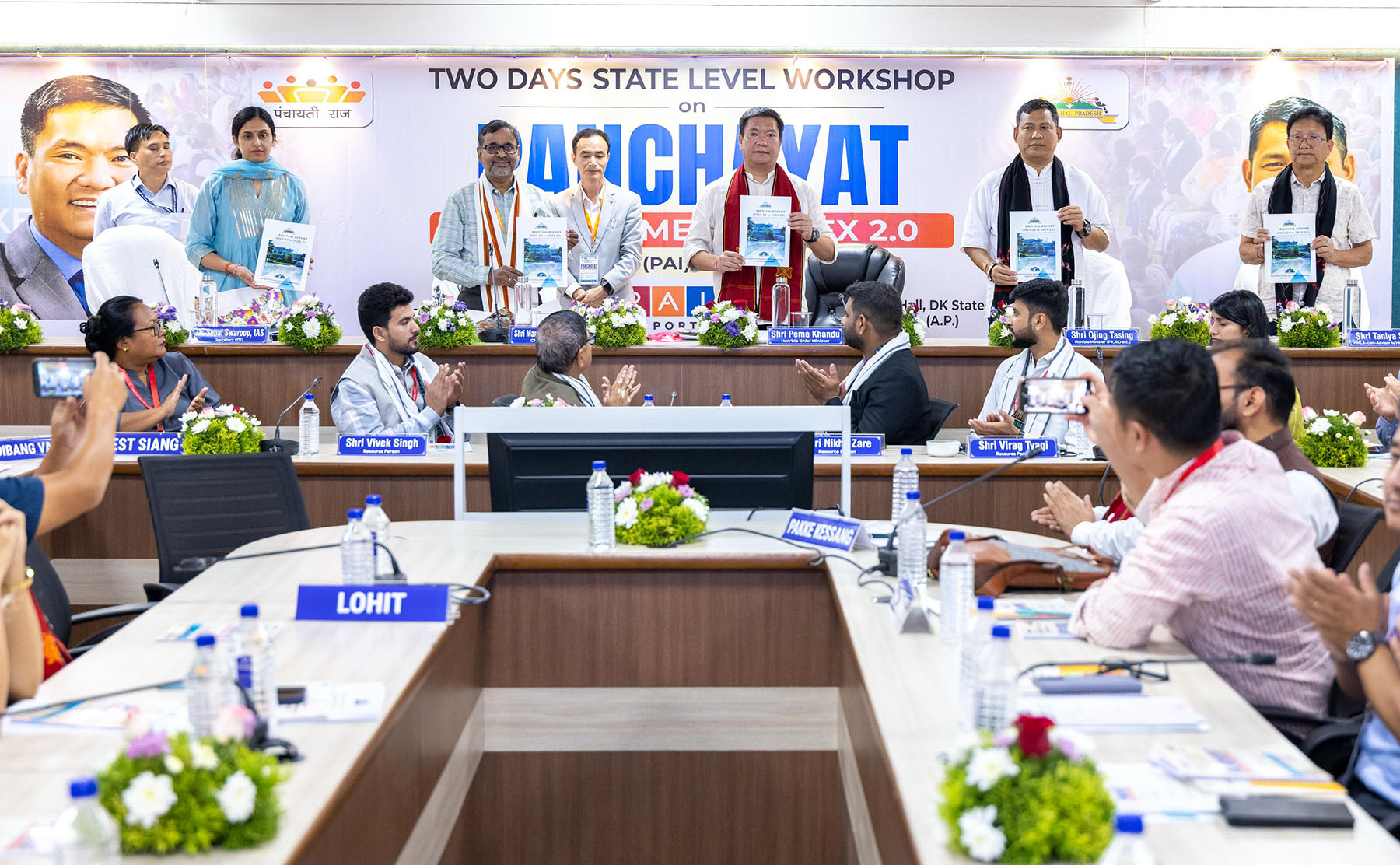
ITANAGAR, Aug 04: Chief Minister Pema Khandu inaugurated a two-day state level workshop on ‘Panchayat Advancement Index (PAI)-2, organized by Panchayati Raj Department and SIRD in collaboration with Union Ministry of Panchayati Raj (MoPR) and Pune’s YASHADA at DK Convention Centre here on Monday, aimed at strengthening evidence-based planning and decentralized governance.
The PAI is a multi-domain and multi-sectoral index to be used to assess overall holistic development, performance and progress of panchayats. It takes into account various socio-economic indicators and parameters to gauge well-being and development status of local communities within a panchayat jurisdiction.
After releasing the PAI-2 booklet, Khandu, in his address, termed it as a scientific and data-driven framework introduced by the MoPR to assess development at the GP level. He said that it serves as a critical tool for bottom-up planning, helping identify local needs and progress on key rural development indicators.
Acknowledging formation of multi-tier committees at the state, district and block levels for effective implementation and validation of PAI data, Khandu said that the state level steering committee headed by chief secretary, state data validation team headed by PR secretary, district monitoring committees under DCs and data validation teams under DPDOs and block-level officers.
On rural governance, he reiterated that Arunachal remains largely rural, thus success of such real-time evidence-based planning tools is crucial. He reaffirmed the GoAP’s commitment to decentralization, citing that 10% of state’s own revenue is earmarked for PRIs. The state has also institutionalized Sustainable, Participatory, Inclusive, Comprehensive Empowerment (SPICE) model to empower grassroots democracy.
He further stressed the need to align PAI-2 with the broader Sustainable Development Goals (SDGs) and Localized SDG (LSDG) themes assigned to PRIs. “Achieving SDG targets by 2030 requires robust local planning and coordination across departments,” he said.
Emphasizing importance of continuous training and capacity building, Khandu termed it as the backbone for quality delivery of schemes and programmes at the grassroots level. He lauded efforts of SIRD & PR for having trained 15,819 personnel in last fiscal year on thematic areas, like governance, planning and implementation.
“The DCs play a pivotal role in grassroots development and service delivery. The government has empowered DCs with significant administrative authority, including power to suspend erring officers,” he said and urged them to lead with dedication and integrity.
The CM congratulated top-performing GPs, districts, circles and blocks under PAI for 2022-2023 before their representatives were felicitated. Advocating healthy competition among local bodies to improve governance, he asked all to strive for national-level excellence.
He also lauded Panchayati Raj Department, led by Minister Ojing Tasing, secretary, officials and MoPR, YASHADA, and SIRD & PR resource persons for holding the impactful workshop.
Besides Tasing, Advisor to PR Minister Tanya Soki, GP chairpersons, chief secretary Manish Kumar Gupta, PR Secretary Dr. Sonal Swaroop, MoPR and YASHADA resource persons, DCs, district panchayat development officers, district nodal officers and selected member secretaries, were present. (CMO)


 20
