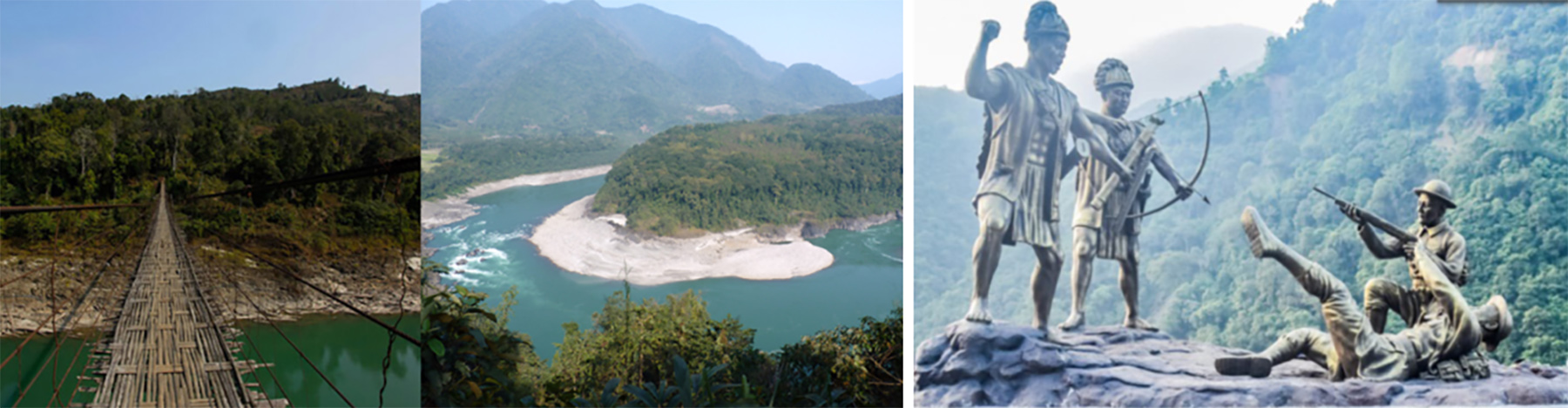
Mighty Siang River Anglo-Abor War memorial
Commitment visible
“Riga is a historic the second largest village in the state with around 3,000 population, 1,800 voters and four polling stations, after Hong village of Lower Siang district. There are 26 major tribes in the state, including Adi, besides over 100 sub-tribes, like Padam, Miyong, Bokar and Pasi, but Riga is the original hub of Miyong with historical importance.
“A decision taken by such a large village sends a louder positive message, which neutralised all rumours doing rounds that consents of 2/3 villagers were taken by making payment. Villagers have done it willingly without any pressure. Riga is one of the eight affected villages and its decision is a positive development which would spread across the district. The media would send the right message about this positive development,” DC P.N. Thungon had said responding to question as to why Riga village is in news for the last few months.
Beyond the Horizon
By Pradeep Kumar
The Upper Siang Hydroelectric Project or Siang Upper Multipurpose Project (SUMP) is the biggest hydroelectric power project planned in Upper Siang district, whose planning was commenced by the NHPC in April 2009 to build various hydro dams in phases over a span of 15–20 years. The main dam is being built across Siang River, which dam reservoir on completion would hold 9 billion cubic meters of water and generate around 11,000-MW, to become the largest hydroelectric dam in India.
On 9.06.2000 midnight, centurion town Pasighat, HQs of East Siang district, was submerged by 30-feet flood water of Siang River when people were fast asleep. The catastrophic flood, caused by reported collapse of a hydropower dam over Yarlung Tsangpo (Siang) River in Tibet, had left a trail of devastation and claimed seven lives. Experts, however, termed it as ‘water bomb’ used by China to test India’s preparedness. It is worth mentioning here that Siang flood washes away paddy fields and erodes huge land every year. The Siang flood has eroded around 3.5-km of community land during past three years, impacting Borguli, Seram, Kongkul, Namsing, Mer and Gadum villages along a 25-km stretch from Old Borguli to Siang-Brahmaputra confluence. This erosion has led to significant damage, including the loss of farmland, infrastructure like a higher secondary school, a football field, girls’ and boys’ hostels, and a sericulture farm and homes, forcing some villagers to relocate.
That is why Siang Flood Warriors (SFW) formed by social worker Gekong Pertin along with Mebo Industrial Estate Sawmill Union had built 16 spurs and 3 guide bunds to mitigate the erosion. Despite such, the flooding and erosion continue to be a serious threat, with locals expressing concerns about lack of adequate Govt support to tackle such recurring natural calamity.
In 2006, media had reported that the NHPC was planning to relocate and scale down the project due to concerns on flooding upstream by China. The situation reversed due to construction of many tall dams/massive storage reservoirs in the river basin area effecting river’s natural flow regime in downstream India. The SUMP was declared a national project in 2008 by the GoI, but agitation by local communities due to concerns about displacement and ecological damage delayed its execution and its pre-feasibility report (PFR) is still not prepared.
Thus, in 2025, NHPC planned to conduct the survey for PFR for site selection. The dam height is nearly 300 meters above the river bed level at dam location to store water up to 750 m MSL. The back waters of the reservoir would touch the foot of Medog Hydropower Station (60,000 MW) being built on the upstream river in Tibet by China so that adequate flood buffer is maintained to safely discharge peak floods by upstream dam failures due to earthquakes, Glacial Lake Outburst Floods and massive landslides.
The SUMP reservoir would act as a regulating basin to release continuous flows downstream according to the river flow regime when the water released from China’s upstream mega power station is regulated or intermittent as per needs of power generation on daily and weekly basis. The SUMP on completion would serve as a boon for the affected people of East Siang district for which Chief Minister Pema Khandu and Pangin MLA-cum-RD Minister Ojin Tasing have been perusing the agitating villagers to consent for construction of the project willingly. CM Khandu has defused the concern about 11,500-MW capacity of the dam saying, before conducting the PFR, it would be wrong to quantify its capacity.
Siang, the 21st district, derived from mighty Siang River, created by bifurcating West Siang and East Siang districts consisting of Rumgong-Kaying and Boleng-Pangin Assembly Constituencies with Pangin as its district HQs, was inaugurated on 27.11.15 by then Chief Minister Nabam Tuki. Siang district geographically, located almost in the centre of Siang belt of Arunachal Pradesh and predominantly inhabited by Adi tribe with P N Thungon as its deputy commissioner, has been in the news, since the Govt proposed to develop the SUMP.
DC Thungon, amidst the negative vibes, has been winning hearts with his go-getter attitude, known for not accepting ‘No’ for any act for greater welfare of the people and the state, for which the people’s opinion has been tilting in favour of the SUMP.
On August 5, Riga, the largest village in the Adi belt, during a huge public gathering, organized by Riga Village Siang Upper Multipurpose Project Development Committee (SUMPDC), attended by Riga Monku SUMPDC chairperson Tamuk Talom, Riga circle chairperson Tarung Taboh, chairperson Riga Mobuk and Taping Tali, announced their MoU signed with the GoAP a week to facilitate conduct of survey for the PFR.
On May 23, it was DC Thungon, who at Boleng was instrumental in signing of MoU by angkang (Kumku) villagers under Riga circle with the GoAP to allow conduct of PFR. DC Thungon, on behalf of the GoAP and Pangkang leaders Taba Tamut and Bakin Tali, on behalf of villagers, had signed the MoU in presence of Panchayati Raj, State Transport and Cooperation Minister Ojing Tasing, Hydropower joint secretary Hage Lailang & CE Atek Miyu and state BJP general secretary Nalong Mize.
The MoU assured a development package of ₹five crore for infrastructure improvement, health services and livelihood programmes in next three years, to be implemented by a newly formed village development committee, comprising of project-affected families for their benefits.
On July 12, 300 Riga villagers had signed a MoU with the GoAP to support conduct of the PFR after a meeting at Itanagar in presence of CM Khandu, Minister Ojing Tasing and Chief Secretary Manish Kumar Gupta. CM Khandu had said that more than 80% of residents had pledged their support and reiterated to hold deliberations with all likely project affected families after conduct of the PFR. The GoAP remains committed to seeking and acting upon public opinion and seeking public consent at every stage of pre-construction activities for the SUMP, he had assured.
Tasing had informed that the MoU was signed after over six months’ detailed parleys with all Riga households. Riga is the maternal village for most of the Minyong tribes, and that migrants of Riga in the past had set up 47 other villages, while continuing to maintain close familial and emotional ties with Riga, he had said, and hoped that other villages, including those sharing a common past, would also support conduct of the PFR.
On July 25, 98 households of Riew village had given their consent for the PFR by singing a MoU at Itanagar in presence of Deputy Chief Minister Chowna Mein, Minister Tasing, chief secretary Manish Kumar Gupta, Siang DC Thungon and Riew villagers. Riew is the second-largest village in Siang belt and consenting households constitute nearly 62% of total population, marking a turning point in public response to the mega-dam project that once faced stiff resistance.
Welcoming the development, Mein, who also holds the power portfolio, had said the development marks another important milestone in the GoAP’s transformative hydropower initiative, a journey which he termed is rooted in “dialogue, understanding and mutual respect.”
“Being a democratic country with a people-friendly Govt, we believe in taking the people’s confidence and making them equal partners in development. Through awareness, technical education and trust-building, we’ve brought communities onboard,” he had said, adding SUMP reflected the GoAP’s broader commitment to sustainable and inclusive development.
The Siang people are known for their bravery as proved during 1911-12 Anglo-Abor War memorial in Kekar Monying Kebang village in Siang district. The statue, unveiled by Deputy Chief Minister Chowna Mein on 01.09.23 in presence of descendants of the heroes and freedom fighters of the war, serves as a tribute to often-overlooked heroes of Arunachal Pradesh who played a crucial role in the Battle of Kekar Monying, courageously opposing invasion of their territory by the British forces. The memorial stands as a poignant reminder of the Battle of Kekar Monying’s historical significance of Adi warriors valiantly confronting the British forces.
DC Thungon, being a bureaucrat, would be transferred on completion of his tenure, but his ground works would help SUMP to stand stall which would remain engraved in state history for the people to recall…kya migam they?


 20