
- On completion, liquid gold to enrich Arunachal coffer
By Special Correspondent
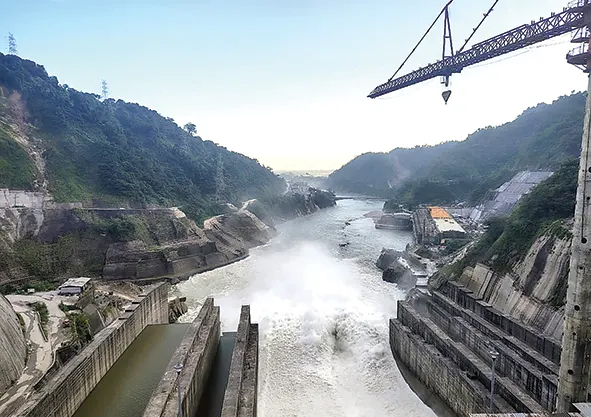
ITANAGAR, Oct 26: Test run of one of the eight units of India’s largest hydropower project, 2,000 MW Subansiri Lower Hydroelectric Project (SLHP) and executed by National Hydro Power Corporation Ltd (NHPC), begun on Friday, NHPC Limited officials said.
A run-of-the-river hydroelectric initiative on the Subansiri River or “Gold River” is the largest tributary of the Brahmaputra River, located at Gerukamukh on Arunachal Pradesh-Assam inter-State boundary.
“Wet commissioning is basically a test run of the turbine to check several parameters without generating electricity. The test run with water flow may take four to five daysmarking the start of the project’s operational phase,” an NHPC spokesperson said on Saturday.
“The SLHP has eight units of 250-MW each. Four of these units are ready for test runs. The next step involves synchronisation of at least two units for the project to start generating power,” he informed.
The SLHP was launched in January 2005., butproject construction work was stalled during December 2011 to October 2019 due to massive protests by anti-dam protagonists in Assam expressing concerns over downstream environmental impacts. The project construction resumed from 15.10,19, after approval given by National Green Tribunal. the PMO pushed for its completion, and the NHPC adopted enhanced mitigation and safety measures.
NHPC CMD Bhupender Gupta, who attended the wet commissioning event, said, “the achievement was a “shining testament” to the corporation’s engineering excellence. “It is more than just a project milestone, it reflects India’s steady march toward a cleaner, greener, and self-reliant energy future.”
The project is expected to generate around 7,500 million units of power annually in a 90% dependable year. It is also expected to provide flood moderation, irrigation and drinking water benefits to the downstream areas.
The financial benefits for Arunachal Pradesh from the 2,000-MW Subansiri Lower Hydroelectric Project (SLHP) will primarily come from its share of the electricity generated. The project is operated by NHPC Ltd., but the state government will receive its allotment of power, which can be monetized or used for state development.
The NHPC Ltd. aims to bring an additional three 250 MW units online this year, with the project expected to reach its full 2,000 MW capacity by March or May 2026. The test run signals its commissioning soon.
Once operational, it is expected to enhance power generation in the NE region and support India’s renewable energy targets. But, Arunachal Pradesh is set to receive 274 MW of power from the project as per agreement. The state can use this power to meet its own energy needs and reduce power procurement costs or sell the surplus to generate revenue.
However, the state from other hydropower projects, like Tato-II HEP, would get 12% free power plus an additional 1% for a Local Area Development Fund (LADF). Moreover, the SLHP has created direct and indirect employment opportunities for local residents. The project has also invested in skill development programs to train local youth for long-term employment in the power sector.
The project led to the development of supporting infrastructure, including roads and bridges, which will have long-term economic benefits for the region. The influx of project personnel and increased economic activity has led to the growth of local markets and businesses in the areas surrounding the project site.


 20
