
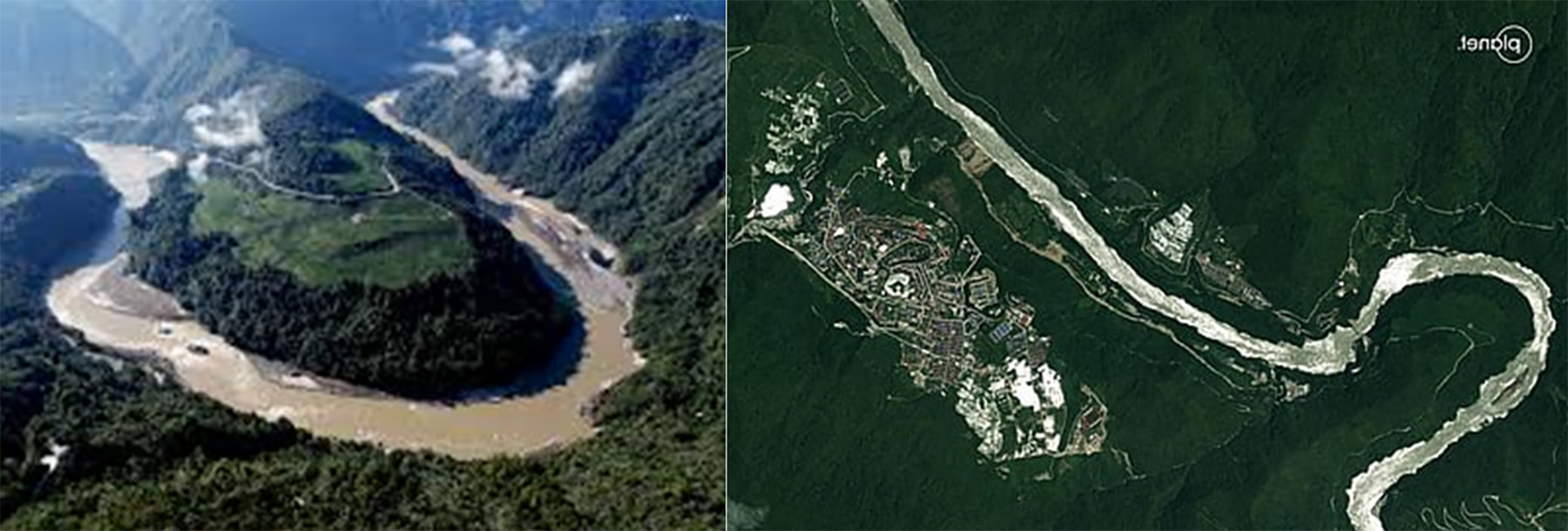
The “Great Bend” Proposed Medong mega dam
Beyond the Horizon
By Pradeep Kumar
On July 19, 2025, China in a groundbreaking ceremony started works on Medong hydroelectric project, on Brahmaputra River in southeastern Tibet near Indian border in presence of Chinese Premier Li Qiang.
“The project, approved by Beijing in December-2024, is linked to China’s carbon neutrality targets and development goals in Tibet region, which China’s People’s Liberation Army invaded in October 1950. The electricity generated will be primarily transmitted to other regions for consumption, besides meeting local power needs in Tibet,” China’s official news agency Xinhua had reported after the ceremony in Nyingchi, a region close to Arunachal Pradesh.
It isn’t just a hydropower project as Chinese Premier Li Qiang called it a “project of the century,” as he stood alongside high-ranking officials to announce the construction of project along the lower reaches of the Yarlung Tsangpo River. The state-run Xinhua News Agency hailed the world’s biggest planned hydropower dam as a “low-carbon development … a safe project that prioritizes ecological protection.”
Medog mega dam project on Yarlung Tsangpho River, upstream of Brahmaputra River, at the “Great Bend” aims to harness a 2,000-meter drop of river water within a 50-km stretch to generate 60,000-MW hydropower, potentially making it the largest dam in the world, surpassing 22,500-MW Three Gorges Dam. The construction will involve five hydropower stations with an estimated investment of around $167 billion, according to Xinhua.
The project, veiled in secrecy, is controversial due to its potential environmental and socio-economic impacts on the transboundary river basin while no one knows what impacts it would have. Thus, It has raised concerns in downstream countries of India and Bangladesh. Experts have said the project could affect the water flow and ecology of Brahmaputra River system.
India had raised concerns about the project and External Affairs Ministry of In January 2025 had said, “China has been urged to ensure that the interests of the downstream states of the Brahmaputra are not harmed by activities in upstream areas.”
Moreover, India has planned a 11,000-MW dam on Siang River, partly as a strategic response to China’s large hydropower dam projects upstream on the same river in Tibet besides to bolster energy security and flood control. If China adopts weaponized water releases, Siang Dam, designated a national project, would counter potential threats.
The proposed dam faces significant local opposition due to concerns about displacement and cultural impact. Anti-dam protagonists have even rubbished the justification that such projects are essential to counter China’s massive dam as a “poor excuse to fool people under the guise of national security.”
But, after a Chinese dam built in Tibet collapsed, 30-metre-tall flood water wave had gripped centurion town Pasighat on the mid-night of 09.06.2000 causing extensive damages. Then East Siang SP Robin Hibu (present Delhi Police special commissioner) with a team headed by present APCC president Bosiram Siram had conducted rescue operation with IAF helicopter next day to save many lives, but six people were killed.
China’s enmity towards India is well-known and it claims Arunachal Pradesh as its territory (South Tibet or Zangnan). Experts have termed Medog mega dam a “ticking time bomb” and apprehended that Bejing could use it as a “water weapon” against India.
Chief Minister Pema Khandu has expressed concerns about China’s mega dam and described the potential impact as a “water bomb” by highlighting strategic importance of controlling water resources, which could have significant implications for India due to the river’s flow into Arunachal Pradesh. Moreover, he has expresses worries that China may weaponize as “water bomb” to affect millions of people downstream in India.
A Chinese expert said that Beijing may not do it, particularly after Prime Minister Narendra Modi’s ‘Operation Sindoor’, response against coldblooded murder of 26 tourists after identifying their religion by Pakistan terrorists at Pahalgam on 22.04.25. But India should take precautionary steps to tackle if ‘chameleon’ China triggers another “Pasighat deluge”.


 20
